Tuesday, March 31, 2009

A few tips of the hat

We're having some internet problems here—no connection at the church today at all, and a pretty poor one here at home—so I haven't had much success with any online work; but I thought I might be able to get a relatively quick links post through.

Jared Wilson has a couple strong posts up, "The Kingdom is For Those Who Know How to Die" and "Faith, Hope, and Love is About Proximity to Jesus." I've also been meaning to note his excerpt from Skye Jethani's new book The Divine Commodity, which I think dovetails with my recent post on worship.

Not to leave the rest of the Thinklings out, Philip has a good post on communicating the gospel, Bird makes a good point about repentance, and Bill asks an interesting question:  is the American church actually too macho?

I love Hap's retelling of the story of Abigail.  If you're not familiar with it, you can find the original in 1 Samuel 25.

Pauline Evans, to whom I haven't linked in far too long, has a nifty little post up on the development of computers, and how the comparisons we use are in some ways quite misleading; she also has one up, I just discovered, on a couple children's fantasy books that I think I'm going to need to read.  (This may follow nicely on our recent discovery in this household of Tamora Pierce.)

Debbie Berkley posted something last January that I've kept meaning to write about, reflecting on the uncertainty we face these days in the light of the wisdom of a fellow Christian from India:  "Never be afraid to trust an unknown future to a known God."  Sage counsel, and certainly no less applicable now, two months on.

And, on the subject of politics (and specifically political dirty tricks), Andrew Breitbart has had some interesting things to say of late about the online war liberals are waging (and winning) against conservatives.  Barack Obama promised to elevate the tone of political discourse in this country, but you don't have to be a Sarah Palin supporter to recognize that some of his followers didn't get the memo.

This isn't everyone I'd like to mention, but I'm only linking to pages I can actually pull up, and it's pretty hit-and-miss at the moment.  Still, I'm glad to note these, and maybe I'll do another one soon to highlight the ones that wouldn't come up.

Monday, March 30, 2009

Question on the twilight of the newspapers

This story on Hot Air (about an intelligent new strategy the Minneapolis Star-Tribune is trying to keep themselves afloat) got me thinking:  why all the liberal angst about newspapers going out of business?  Just think of the environmental benefits!  Think of all the trees cut down every year to produce the reams and reams of newsprint used by the newspapers that are now critically endangered (as well as the ones that have already gone extinct); how environmentally unenlightened of these heartless major corporations to insist that they must be allowed to distribute "a five-pound lump of paper" to millions of people every day in order to do their jobs.  Surely in this Age of Obama they should be required to Go Green just like everyone else and spare our nation's forests, right?  Shouldn't we view the demise of dead-tree editions across the country as a good thing, rather than go looking for ways to prop up their environmental rapacity by putting them on the public dole?

. . . OK, be honest with me—is that too far over the top?  In all seriousness, I love a good newspaper (though they're a lot fewer and farther between than those lamenting the state of the industry like to pretend), but it does occur to me that they're getting a very different break from the Left in this country than a lot of industries.  That's no real surprise, of course; after all, they're a structural component of the American Left, plus they get to set the terms in which their current peril is reported, analyzed, and discussed—an advantage that was never given to the PR flacks for companies like Philip Morris or Enron.  Even so, as I think about it, I'm still a little surprised that I haven't heard word one about what their failure could potentially do to pulp production in this country, either in terms of its environmental advantages or in terms of additional unemployment.  I can't help thinking that if there were somehow an equivalent failure on the conservative side of the political spectrum, we'd be getting stories with headlines like "Silver Lining of Industry Collapse:  Will Save Millions of Acres of Forest, Experts Say."

I have to admit, this makes me smile

I've been a fan of Law & Order almost since its inception.  Like most folks, my favorite characters over the show's life are the two big ones, Det. Lenny Briscoe (Jerry Orbach, RIP) and EADA/DA Jack McCoy (Sam Waterston); part of that, probably, is that both actors have always struck me as people I'd enjoy knowing in real life, quite aside from the people they play.  Also like most folks, my favorite character after those two was ADA Abbie Carmichael (Angie Harmon), whom I really wish had had a significantly longer run on the show (especially as I didn't care for her replacement at all)—which meant it was a very pleasant surprise (dare I pull a Chris Matthews and say a thrill ran up my leg?) to read that she's a fan of Sarah Palin:

I admire any kind of woman like her. My whole motto is to know what I stand for and know what I don't stand for and have the courage to live my life accordingly and she does exactly that. The fact that this woman has made the decisions she's made and literally lived her life according to that and takes heat for it is absolutely disgusting to me," she added. "People cannot look at this woman. I really think they're afraid of her and her morals, ethics and values and the fact that she hangs on them.

Of course, Fox News felt the need to conclude the article with a bunch of celebrities telling them how wonderful Barack Obama is and what a great job he's doing; but Angie Harmon got the bulk of the piece to praise Gov. Palin (and also to express her dissatisfaction with President Obama, and with being accused of racism for not being liberal), and that's an enjoyable little spark for the day.

HT:  Joseph Russo

Reader's guide: in defense of the church

As I noted in the post immediately below, I started this series last year and forgot about it after August, but I don't want to let it drop; this is too important.

Part I: Preaching

Part II: The institution

Part III: Doctrine

Part IV: Jesus

Part V:  Process

Part VI:  We need each other

In defense of the church, part VI: We need each other

Therefore, brothers, since we have confidence to enter the holy places by the blood of Jesus, by the new and living way that he opened for us through the curtain, that is, through his flesh, and since we have a great priest over the house of God, let us draw near with a true heart in full assurance of faith, with our hearts sprinkled clean from an evil conscience and our bodies washed with pure water. Let us hold fast the confession of our hope without wavering, for he who promised is faithful. And let us consider how to stir up one another to love and good works, not neglecting to meet together, as is the habit of some, but encouraging one another, and all the more as you see the Day drawing near.

—Hebrews 10:19-25 (ESV)

On a nobler and more elevated note than the previous post . . .

I started doing this series over a year ago now, carried on for a while, and then some time last August, had my attention fixed firmly enough in another direction that I forgot completely about it.  (Gee, I wonder what could have done that?)  I don't want to just let it go, though, because this is too important for that.

I've talked about various aspects of the church—the value of preaching, the realistic necessity of the institution, and so on—and about the fact that Jesus loves the church, whether we like it or not; I think it also needs to be said, as the authors of Hebrews do, that whether we like the church or not, we need it.  If we're going to be faithful disciples of Christ, we need to be a part of the church, and we need to be involved.

Part of this is that, as David Wood argues, we need spiritual friendship in order to live as Christ calls us to live.  Not even Jesus tried to live the godly life on his own—he surrounded himself with good friends who went with him everywhere.  The Rev. Wood makes this point in the course of talking about the pastoral life and pastoral excellence, but if it's more critical for pastors, that's only because we serve as leaders and exemplars for the church; this is necessary for pastors because it's necessary for all Christians if we're actually going to live as Christians.

This is how God wired us:  for friendship, relationship, community, to lean on each other and depend on each other to be strong where and when we ourselves are weak.  We need others who know us well enough that they can help us see ourselves more clearly and accurately than we can through our own eyes, and whom we can trust to rebuke and correct us when we're going awry.  And let's face it, resisting temptation is a lot less fun in the moment than giving in to it; we need people whose company we enjoy with whom we can go find something else to do.  "Just say no" only works for so long—we need something better to which we can say "yes" instead.

This is well illustrated by an old story, which has been told in many variations, of a young man who was feeling spiritually dry and cold, and so went to see one of the great old saints of the church to seek advice.  He poured out his heart to the old saint, told him of his problem, and asked what he might do about the dryness and coldness of his spiritual life.  The old man didn't say a word, but picked up the fireplace tongs and used them to reach into the fire and pluck out a coal, which he set on the hearth.  The coal immediately began to fade, first from bright cherry-red to dull red, to orange, and ultimately to black.  After a little while, the old saint leaned forward, picked up the coal with his hand, and tossed it back into the fire, where it was soon burning merrily once again.  The young man, with a thoughtful look on his face, thanked the old man and took his leave.

It's not just about what we get out of being a part of the church, though—we also need the church for what we can give to it.  For our own growth, we need the opportunity to serve others as they serve us.  This helps us develop our gifts, stretching us to take risks and try new things.  More importantly, it draws us out of ourselves and teaches us to value and care for others.  We can't become loving people without actually loving people—and the people who are the hardest to love are often the most important for us in that respect, for it's in loving the unlovable that we come closest to Christ's love for us.

Finally, of course, the fact that the church needs us matters in and of itself, too.  God calls us to serve him, and part of that is participating in and serving his body, his people, the church.  Yes, this means setting aside some of what we want; it means making compromises, and putting other people ahead of ourselves.  This too, of course, is part of our spiritual growth, but it's also the recognition that the call of God on our lives isn't just about us, about fulfilling our needs and giving us what we want—it's also about others, and how we can be of use to bless them.

Now, I'm not so foolish as to think that this will necessarily come easily; I'm a pastor, I know better.  But what I said in the first post in this series still holds true:

I don't stay in the church because I have found it to be a wonderful place and a wonderful experience; taken all in all, I've found it quite uneven. Rather, I stay in the church as an act of faith that God meant what he said when he called us his people, his family, his body, and promised that not even the gates of Hell would prevail against us—and I say that as one who knows full well that those gates threaten us from within as well as from without. However ambivalent I may sometimes be, it remains true through all that Jesus loves the church, and died for her, and that we are called to follow his lead.

All of which is to say, as much as I understand the stones people throw at the church (having fired off a few myself at times), I do believe the church needs to be defended; and I say that not because I'm in the business, of the guild, as it were, but rather despite that fact. However badly we screw it up, as we often do, this is still something God has ordained, and it's still important that we gather together in worship and fellowship and ministry. Yes, that means friction, which is unpleasant; but that friction is one of the things God uses to sand away our rough edges and polish our strengths. True community—where, as Kurt Vonnegut beautifully said, "the terrible disease of loneliness can be cured"—is not an easy thing, which is why far too many churches don't try all that hard to create it; but for all that, it's important for our well-being, and if we will commit to it, it's a beautiful gift of God.

There are days . . .

This is right up there with wanting the James Bond car so that one could drop oil slicks or caltrops for tailgaters.  Excessive, yes, but on our worse days, the thoughtlessness of others can drive us to wishing, just a little, that we could actually do something like this.  At least, for some of us, it can . . .  Check the mouseover on this one.


Sunday, March 29, 2009

The problematic blessings of God

Thus says the Lord God:
“Behold, I will lift up my hand to the nations,
and raise my signal to the peoples;
and they shall bring your sons in their bosom,
and your daughters shall be carried on their shoulders.
Kings shall be your foster fathers,
and their queens your nursing mothers.
With their faces to the ground they shall bow down to you,
and lick the dust of your feet.
Then you will know that I am the Lord;
those who wait for me shall not be put to shame.”

—Isaiah 49:22-23 (ESV)

The Jews get a lot of flak from many Christians for their failure to understand what God was trying to do and thus to fulfill the part in his plan. Now, obviously someone who believes as I do that Jesus is the promised Messiah is going to have a different take on that than someone who doesn’t; but without getting into comparative theology, I think it needs to be said that we should all be a lot humbler about such arguments. Many of us (perhaps most of us) have an unfortunate tendency to present our positions as if their truth is obvious, and should be obvious to those who disagree with us—meaning, of course, that we’re the noble ones who have the truth, and our opponents must be arguing for ignoble reasons. This is not only wrongheaded, it’s wrong-spirited.

What’s more, in some cases, it’s also evidence of our own lack of self-knowledge and self-awareness; and this would be one of those. Consider this section of Isaiah (which is representative of other passages in the prophets): God is proposing to bless his people by bringing in the nations to join them. In order to accept this blessing, they need to do two things: one, they have to give up their national self-understanding—what we might, by analogy to the present day, call “Israelite exceptionalism”—and two, they have to welcome the other peoples of the world in.

Now, to be sure, God isn’t asking Israel to take a secondary place; quite the contrary, the nations will honor them and bow before them in recognition of how much they owe the people of Israel. That said, remember, the nations are outsiders, and some of them are bitter enemies; he’s asking them to welcome strangers, rivals, and people who have hurt them badly into their land and into their people.  He’s asking them not only to forgive their enemies, but to adopt their enemies, to welcome former enemies into their home, to love them, and to trust them as family.

That’s a challenge, if we’re honest.  If we really put ourselves into the story, it’s not necessarily all that obvious that it really qualifies as a blessing.  After all, we’re used to thinking of blessings as being for us, while the blessing Isaiah promises here is as much for the nations as it is for Israel; God blesses Israel in part so that they may bless the nations.  To recognize this as a real blessing, we need to understand that this is what the blessings of God look like—they really never are just for us.  We aren’t merely recipients of his blessings, we’re conduits.  That’s just how God works.

God’s blessings often aren’t easy to receive.  Grace isn’t easy.  Love isn’t easy.  They come with challenges, asking us to do things that we don’t necessarily want to do.  I would venture to say that anyone who takes them lightly, who isn’t made at least a little uncomfortable by the blessings of God, doesn’t understand them as well as they should.  I’m certainly not saying that we should encourage anyone not to accept the grace of God; but if we find anyone reluctant to do so, we should understand that their reluctance is not altogether unreasonable.  God’s blessings are always best for us . . . but they’re often not what we think is best for us, and so we have to give up our own ideas of what’s best in order to accept them.  Doing so is itself a blessing—but we should never make the mistake of thinking that it’s an easy and obvious step.

Just to get your feet tapping a little

I was keeping our littlest one happy yesterday afternoon after she woke up, still sick, from her nap; for whatever reason, one way I did that was by playing her a few CCR videos, and I got a couple of their songs stuck in my head.


And the best song ever written about baseball:


Saturday, March 28, 2009

In Christ alone my hope is found

John Piper doing what he does best—preaching the gospel:


HT:  Shane VanderHart

Friday, March 27, 2009

The limits of the merely human

This from Ray Ortlund:

Everything man-made lets us down. Sooner or later, everything man-made reveals its hidden weaknesses. Only Christ will not fail. Only Christ does all things well. I don't. You don't. Christ does. Always. Infallibly. . . .

Man-made things go boom. They cannot be trusted. Respected, yes. Honored, yes. But not trusted.

The only unfailing object of our trust and hope is Christ himself. Theological systems have their uses, but also their limits. Christ, Christ, Christ—the risen, living, present Person of the Lord Jesus Christ who is right here right now and always will be, forever keeping his promises—only he has no limits, only he cannot disappoint.

Amen.  The wellspring of our thought must always be Christ; as theologians, we must always be biblical theologians first and foremost, and as preachers, we must be teaching our people to be biblical theologians, and the center and taproot of our biblical theology must always be hearing the voice of Christ and the word of the gospel in every part of Scripture.

And it should be said, this applies to every aspect of life—to political systems, and politicians, for instance, no less than theological systems and theologians.  Even the best political systems, though they have their uses, have also their limits; even the best politicians have their weaknesses and will let us down.  We must seek to find and promote the best we can, systems and politicians alike, but always remembering that only Christ will not fail, only Christ has no limits, only Christ cannot disappoint . . . and the corollary, that there are many things that cannot be done well through political means and processes, but only by the body of Christ, whom he empowers for his purposes by his Holy Spirit.

To lure independents, nominate a conservative?

In yesterday's open thread on HillBuzz, the poster made an interesting argument that I've been mulling ever since:

We don’t believe Republicans can win the White House with a moderate—they need a conservative, and should not try to court moderate Democrats like us. Paradoxical, we know, but hear us out. We believe Independents don’t know what to do with a moderate Republican like McCain . . . there isn’t a clear line of distinction between Republican and Democrat in that case, so Independents don’t see a good choice to make, and seem to default vote Democrat in that case. But, those Independents had no trouble voting for Bush . . . and Republican turnout for Bush in 2004 was higher than it was for McCain in 2008. Without Palin, a true conservative, that turnout would have been dismal.

As fellow Palinites, those folks are of course offering this in support of the proposition that Sen. McCain did considerably better with Gov. Palin on the ticket than he would have if he'd picked someone else—something which I argued last summer would be the case and am convinced was indeed the case, despite the MSM's best efforts to bring her down.  As someone whose political convictions are fairly described as conservative, I of course believe already that the GOP ought to nominate a conservative for the White House next time rather than a moderate.  As such, the perception-of-intelligence problem (our tendency to judge as "intelligent" anyone who comes up with a good argument for what we already believe, or want to believe) is clearly in play here.  The fact that I have, and know I have, a predilection for counterintuitive arguments such as this only reinforces that.  So as I read this, I have to try to filter all those things out.

Having done my best to do so, however, this still makes sense to me—and the evidence, such as we have, does seem to bear it out.  When, after all, was the last time a Republican won running as a moderate?  Wouldn't it be Eisenhower in 1956?  Broadly speaking, Nixon ran as a conservative in 1968 (talking about the "silent majority"), George H. W. Bush ran as a conservative in 1988 ("Read my lips:  No new taxes")—before losing in 1992 after his time in office proved him nothing of the sort—and George W. Bush ran as a conservative in 2000.  Reagan, of course, inarguably was a conservative, if a rather more pragmatic one than many sometimes remember.   Meanwhile, even if you don't blame Gerald Ford for his loss in 1976, the Republican Establishment types didn't do much in 1996 or 2008.

The first read, anyway, does seem to suggest that independents are more likely to vote for a conservative Republican than for a moderate Republican, at least at the national level; this thesis seems to me to support further investigation even if I do find it appealing.  Not being a statistician (except for a certain amateur interest when it comes to sports), I have no idea how to investigate this to see if it stands up to more rigorous examination—but I hope someone puts in the work, and if so, I'll be interested to see their conclusions.

Thursday, March 26, 2009

What our gaffes reveal about our character

The good person out of the good treasure of his heart produces good, and the evil person out of his evil treasure produces evil, for out of the abundance of the heart
his mouth speaks.

—Luke 6:45 (ESV)

Michael Kinsley somewhere defined a gaffe as “what happens when the spin breaks down.”  It’s a wry observation that captures a real truth about why gaffes matter:  because they reveal something about a given politician that said politician doesn’t want us to see.  They’re the places where the mask slips.  That may not always be true, and the real meaning of a particular gaffe may not always be the one that first comes to mind, but in general, these are meaningful moments that tell us more about our politicians than our politicians will usually tell us about themselves.

The highest-profile gaffe of recent weeks, of course, is the president’s “Special Olympics” quip on The Tonight Show, which (much to the administration’s chagrin) turned out to be the rimshot heard ’round the world, despite the best efforts of his sycophants to wave it away as meaningless.  We know better than that, these days; we know gaffes are meaningful, and so by and large, we haven’t bought that line.  At the same time, though, what I haven’t seen is much thoughtful reflection on what Barack Obama’s gaffe does mean—most of the commentary has only been interested in its political significance (and on increasing or decreasing that significance, as it suits the one offering the comment).

An exception to that is John Stackhouse’s recent post, probably because it’s not just about the president—it’s also a reflection on his own gaffes:

We have to cut each other a little slack: people under stress sometimes do inexplicable things, including making tasteless jokes or using inappropriate language.

But I’m not inclined to let myself entirely off the hook, however forgiving I might feel toward President Obama or any other public figure. I recall the words of Jesus: “Out of the abundance of the heart, the mouth speaks” (Luke 6:45).

That joke came from somewhere. That word came from somewhere. . . .

Yes, we live in a sarcastic and vulgar culture . . . It is part of the air we breathe and the toxins enter us whether we like them or not.

Again, recognizing that kind of constant cultural influence should help me be more understanding and forgiving of others who screw up in public.

Nonetheless, it is simply true that sometimes I really do mean what I say. Sigmund Freud was prone to overstatement, but there is more than a grain of truth in his dictum, “There is no such thing as a joke.” And as I search my heart for the attitudes expressed in this joke or that word choice, I confess I am sometimes dismayed at what I find. . . .

Sometimes, alas, the way you really do think about things and the way you really do talk about things—that is, the way you think and talk when you think no one can hear or no one will be offended—really does come out in public.

Kyrie eleison—Lord, have mercy.

And may we attend to what we have inadvertently exposed in our gaffes. It’s good to get forgiveness. It’s better to get healed.

I believe we’re right to ask what the president’s wisecrack tells us about the abundance of his heart; but as we do so, we’d best not get too cocky; we’d best proceed with all due humility, and ask ourselves what we’d let slip about our own hearts if we were in his shoes.  And perhaps we’d also do well to bear in mind the counsel of the book of James:

Not many of you should become teachers, my brothers, for you know that we who teach will be judged with greater strictness.

—James 3:1 (ESV)

Here's a noteworthy admission

God bless them. . . .  Over 50 million people voted for me and Sarah Palin—
mostly for Sarah Palin.

—John McCain

That, courtesy of CNN's PoliticalTicker blog, was one of Sen. McCain's comments today at the Heritage Foundation.  It's a remarkable comment—remarkably honest, I think, and really remarkably gracious, too; it reminds me again of all the things I really do like about the man, for all the issues I have with him.

Wednesday, March 25, 2009

No matter how far you run, the Father's heart goes farther

Your worst days are never so bad that you are beyond the reach of God’s grace,
nor are your best days ever so good that you are beyond the need of it.

—Jerry Bridges

That summarizes the message of Luke 15 about as succinctly as anyone ever has.  It’s unfortunate that the crowning parable of that chapter is usually referred to as “The Parable of the Prodigal Son,” because the reality is, both sons are lost.  One betrayed his father publicly and abandoned him physically, while the other betrayed him privately and abandoned him internally, but each in his own way was a prodigal, in desperate need of grace; neither realized it or asked for it until it was offered (no, the younger son didn’t come home repentant, but in hope of earning his way back into the family), but the father offered it to both of them anyway.  As he always does, whether we want him to or not.  Such is the gospel.

HT:  Of First Importance

This is what a political cannonization looks like

and no, that's not a misspelling; British MEP Daniel Hannan definitely broke out the rhetorical cannons for this one, and his aim was unerring.  The Aged P called this a "very polite and beautifully enunciated assassination," and he's right; to his description I would only add "devastating," because it's that, too.  Here in the U.S., Republicans like Aaron Schock ought to be taking notes, because most of what MEP Hannan said to PM Gordon Brown could be said with equal point to Speaker Nancy Pelosi, Majority Leader Harry Reid, and others in the Obama/Pelosi administration.


We should have seen Sarah Palin coming

When I started this blog, I lived in a small town in the Colorado Rockies—and when I say "small," I mean it; to give you an idea, there are more students in my oldest daughter's new elementary school than there are people living in Grand Lake.  (Full-time, anyway.)  If you've never lived in a small town in the mountains, you need to understand that it's a different world up there.  You might have the idea that mountain towns are full of colorful characters, and it's true; they also tend to be fiercely independent, even more fiercely stubborn, and not always so good at compromising and playing nice with others.  As I've written before, the downside of that is that you tend to get communities that range from mildly dysfunctional to complete trainwreck towns like Leadville was (and maybe still is, for all I know).

I'm not just going on my own experience in saying this, either; during my five years up there, I compared notes fairly frequently with other mountain pastors, because we were all dealing with similar issues that our flatlander colleagues just didn't understand.  All our communities were different, to be sure, but we shared common root issues and struggles.  Our town made the headlines twice during my five years there:  once when one of our residents sought redress for his grievances against the county's commercial hub in the cockpit of the 60-ton Komatsu D355 bulldozer that he'd turned into a 75-ton tank, and once when our church's oldest and most-beloved member died of an unprovoked attack by a rogue bull moose, something which really isn't normal moose behavior.  None of my colleagues had anything quite that out of the ordinary happen, but they all had some pretty strange stories of their own; that's just how it is in the mountains.  Or as my organist from Colorado would say, that's life in a tomato can.

All of this is the reason why I found myself starting to write in an e-mail yesterday, "If there's a Patrick Henry left in this country, he lives somewhere in the Rockies"; but as I wrote that, I suddenly remembered how many of our most characteristic people—the sort of folks who were still climbing fourteeners in their eighties and musing that when they died, they'd have their bodies autoclaved and set out to fertilize the roses—spent significant time in Alaska every year, and/or had lived there in the past and loved it.  It occurred to me that outside of Anchorage and Juneau, the spirit of our little mountain towns, which is the spirit of the old frontier folks who just had to get out from under the conformity of society, is also very much alive and well in Alaska.  (Maybe even in Anchorage and Juneau to some degree.)

That having occurred to me, I suddenly realized that that said something very important about Gov. Palin.  Her emergence was a complete shock to most of the Washington elite—of both parties, which is why she took some heavy hits from many who should have had her back—but it shouldn't have been; the fact that it was says a lot more about them than it does about her.  I don't say that we should have expected someone as purely gifted as Sarah Palin to appear on the scene, because she's a once-in-a-generation political talent (yes, I think she's a level beyond Barack Obama in that respect, for all his evident gifts as a campaigner), but in a more general way, we really should have seen her coming.  In particular, the very elites who were so scandalized by her arrival on the landscape should have seen her coming, if they were actually doing their jobs.

Why?  Well, what is the Republican base looking for?  Another Reagan—and by that I don't just mean a "real conservative."  Newt Gingrich was more conservative than Reagan, and I don't believe we're looking for another Newt (or even the return of the first one, though many folks would accept that in a pinch).  No, the base is looking for a common-sense, common-folks, common-touch conservative, someone who's conservative not merely pragmatically or even philosophically but out of an honest respect for and empathy with the "ordinary barbarians" of this nation; we're looking for someone who understands why Russell Kirk, the great philosopher of American conservatism, lived his entire adult life not in one of the media or academic centers of this country, but in rural Mecosta County, Michigan (the next county south of where my in-laws live)—and who understands that that fact has everything to do with his conservatism.  We're looking for someone whose conservative principles are anchored in the bedrock of this nation, and who understands our conservatism not merely as an intellectual exercise, but out of shared life experience and a common worldview.

That, I think, is why George W. Bush won the GOP nomination in 2000, because he projected that—and indeed, he has many of those qualities; he just wasn't all that conservative, and so he disappointed many.  For all the Texas in him, he still had too much of Harvard and D.C. in him, too, and so was too prone to play by the rules of the political elite.  It's telling that the great success of his second term (the surge) came from standing up, not to the mandarins of his own party—some of them, yes, but they were balanced somewhat by John McCain, who'd been arguing for the surge for years—but to the senior leaders of the U.S. military, whom he could approach on very different terms.  He could tell the Joint Chiefs to shut up and soldier; he doesn't seem to have had it in him to do so to the Speaker of the House, the Senate Majority Leader, and the White House correspondents, and in that lay much of the malformation of his presidency.

The problem is that the qualities the GOP base is seeking aren't qualities which are rewarded by the political process in most places; in most of this country, to achieve the kind of prominence and to compile the kind of record that are necessary to justify a run for the White House, it's necessary to compromise those qualities.  To get to Washington, you must increasingly become like Washington—that's just how the political process works across most of this country.

The exception to that—the only great exception I can think of—is the remaining frontier communities in the American West; and of those, it may well be that the only one that's really large enough for anyone to rise to political prominence without extensive exposure to the elite political culture in America is Alaska.  I don't hold our mountain communities up as any sort of ideal—I know well from experience that they're no Shangri-La—and I'm not going to try to do so for Alaska, either; but if anyone in this society was ever going to rise to political prominence as a true champion of conservative ideals, of the spirit of us "ordinary barbarians," without being co-opted and corrupted by the spirit and outlook of the political elite, it was going to have to be from someplace like Alaska.  We aren't going to get another Reagan from Massachusetts, or Minnesota, or Arkansas, or Florida; from Alaska, we have a chance.  The fact that few in the elite would be likely to take such a person seriously is actually part of the point, since they didn't take Reagan seriously either; the revolt against elite opinion (which is not, mind you, the same thing as populism, for all that many in the MSM confuse the two) is part of what the base wants, and someone willing to lead it and stick to it is one of the qualifications.

All of which is to say, we might not have predicted specifically the remarkable and gifted woman who is governor of Alaska, or that she would arrive on the scene exactly when she did (though as bizarre as the 2008 presidential election was, when would have been a likelier time?), but we should have expected someone to come out of Alaska, and probably fairly soon.  The "can anything good come out of Nazareth?" sort of incredulous reaction that we got from so many in the punditocracy was not only unjustified, it was a clear sign of their myopia, that they're so burrowed in to being insiders that they're largely incapable of looking out the window to see what's going on outside.  The GOP base wants another Reagan, and won't be truly happy until it has one; and where else could such a figure come from?

Update:  Welcome to all of you coming over from C4P and HillBuzz—it's good to have you drop by.  The moose stew should be ready in a bit.  If you want to check out a few more of my posts on Gov. Palin, the links post is here.

Tuesday, March 24, 2009

Thought on worship

I've been trying to work this thought into a fully-developed (and fully-coherent) post for several days now, and for one reason and another just haven't managed it; I still want to do more with it, but for now, I think I'll just put this out there as best I can at the moment.  There is the assumption in most churches, I think—even in many that would deny it consciously, I think it's still there, unexpressed, at the level of subconscious expectation—that the pastor's/worship leader's job is to give people what they want in worship.  All our thinking is organized around that, and much of the language we use in describing our worship supports and contributes to that assumption.  

I think the reason for that is that in the attractional paradigm for church growth, the "worship experience" is the core of the "attractional" part.  It seems to me that whatever the message the preacher is selling, be it self-help or social justice or self-realization or what have you, the worship—by which is usually meant the music part of the service—is the bait on the hook.  It's the free weekend in Vegas to get you to come and listen to the pitch for the time-share (if they're still doing that in the current economy; I've had people try to get me to take one of those trips more than once, but never wanted to):  the worship is the fun time, and then the preacher gives you the pitch.  If the music's good enough and you like what he's selling, you come back; but the emotional experience of the worship is definitely the spoonful of sugar that makes the medicine go down.

This has taught us in the American church to see worship in this way, as what we get out of church in exchange for whatever we're asked to put in.  Even in liturgical churches, people evaluate it that way—does the liturgy comfort me, do I like doing the same thing every week, do I not like doing the same thing every week, does the form help me do x, does the routine bore me, and so on.  What we miss is that liturgy is a discipline—and it's a discipline because worship is a discipline.  It's not about what the liturgy does for us, because it's not about what worship does for us:  it's about what the liturgy invites us, leads us, calls us, instructs us to do.

It's the discipline of recognizing that we don't come to worship on our own initiative, but only in response to God's call; of recognizing, as we praise God for his glory and holiness, that in comparison to him, we don't look that great, and that no matter how wonderful we may think we are, we are in fact broken messed-up sinners just like everyone else—and need to humbly confess that fact to him, to each other, together.  It's about the discipline of sitting ourselves down in his presence to receive his Word with open ears, open minds, open hearts—not to use it to get what we want, but to accept it and let him tell us what we need.  It's about disciplining our hearts to receive his sacraments in that spirit, and to respond to Word and sacrament by affirming our faith, standing together to pledge our allegiance as a people to the King and Kingdom of Heaven, than which we owe no greater allegiance.  It's about the discipline of intercessory prayer, which is our confession that we aren't strong enough and great enough to make it all work on our own, and of the offering, which is our confession that we owe God everything, not least gratitude for all that he's given us.  Even receiving the charge and benediction is a discipline:  it's the acceptance of the fact that we are not our own and our lives are not our own, and that what we do and hear and say on Sunday mornings ought to form the lines of everything we do and say and think across the other six and a half days.

As we look at the form and content of our worship services, "Is this what I want?" really ought to be the last question on our minds; what we need to ask is, "What is this asking me to do?  How is this forming me as a disciple of Christ?"  To mangle a line, ask not what your worship service can do for you; ask what you can do for God through your worship service.

Candidate Obama vs. President Obama

C4P calls this NRSC ad "devastating."  They're right.  Barack Obama stands condemned out of his own mouth.


Monday, March 23, 2009

What has Christ to do with politics?

What indeed has Athens to do with Jerusalem? What concord is there between the Academy and the Church? what between heretics and Christians?

—Tertullian, The Prescription Against Heretics, 7

This famous rhetorical question of Tertullian’s has been used in many ways—including, by many skeptics, as a tool with which to bash him in particular and Christians in general as arrogant know-nothings who prefer to stay ignorant.  In context, that’s not exactly fair, given the nature of the philosophy he’s rejecting, and the sort of disputations it produced; but the fact remains that most people aren’t satisfied just to wave away all skeptical inquiries and challenges as Tertullian did, declaring,

With our faith, we desire no further belief. For this is our palmary faith, that there is nothing which we ought to believe besides.

Indeed, I don’t think we should be satisfied thus.  For all that he meant it as a rhetorical question, if we truly believe that all truth is God’s truth and that his common grace is available to all people—which, if we follow Scripture, I think we should—then his question needs to be taken seriously as a question, and addressed accordingly.

The same, I believe, must be said of the relationship between faith and politics.  Consider Tertullian’s description of the philosophical art of his day as 

the art of building up and pulling down; an art so evasive in its propositions, so far-fetched in its conjectures, so harsh, in its arguments, so productive of contentions— embarrassing even to itself, retracting everything, and really treating of nothing!

That’s as vivid a description of academic disputation now as it ever was—but at least as much, if not more, it’s also a vivid description of our political scene.  Looking out at a political landscape in which people do things like try to bankrupt their political opponents with an unending stream of frivolous complaints, Tertullian might well have asked, “What has Calvary to do with D.C.?”  And again, though he would undoubtedly have answered “Nothing,” and moved on, we need to stop and consider the question carefully and thoughtfully.  What is the proper connection between these two very different things, the life of faith and the life of politics?

This is a problematic question, and while it has ever been thus—this relationship has never been as clear and easy to understand as many people have assumed—the current polarized state of American politics causes us to feel the problem quite keenly. The negativity and the fearmongering are corrosive to the spirit, and the vehemence with which people disagree is wearying.  To be sure, neither the nature nor the degree of this problem are unique in American history (just think of the 1860s, when the political divisions in this country were so deep, we wound up going to war over them); what is new, however, is the particular role of religion in our political disputes. In the Civil War, as Lincoln noted, it was true that “both read the same Bible and pray to the same God, and each invokes His aid against the other” (while in the background echoed St. James’ anguished cry, “This should not be!”); in contemporary America, however, the situation is very different. In our day, by and large, churchgoers tend to side with one party, while those who have no use for church vote for the other—and in popular perception, the gap is nearly total (to the utter irritation of liberal Christians, who understandably don’t like being overlooked).

In light of this, many would say that the problem is that religion is mixed up with politics when it shouldn’t be. In this view, religion only serves to exacerbate our differences and drive the wedges between us deeper, and the only solution is for religious folk to keep their faith in their churches and out of the voting booth.  There’s a certain superficial appeal to this suggestion, but a little more thought shows it for the discriminatory idea it really is. Why, after all, should non-religious people be permitted to vote on the basis of their deepest convictions, but religious people be forbidden to do the same? Any attempt to make religion the problem is ultimately an attempt to privilege one mode of thought (the secular) over others, and thus is essentially antithetical to the nature and purpose of the American experiment.

Our current situation is complex, and there is no one step we can take that will make it better; everyone involved in our political system contributes in some way to its problems, and it will take efforts from all sides to improve America’s political health. Those who are Christians need to address the ways in which overtly faith-based political involvement has often been unhelpful; to do this, it will be necessary for us to do a much better job of integrating our theology with our politics.

That might seem counterintuitive to many, who would point to the great many references to the Bible and Christian faith which we already hear from our politicians (and not just Republican politicians, either), but it’s the truth. The problem is that as frequent as such statements may be, most of them aren’t good political theology; while there may be an effort to relate Christian faith to politics, the effort is made in the wrong way and thus does not bear good fruit. Rather than true political theology, what we get instead is mere theologized politics; we get faith used as a tool to advance a political agenda, rather than free to critique and correct that agenda.  This is the point at which things go awry.

Another shameless plug

I've been working for a while now on a new website for our church, and now we're all set up and going.  I'm sure I'll be tweaking things for a while, and that others here will be doing so as well, but as a beginning, I'm happy with it.  Wander over and check it out, if you would, and if you have any suggestions for improvement, leave a comment on this post—I'm always glad for a good idea or two.  And if you happen to be in the area of a Sunday morning, drop in and say hi—we'd love to have you join us.

Joe Biden, Comedian-in-Chief

For all the flap about President Obama stiffing the Gridiron Club and sending Vice President Biden in his stead, I have to think that from an entertainment perspective, Joe Biden was a better choice; it certainly sounds like he put on a good show.  Here's a partial transcript of his remarks, courtesy of the "Playbook" at Politico:

Axelrod really wanted me to do this on teleprompter—but I told him I’m much better when I wing it. . . . I know these evenings run long, so I’m going to be brief. Talk about the audacity of hope. . . . President Obama does send his greetings, though. He can’t be here tonight—because he’s busy getting ready for Easter. [Whisper] He thinks it’s about him. . . .

I know that no president has missed his first Gridiron since Grover Cleveland. Of course, President Cleveland really did have better things to do on a Saturday night. When he was in the White House—he was married to a 21 year old woman. . . . I understand these are dark days for the newspaper business, but I hate it when people say that newspapers are obsolete. That’s totally untrue. I know from firsthand experience. I recently got a puppy, and you can’t housebreak a puppy on the Internet.

Now let’s see: we have a Republican speaker who was born in Austria, and tonight’s Democratic speaker was born in Canada. Folks, this is Lou Dobbs’ worst nightmare. . . We are now two months into the Obama-Biden administration and the President and I have become extremely close. To give you an idea of how close we are, he told me that next year—maybe, just maybe—he’s going to give me his Blackberry e-mail address. . . . But the Obama Administration really is a good team. I am the experienced veteran. Rahm can be an enforcer. And Tim Geithner is always there when you need to borrow money, no questions asked.

You know, I never realized just how much power Dick Cheney had until my first day on the job. I walked into my office, and you know how the outgoing president always leaves the incoming president a note in his desk? I opened my drawer and Dick Cheney had left me Barack Obama’s birth certificate. . . . I now realize that we have to be extra careful when we annunciate new policy ideas to make sure they don’t look like they’re personally motivated. For example, the other day there were a whole bunch of stories about the President’s hair going gray; the next day there’s a story about a Vice President who’s trying to grow new hair, and then the day after that, the two of us come out in favor of stem cell research. That looked bad.

I’d like to address some of the things I said: Like when I said that “JOBS” is a three-letter word. I did say that. But I didn’t mean it literally. It’s like how, right now, most people think AIG is a four-letter word. . . . Or when I announced our stimulus package website, I was asked how you get to it: All I said was I didn’t know the website number. What I really meant to say was, “Ted Stevens didn’t tell me what tube the website is in.”

Sunday, March 22, 2009

The Not-So-Great Communicator

You know you're not having a good week when you build your reputation on your speaking ability and then you start getting headlines like this:

Obama struggles as communicator

The Note, 3/20/2009: So Special—Obama loses a week, as a great communicator doesn’t communicate

Barack Obama Is a Terrible Bore

But that was the week that was, for President Obama—the week in which he took a pounding for closing a press award ceremony to the press.  I think Ed Morissey's crack on his Special Olympics gaffe captures the spirit of his week as well as anything can:

You know how you can tell when a President has a bad day?  When his comparison of an American corporation to terrorists is the second-stupidest thing he said.

He'll bounce back, I'm sure; every scorer has games where they just can't put the ball in the hole.  But no question, the president was in a real shooting slump this week, and the shine is starting to wear off with the press—they're actually starting to notice these things.  He'd best get back on his game in a hurry, or it'll hurt him.

Friday, March 20, 2009

President Bush is a class act

This from Andrew Malcolm, in the Los Angeles Times' "Top of the Ticket" blog:

Tuesday in Calgary, the 43rd president gave the first of about a dozen paid speeches arranged so far by the Washington Speakers Bureau on his 2009 schedule. And here's what Bush told about 2,000 business persons about his successor, the 44th president:

"There are plenty of critics in the arena. He deserves my silence."

Bush said something else too:

"I love my country a lot more than I love politics. I think it is essential that he be helped in office." . . .

Bush also said if the new president wanted his help, "he's welcome to call me."

Apparently, Dick Cheney's not very happy with him, but I think this is both gracious and wise of our most recent ex-president.  Good for him.

An all-time classic bad review

I don’t normally post food reviews—actually, let’s come right out and say it, I’ve never before posted a food review, and never thought to do so—and even if I did, I’d have no particular reason to post a review of a restaurant in England, seeing as I live on the wrong side of the Great Puddle; but the food reviewer for The Times of London, AA Gill, just had an absolute screaming fit in print, handing out a zero-star review that actually, if you can believe it, makes the grade sound at least one star too high.  The whole thing’s worth reading for sheer unintentional comedy value (though one does feel a certain sharp sympathy for Gill for having to endure the experience), but the opening in particular is beyond price:

You’d think they’d get it. You’d think, wouldn’t you, that when the world falls on your head, you might do something different. It’s like Moses. Comes down from the mountain, still smelling of burning bush, eyes revolving, levitating with the true believer’s va-va-voom, and he bellows: “God, the God—Mr God to you—just gave me these instructions, written in sodding marble, and it's going to get us out of here. After 40 years in this hole, we’re going home. Milk and honey, vineyards, fedoras. Listen up.”

Then a bloke at the back says: “Well now, hold on. Hold on. Maybe we shouldn’t be hasty in discarding the golden calf. Granted, it’s been a bit tricky recently, but it just needs a bit of tweaking. Have you ever thought that perhaps what we need is a bigger golden calf?”

And that’s when Moses loses the plot, and throws a right strop. Not only did God give him celestial sat-nav, he also gave him a proper, Old Testament, fundamental fire-and-brimstone temper. (That and a foreskin, which was something of a novelty for the Jewish ladies.) Anyway, I’m with Moses. Not only the foreskin bit, but I’m just about to have an exodus tantrum.

Read the whole thing, and you’ll understand why . . .

What do love and grace have in common?

They're both a lot harder than we think.  I've been arguing for a while now that grace is painfully difficult to accept, because free is a higher price than we want to pay; yesterday, Jared Wilson put up a superb post pointing out that love doesn't really make things easier, either.  It's short and I'd love to copy the whole thing, but then you wouldn't have any incentive to go over and read it there, so I'll excerpt it instead.

Why do we think it's easier to love people than it is to just be religious?

I'm not sure people who think and speak that way really even know what love is.

Maybe the reason we don't all, in the spirit of unity and rainbows, just set aside our differences and love each other is because it's really freaking hard to do that. . . .

It's a lot easier to follow some rules everyone can see me keep than it is to truly, actually love people.

Anybody can be on their best behavior. But to love someone who hates you? That takes Jesus and his cross.

Go read the whole thing.

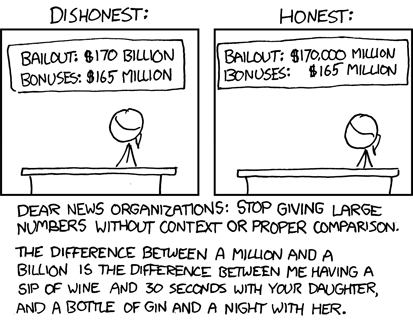
Randall Munroe nails the AIG furor


I hadn't thought about it, but he's right; whatever we know rationally, when we stop to think about it, the actual digits we see in the two numbers are very similar, and that has a subliminal effect.

Also (and for those who might be skeptical about this), the mouseover on this one is classic:  "And 0.002 dollars will NEVER equal 0.002 cents."

Thursday, March 19, 2009

Why America needs Sarah Palin, cont'd.

Other Republican governors, such as Louisiana's Bobby Jindal and South Carolina's Mark Sanford, raised concerns about the "stimulus" bill just as Gov. Palin did, and announced their intention not to take all the money alloted to their states; and when the time came, they followed through on their promise not to take all the money, though they did take most of it.  Gov. Palin, on the other hand, told the feds, "Sorry, but we only need about half of that."

Seriously.

Protesting federal "strings," attached to stimulus funding, Gov. Sarah Palin said she doesn't want nearly half the estimated $930 million Alaska is eligible for.

"Will we chart our own course, or will Washington (D.C.) engineer it for us?" Palin said.

She expected to file an appropriations bill this afternoon accepting about $251.5 million in stimulus funds, coupled with allocations of $262.6 million already requested for transportation and aviation projects for a total state take of about $514.1 million. . . .

The Anchorage Daily News had this quote from the governor explaining her reasoning:

We are not requesting funds intended to just grow government. We are not requesting more money for normal day to day operations of government as part of this economic stimulus package. In essence we say no to operating funds for more positions in government.

The written statement released by the governor's office contains a pretty pointed critique of the "stimulus" bill and the reasoning behind it.

Governor Sarah Palin submitted her federal economic stimulus appropriation bill to legislators today to provide jobs and needed infrastructure improvements in Alaska under the American Recovery & Reinvestment Act (ARRA). Governor Palin is accepting just 55 percent of the available stimulus funds, all for capital projects. This amount includes the funds the state accepted last month for Department of Transportation projects.

"We will request federal stimulus funds for capital projects that will create new jobs and expand the economy," Governor Palin said. "We won't be bound by federal strings in exchange for dollars, nor will we dig ourselves a deeper hole in two years when these federal funds are gone. For instance, in order to accept what look like attractive energy funds, our local communities would be required to adopt uniform building codes. Government would then be required to police those codes. These types of funds are not sensible for Alaska."

The legislation does not include funding requests for government operating programs. . . .

"The law requires me to certify that the requests I forward for legislative approval will meet the requirements of the ARRA to create jobs and promote economic growth," Governor Palin said. "Legitimately, I can only certify capital projects that are job-ready. Alaska has seen unprecedented increases in the level of state funding for education because that is our priority. I don't want to automatically increase federal funding for education program growth, such as the National Endowment for the Arts, at a time when Alaska can't afford to sustain that increase."

"Simply expanding state government under this federal stimulus package creates an unrealistic expectation that the state will continue these programs when the federal funds are no longer available,” said Governor Palin. "Our nation is already over $11 trillion in debt; we can't keep digging this hole." . . .

"Our desire is to foster a discussion about what is true stimulus and what is just more federal interference in Alaskans' lives through the growth of government," Governor Palin said. "We think stimulus items devoted to government agency growth and program expansion ought to be examined in light of the funding needs already being addressed with our pending budget requests." . . .

"We need to ensure that these stimulus dollars are used for job opportunities for Alaskans, while preserving the regular operating spending decisions through the normal budget process," Governor Palin said.

Here's video of her press conference:


For those who may have forgotten, since it's been a while:  that's what conservative government looks like.

Update:  OK, there was another 14% of the money, allotted for Medicaid funding, which the state had already accepted; Gov. Palin's actually only proposing to reject 31% of the "stimulus" money.  The point holds.

The stubborn faithfulness of God

“The former things I declared of old; 
they went out from my mouth, and I announced them;
then suddenly I did them, and they came to pass.
Because I know that you are obstinate,
and your neck is an iron sinew and your forehead brass,
I declared them to you from of old, before they came to pass I announced them to you,
lest you should say, ‘My idol did them,
my carved image and my metal image commanded them.’

“You have heard; now see all this; and will you not declare it?
From this time forth I announce to you new things, 
hidden things that you have not known.
They are created now, not long ago;
before today you have never heard of them, lest you should say, ‘Behold, I knew them.’
You have never heard, you have never known, from of old your ear has not been opened.
For I knew that you would surely deal treacherously, 
and that from before birth you were called a rebel.

“For my name's sake I defer my anger,
for the sake of my praise I restrain it for you,
that I may not cut you off.
Behold, I have refined you, but not as silver;
I have tried you in the furnace of affliction.
For my own sake, for my own sake, I do it, 
for how should my name be profaned?
My glory I will not give to another.

—Isaiah 48:3-11 (ESV)

Israel had a long history of faithlessness to God—it’s what got them taken off into exile—but despite all that, he refused to give up on them. He reminds his people of the many times in the past that he had told them what would happen, and then brought about what he predicted; and look at verses 4-5. Why did he do this? “Because I knew how stubborn you are”! If God had simply done good things for them, would they have given him the credit? No, they would have given the credit as they saw fit, to the idols they themselves had made. God told them what he was going to do before he did it so that they would know who was truly responsible. They could always refuse to admit that knowledge—and sometimes they did; that’s why God has to say, “You’ve heard these things. Won’t you admit them?”—but they would have no excuse and no justification for their refusal.

This is also why he says, “From now on I will tell you of new things, of hidden things unknown to you. They are created now, not long ago; you have not heard of them before today, and so you cannot say, ‘Yes, I knew of them.’” This is the reason, or part of the reason, why God chose to use Cyrus to return the Jews to Israel: because it was a new thing, something he hadn’t done before, and that his people couldn’t and wouldn’t have predicted. It also gave him the opportunity to predict—by name—the appearance and success of someone from a pagan nation, someone who didn’t worship him or even know of his existence, and thus to demonstrate in a new way that he truly is the God of the whole world, the LORD Almighty, not just the God of Israel.

And he does all this despite Israel’s willful refusal to listen. “See,” he says, “I have refined you, but not as silver.” In Malachi 3, the prophet says that the Lord will sit as a refiner of silver; this is significant because the refiner of silver burns away all the dross, all the impurities, until only the silver is left, and in its absolute purity he can see his face reflected in it. Here, the Lord is giving up on that, at least where Israel is concerned. Their time in exile hasn’t brought them around to repentance, it hasn’t brought them to a spirit of true faithfulness—but there’s no point in leaving them in the fire; there’s no point in refining them further, because it wouldn’t accomplish anything. To try to refine them as silver would leave nothing of them at all, because everything would burn away, and so God declares, “I delay my wrath . . . I hold it back from you,” simply for the sake of his own reputation and his own praise.

There’s a real note of grief and sorrow in this chapter. After all God has done for his people and all the promises he’s made them, and even after the promise to bring them back from their exile in Babylon, they remain obstinate, unwilling to open their hearts, unwilling to seek him first; and so here, it seems to me, we have God conceding that that isn’t going to change. Their neck remains unbending iron, their forehead remains obdurate bronze, and their ears remain insistently closed, refusing to hear what God would tell them; and so he says, “I am the LORD your God, who teaches you what is best for you, who directs you in the way you should go”—the very thing his people refused to believe, because they thought they had a better idea what was best for them, and which way they should go.

They thought they knew best, and they refused to accept his correction, and so all God can do is cry out, “If only you had paid attention to my commands, your peace would have been like a river, your righteousness like the waves of the sea. Your descendants would have been like the sand, your children like its numberless grains; their name would never be cut off nor destroyed from before me.” If only . . . if only. “Jerusalem, Jerusalem,” Jesus cried out, “how often I have longed to gather your children together as a hen gathers her chicks under her wings; but you were not willing. Look, your house is left to you desolate, and you will not see me again until you say, ‘Blessed is he who comes in the name of the Lord.’”

And yet, despite it all, God remains faithful. He delivers his people from Babylon, bringing them back to Jerusalem, even though it won’t be the deliverance he desires, even though he knows it won’t bring them his peace because their hearts remain wicked; he delivers them because he has promised, because his nature requires it, because who he is is to be faithful and to keep his word. He remains faithful and delivers his people because even though they don’t believe in him, even though they don’t listen to him, even though they don’t trust him, yet he is who he says he is; he is faithful even when his people don’t expect him to be, don’t trust him to be, maybe at some level don’t want him to be, and even when they will never respond to his faithfulness with faithfulness of their own.

You cannot outrun God, and you cannot go beyond his faithfulness; no matter how far you may go in your sin, repentance isn’t about turning around and trying to find your way back to God, because he’s already there—repentance is simply about accepting being found. No matter what may come and how far you may push it, you cannot go beyond the faithfulness of God until you’re dead—and maybe, somehow, not even then. You just can’t. If you don’t believe that, just look at Jesus; just look at how far God has already gone, and think about it for a while.

So what does God ask from us? To trust him. To trust in his faithfulness, and to live out of that trust. Being faithful to God isn’t a matter of doing certain things, or living in a certain way; that’s what results from faithfulness. The faithfulness God desires is a matter of trusting him enough that we live as he calls us to live, not out of duty, but because we really believe that he teaches us what’s best for us, and because we trust him that he truly is directing us in the way in which we should go.

(Excerpted, edited, from “The Stubborn Faithfulness of God”)

The latest in SheepGI graphics

This must be seen to be believed . . . and even then, it's hard.


HT:  The Anchoress

Notes on the AIG story

Make This One Go Viral: Obama’s Stimulus Bill Explicitly Grants AIG the Legal Right to Hand Out Unlimited Bonuses (Update)

This amendment provides an exception for contractually obligated bonuses agreed on before Feb. 11, 2009, which exempts the very AIG bonuses Obama is condemning every single chance he gets. The amendment is in the final version and is law.

And who’s responsible for that language being there? Sen. Christopher Dodd (D-CT):


Dodd lied. He spent a full day lying to the American people, and now he’s trying to shift blame to others. He and his pal Barney Frank want to publicly name the people who received the bonuses authorized by Congress and this administration in an attempt to deflect blame for their own actions.

And whose idea was it to add the language on the bonuses? The Obama administration’s.

Both Dodd and a Treasury Department official who asked not to be named told CNN the administration pushed for the language because they were afraid that the government would face numerous lawsuits without it.

Dodd told CNN’s Dana Bash and Wolf Blitzer that Obama administration officials pushed for the language to an amendment designed to limit bonuses and "golden parachutes" at those companies."The administration had expressed reservations," Dodd said. "They asked for modifications. The alternative was losing the amendment entirely."

(Incidentally, speaking of bonuses from AIG, you know who else got over $100,000 from them? Barack Obama.) Dodd clearly bears considerable responsibility for this mess; but the president who proclaimed "a new era of responsibility" wants him to take all of it, in order to protect Tim Geithner and Lawrence Summers (and possibly himself). I can’t think that's going to go over well with the Congressional Democrats.

As unpopular as it may be to say, though, hammering AIG and the folks who took the bonuses is unwise.  There was actually some reason for these bonuses, for one thing—it may not have been sufficient, but this wasn't just an attempt to fleece the taxpayer—and for another, the downside here is much greater than the upside, as Ruth Marcus points out:

In the short run, hammering the AIG employees to give back their bonuses risks costing the government more than honoring the contracts would. The worst malefactors at AIG are gone. The new top management isn't taking bonuses. Those in the bonus pool are making sums that for most of us would be astronomical but that are significantly less than what they used to make. Driving away the very people who understand how to fix this complicated mess may make everyone else feel better, but it isn’t particularly cost-effective.

In the longer term, having the government void existing contracts, directly or indirectly, as with the suggestions of a punitive tax on such bonuses, will make enterprises less likely to enter into arrangements with the government—even when that is in the national interest. This is similarly counterproductive.

Remember, the contracts were negotiated long before the government put a cent into AIG. "The plan was implemented because there was a significant risk of departures among employees at [the company]," AIG wrote in a paper explaining the plan, "and given the $2.7 trillion of derivative positions at [the company] at that time, retention incentives appeared to be in the best interest of all of AIG's stakeholders." . . .

"That was then and this is now" is not a valid legal principle. "We are a country of law," Obama economic adviser Lawrence Summers said Sunday. "There are contracts. The government cannot just abrogate contracts." He was right. . . .

The administration argues that anger over the bonuses, among the public and members of Congress, was at such a level that the president needed to say something to show that he understood the fury. Perhaps, but there is a countervailing risk in stoking this populist rage—especially if the administration needs to come back to Congress for more money for the banks.

Once the pitchforks are out, it’s awfully hard to convince the mob to put them down.

Truth to tell, though, I think Marcus has misunderstood the reason for President Obama’s faux-populist outrage; I think this is a deliberate attempt at misdirection.  After all, firing up "the mob" may be risky, but it's the easiest way to manipulate a lot of people at once.  This whole scenario reminds me of the many mysteries I’ve read/watched in which the person who "discovered the body" actually turns out to be the killer.  What better way to keep people from thinking that you’re the one who did the deed than to be the guy who rushes out into the street shouting "Murder!"—it's classic sleight-of-hand.  Blow outrage at the man who only took over after the disaster happened (and who at least has a plan to restructure AIG and repay the Treasury, which is more than we can say of anyone else) and at the big shots getting the big bonuses, you get folks made at all those "rich Republicans" (even if most of them actually voted Obama) and (you hope) keep them from looking for evidence of Democratic complicity.

That complicity, by the way, goes beyond the White House or the Senate.  Most people remember, vaguely, that New Mexico Governor Bill Richardson withdrew his nomination to Commerce because he was under investigation in a pay-for-play scandal, but most folks don’t know anything about the nuts and bolts of that investigation, or about CDR Financial Products, the company on which it’s focused; unless you live in a county that’s staring at bankruptcy because of CDR's "black box" deals, you probably don’t know that this scandal goes a long way beyond New Mexico.  

In particular, you probably aren’t aware that this scandal is connected to the whole mess with AIG, or that Democratic politicians are tied into it at all levels of government.  The blog The 46 has been tracking this story for a while now; start with the post linked above and follow it out—the whole mess is complicated and will take some real focused attention if you aren’t a financial whiz, but it’s well worth your time.  When you understand the ways in which CDR has been colluding with local companies and politicians to use municipal bond issues to line their own pockets at taxpayer expense, it will blow your mind.

Finally, Larry Kudlow offers a note of hope in the midst of everything.  He’s ticked over the way the government has mismanaged the takeover of AIG, calling it a "fiasco" and a "complete farce," and concluding, "The government shouldn’t run anything, because it cannot run anything"; at the same time, though, he believes there’s reason for optimism:

This week’s decision by the Federal Accounting Standards Board (FASB) to allow cash-flow accounting rather than distressed last-trade mark-to-market accounting will go a long way toward solving the banking and toxic-asset problem.

Many experts believe mortgage-backed securities and other toxic assets are being serviced in a timely cash-flow manner for at least 70 cents on the dollar. This is so important. Under mark-to-market, many of these assets were written down to 20 cents on the dollar, destroying bank profits and capital. But now banks can value these assets in economic terms based on positive cash flows, rather than in distressed markets that have virtually no meaning.

Actually, when the FASB rules are adopted in the next few weeks, it will be interesting to see if a pro forma re-estimate of the last year reveals that banks have been far more profitable and have much more capital than this crazy mark-to-market accounting would have us believe.

Sharp-eyed banking analyst Dick Bove has argued that most bank losses have been non-cash—i.e., mark-to-market write-downs. Take those fictitious write-downs away and you are left with a much healthier banking picture. This is huge in terms of solving the credit crisis.

This follows on a piece he wrote last Friday in which he wrote,

Out of the blue, bank stocks mounted an impressive rally this week, jumping nearly 40 percent on the S&P financial list. One after another, big-bank CEOs like Vikram Pandit of Citi, Ken Lewis of BofA, and Jamie Dimon of JPMorgan are telling investors they will turn a handsome profit in the first quarter, their best money gain since 2007. This is big news. And it triggered the first weekly stock gain for the Obama administration.

But this anticipated-profits turnaround doesn’t seem to have anything to do with the TARP. It’s about something called the Treasury yield curve—a medical diagnostic chart for banks and the economy.

When the Fed loosens money, and short-term rates are pulled well below long rates, banks profit enormously from the upward-sloping yield curve. This is principally because banks borrow short in order to lend long. If bankers can buy money for near zero cost, and loan it for 2, 3, or 4 percent, they’re in fat city. Their broker-dealer operations make money, as do all their lending divisions.

So the upward-sloped yield curve is the real bailout for the banking system.

Now, turn the clock back to 2006 and 2007. In those days the Treasury curve was upside down. Due to the Federal Reserve’s extremely tight credit policies, short-term rates moved well above long-term rates for an extended period, and that played a major role in producing the credit crunch. Since interest margins turned negative, the banks had to turn off the credit spigot, and all those exotic securities—like mortgage-backed bonds and various credit derivatives—could no longer be financed.

The Fed’s long-lived credit-tightening also wreaked havoc on home prices and was directly responsible for the recession that began in late 2007. At the time, Fed head Ben Bernanke said the inverted yield curve wouldn’t matter. Gosh was he wrong.

In other words, Kudlow’s arguing (and the evidence seems to be with him) that the credit crash was caused by federal over-management of the economy, and that now that that particular form of over-management has ceased, things are starting to recover.  He went on to argue in that column that "if somebody tells the banks they don’t have to sell these loans at distressed prices," which is what the FASB’s rule change noted above has done,

the banks will enjoy plenty of breathing room to reap the benefits of the upward-sloping yield curve.

Let the banks hold these investments over a long period, rather than force them to sell now. The economy will get better, as will housing and other impaired assets.

If his analysis is correct—and the evidence seems to be with him on this—then the recovery has already begun; we simply need to let it take the time it’s going to take.  The one thing that seems to be clear is that further government attempts to manage the recovery will only make matters worse, since the government can’t manage its way out of a paper bag.  That’s not a shot at Democrats, either, as it was no different when Republicans are running the show—the economy is simply too big to be managed.  All you can really do is try to keep the rules as fair as possible and try to manage the inputs so as not to distort the market (since distortions create greater opportunity for bubbles and subsequent crashes).  Here’s hoping our current government can at least resist the temptation to make matters worse.

Wednesday, March 18, 2009

The gospel-driven church and politicized faith

Hear this, O house of Jacob, who are called by the name of Israel,
and who came from the waters of Judah,
who swear by the name of the Lord and confess the God of Israel,
but not in truth or right.
For they call themselves after the holy city, and stay themselves on the God of Israel;
the Lord of hosts is his name.

—Isaiah 48:1-2 (ESV)

These descriptions mark the Israelites as God’s people: he’s the one who chose them, he’s the one who named them, he’s the deity with whom their nation is identified and in whose name they take their oaths. He is, we might say, the God of their civil religion, in the same way as our public officials and witnesses in our courts swear on the Bible and end their oaths of office with the words, “so help me God.” But just as we have a lot of people who say those words and mean nothing by them, so Israel’s outward participation in the rituals of their faith said little for the reality of their beliefs; and so God says, “Though you call upon me and take oaths in my name, it’s neither in truth nor in righteousness.” Their faith, he says, is false, because it’s not based in real knowledge of him nor does it produce any real willingness to live as he wants them to live.

This is a pretty strong charge. In contemporary terms, he’s saying that the faith of the nation as a whole—not of everyone in it, of course, but of the nation as a whole—is nominal. It’s a matter of outward show with no inward reality, of religious exercise without any real faith. This wasn’t an issue which was unique to them, of course; if we want to be honest, looking around at the church in this country, we’d have to wonder if God would say much the same sort of thing to us, if Isaiah were alive in our day. It seems to me that Michael Spencer would be one who would agree; though he doesn’t put it in the terms Isaiah uses, his indictment of American evangelicalism boils down to pretty much the same thing: on the whole, we invoke the name of the God of Israel, but not in truth or righteousness.

Now, whatever disagreements I have with Spencer’s specific predictions, I think he’s identified a real problem in much of the American church; I think we need to realize that Isaiah’s words to Israel hit a lot closer to home than we might like to think. It seems to me that verse 2 offers us something of a clue as to why. At first glance, this might seem like an odd follow-up to verse 1; but consider the description of the people of Israel here: “you who call yourselves citizens of the holy city and rely on the God of Israel.” Here as in verse 1, God is identified as the God of Israel; and what does the prophet say in response: “The LORD Almighty is his name.”

That’s subtle, but I think it’s a rebuke to the parochialism of Israel. Their concern is only for themselves, and they see their God as just “an amiable local deity who exists to keep track of Israel’s interests,” as John Oswalt puts it. Instead of seeing themselves as a nation formed by the only God of all time and space for the purpose of bringing all the nations to the worship of that God, they see themselves as a nation like any other nation, with a god like any other nation, out for their own best interests like any other nation; and since they’re a small nation, they must have a small god, and thus they keep running after the gods of the bigger, more powerful nations in hopes of improving their geopolitical standing. 

What God wants them to see is that the nation ought to be only of secondary importance; he’s promised to return them to their homeland, yes, but not because their political independence or political power are of any significance whatsoever. It is, rather, for his own sake, for the sake of his reputation and his glory. What matters is God’s plan for the world, and their faithfulness to serve him by doing their part in it.

The Israelites didn’t get that, and didn’t particularly want to; and it seems to me that many American evangelicals, whatever they might say about what they believe, functionally don’t get this one either.  Spencer’s right that the evangelical involvement in American politics has gone wrong in some important ways, and I certainly agree that “believing in a cause more than a faith” is a bad thing; but while that has in some ways and in some cases been the effect of evangelical political involvement, I think the real error goes deeper.

The real problem here, I think, is that we’ve made our nation too important in our worldview and theology—to the point of idolatry, in many cases.  Many of us who consider ourselves Bible-believing Christians have the American flag in our sanctuaries and sing hymns to our country on patriotic holidays, and we never even stop to ask whether doing so honors and pleases God.  There may be a prima facie case for including such things in our Sunday worship—I don’t know, because I’ve never heard anyone try to make it.  It’s simply assumed.

I’m all for patriotism, in its place; I grew up in a Navy family and I’m proud of the fact, and one of the reasons I don’t support the Democratic Party is because I don’t believe they give this nation enough credit.  I don’t accuse Democrats of being unpatriotic, but I do think many of them are deficient in that respect.  But if I’m all for patriotism in its place, I firmly believe that’s second place, behind our allegiance to the kingdom of God; and I think it’s all too easy to mix them up, just as the people of Israel did.

This sort of mindset was evident, for example, in the predictions of many self-proclaimed prophets last fall that John McCain would defeat Barack Obama in November.  Why?  Because Sen. McCain’s policies were God’s policies and God was on Sen. McCain’s side, because Sen. McCain would be a better President for America and God’s on about blessing this country.  They missed the fact, as too many Christians in this country (and not just conservatives, either) miss the fact, that America is not God’s chosen nation.  The Puritan colonists of New England may have been trying to found a city on a hill that would lead the English church to reformation, but for all the many ways in which our presidents have appropriated such language to describe this country, and for all that many have agreed with de Tocqueville in describing America as “a nation with the soul of a church,” the USA is not the city on a hill that Jesus was talking about.  We are at best, in Abraham Lincoln’s words, God’s “almost-chosen people.”

To lose sight of this fact is to lose sight of the truth that we worship, not the God of America, but the Lord of the Universe and Creator of all time and space; it’s to come to see the Lord Almighty as functionally an amiable local deity who exists to keep track of America’s interests.  Granted, this doesn’t pose the same exact temptation as it did for Israel, since in our case, we are no small nation on the edges of power, but are rather one of the dominant powers of the earth; but it does skew our understanding of who God is and what he’s on about, and what we’re supposed to be on about.

When this happens, it results in the phenomenon that Spencer decries, not exactly because we’ve exchanged our faith for a cause, but rather because we’ve identified the kingdom of God in our minds and hearts with the nation of America.  It results in us coming to believe that we advance the kingdom of God in the ballot boxes, legislatures, courts, and executive offices of this nation, that our battle is in fact against flesh and blood and is to be fought with the weapons of flesh and blood; when that battle goes against us, the temptation is there to conclude (as I heard people conclude last November 5) that God has somehow failed and that his will has not been done.  Those sorts of reactions lead many outside the church to conclude that what American evangelicals really worship is our political agenda—a conclusion which should make us deeply uneasy.

None of this is to say that Christians shouldn’t be involved in politics, that the evangelical political agenda (broadly understood) is substantively wrong, that evangelicals should become liberals or retreat from politics, or anything else of that sort.  But whether the substance of our participation is wrong or not, the spirit of our participation has been wrong in all too many cases, because—whether consequently or merely concurrently—we’ve lost the gospel focus to our faith.  We’ve treated our faith as a this-worldly thing—whether it’s “God’s politics” or “your best life now,” it’s all the same mistake at the core—and ended up with a religion defined in this-worldly terms, as a matter of “do this” and “don’t do that” in which success can be quantified in this-worldly categories.  In a word, we’ve ended up back in legalism; whether that legalism is focused on “thou shalt not,” on going out and doing good with Jesus as your role model, or on voting the right way and being politically active for the right causes, in the end, is only a difference in style.  And whatever legalism might be, what it clearly isn’t is Christian.

Again, I do believe that there are things we should do, and things we shouldn’t do, and causes we should support, and votes which are honoring to God and others which aren’t.  But none of those things is central to what the church is supposed to be, and none of them should be what we’re primarily about; none of them should be driving the bus.  As Jared Wilson has been arguing at length for some time now, the church needs to be “cross-centered, grace-laden, Christ-focused [and] gospel-driven”; to be faithful to our calling, that must be the core of who we are and the purpose of everything we do.  That should determine every aspect of our lives, in fact—which, yes, means that we should do certain things and not do other things, and certainly should shape our voting and our political involvement as it shapes everything else we do.  But we should always be bringing everything back to the gospel, not to a list of do’s and dont’s, much less a political platform or agenda; that and nothing else should be the touchstone for our lives and our decision-making.

If our politics is secondary to and derivative of our faith, we’re doing it right.  If our faith is secondary to and derivative of our politics, we aren’t.

(The beginning of this post is excerpted from “The Stubborn Faithfulness of God”)