I haven't gone anywhere, I'm not dead, and I'm not feeling overwhelmed by life; but I think my wireless card is going, as my connection has been sketchy, and I have been ill (though doing better today, it seems). We'll see how the day goes, but I have at least a couple things I'd like to finish up.
Showing posts with label Technology. Show all posts
Showing posts with label Technology. Show all posts
Thursday, June 17, 2010


Thursday, November 12, 2009
This is not a spoof
Large Hadron Collider broken by bread dropped by passing bird.
Seriously.
Of course, when the same newspaper website also features the headline "New Bra Transforms into a Golf Putting Mat," you just have to figure it's a weird news day.
Friday, October 30, 2009
Farewell to GeoCities
You probably noticed that Yahoo rather ignominiously killed off GeoCities this week; that probably didn't matter a whit to your life, though, which is as good an illustration as anything of why they did it. GeoCities has long since been rendered irrelevant by Blogger, Facebook, WordPress, MySpace, Twitter, Last.fm, and the whole world of what's commonly called Web 2.0. If you're like me, your primary mental picture of GeoCities is of acres and acres of ugly websites (which, unfortunately, spawned imitators such as SiteRightNow that are still around, helping people build GeoCities knockoffs).
As Slate points out, though, that undersells GeoCities. For all the disaster it became (especially for Yahoo), GeoCities had the right idea; in fact, it was ahead of its time. (That may have been the problem—it was too far ahead of its time for its founders to see the right way to implement its core idea; they did the right thing, but the wrong way to produce long-term success.)
GeoCities deserves much more credit than we give it, because it was the first big venture built on what is now hailed as the defining feature of the Web 2.0 boom—"user-generated content."
The company's founding goal—to give everyone with Internet access a free place on the Web—sounds pretty mundane now. But GeoCities launched in 1995 (it was originally called Beverly Hills Internet), when there were just a few million people online. Back then, the idea that anyone would want to carve out his own space on this strange new medium—and that you could make money by letting people do so—bordered on crazy. (Two other free hosting companies—Tripod and Angelfire—started up at around the same time, but they proved far less popular than GeoCities.) In an early press release, David Bohnett, one of GeoCities' co-founders, hailed the idea this way: "This is the next wave of the net—not just information but habitation." Look past the tech-biz jargon, and his prediction is startlingly prescient. Today, few of us think of the Web as a simple source for information; it's also a place for dissemination, the place where we share life's most intimate details. In other words, it's for "habitation"—and GeoCities helped start that trend.
This is why one insider commented,
Had they done things right with GeoCities, there would be no Facebook, YouTube or MySpace.
Unfortunately for them, though, they didn't, because they only got half the picture; they missed what seems, in retrospect, to be the obvious corollary of their big idea.
The site came upon one of the chief ingredients of Web success—letting people put up their own stuff—but was missing what we've since learned is another key feature: a way to help people find an audience for their daily ramblings. The main difference between GeoCities and MySpace is the social network: Both sites let you indulge your creativity, but MySpace gave people a way to show off their pages to friends. On MySpace, your site was no longer shunted off to some little-traveled corner of the Web. Instead it was at the center of your friends' lives—and so there was some small reward to keep hacking away at it. At least, that was true when MySpace was hot, which is no longer the case—just like GeoCities, it lost cultural cachet to newer, better sites that came along after. In this way, too, GeoCities was a trailblazer, the first example of another reality of user-generated sites: They're extremely susceptible to faddism. You want a page on GeoCities or MySpace or whatever else only if other people are there too. As soon as the place becomes uncool . . . everyone leaves in droves.
The result is best summed up by T. S. Eliot:
This is the way the world ends
This is the way the world ends
This is the way the world ends
Not with a bang but a whimper.
Friday, October 02, 2009
Translucent concrete?


LiTraCon, short for light transmitting concrete, is an innovative new combination of optical fibers and light concrete. The resulting concrete is just as strong as conventional concrete, but it transmits light like glass. The optical fibers are small enough that they aren’t visible in the finished product; the surface of the concrete is homogenous while the structure remains sturdy.
Wow.
Friday, September 18, 2009
Are you sure you're looking for the right thing?
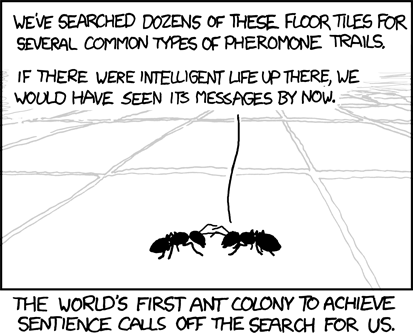
There are scientists who like to insist that "absence of evidence is evidence of absence." At least, there are those who like to do so when the subject is the existence of God; I don't know if they chant the same mantra with regard to SETI (Search for Extra-Terrestrial Intelligence). Certainly, though, there are many outside the scientific community who consider SETI a waste of time and money, and who make essentially that argument against it—and not without scientific support (see for instance the Fermi paradox).
Against that, though, xkcd's Randall Munroe raises an important question: are we looking for the right sort of evidence? Can we really say that the evidence for which we're looking is sufficient to draw any conclusions about the existence of extraterrestrial life? Put another way, do we know so much about extraterrestrial life that we can be certain that any such beings would necessarily produce evidence of their existence that meets our pre-determined criteria? Or are we, like these ants, looking for the wrong sort of thing?
This is a cluster of questions deserving serious consideration—and not only when it comes to the existence of extraterrestrial life, but also with regard to the existence of God. As the philosopher Edward Tingley has pointed out, much of the argument offered for atheism rests on the dogmatic insistence that if God exists, he must necessarily be subject to scientific proof based on evidence deemed acceptable by people who are philosophically and emotionally committed to atheism. The insistence is, essentially, "Prove yourself on our terms"; which is, essentially, a justification for the fixed intention to disbelieve. God didn't take that from the Pharisees, and there's no reason to think he has any interest in taking it from the scientific community, either. One suspects he probably has that in common with the aliens, if there are any.
Thursday, September 17, 2009
The Twitter devotional
This will be of interest to those of you who tweet (I don't, at least right now). Logos Research Systems, maker of Logos Bible Software, posted this announcement today on their Facebook page:
While I try to keep God’s Word in my heart and mind on a regular basis, I must say that among email, work projects, family, Facebook, Twitter . . . my heart and mind tend to stray a little. That’s why I’m excited about the new project we’re launching today.
Today we are announcing the launch of 7 new Twitter accounts that are designed to help you take a moment in your day and meditate on God’s word.
We set the accounts up about a couple week ago to run them through some testing, and I’ve been following them in my personal twitter account. It has been really encouraging to glance over at my feed throughout the day and see a simple reminder of who God is and who I am in Christ.
We hope that these accounts will be a blessing to all you Twitter users and that, amongst the endless chatter of Twitter, you will stop for a moment focus your heart and mind on God’s Word.
Here are the accounts you can follow:
Follow @BibleHope
Every three hours we'll send out a tweet with an encouraging verse from Scripture.
RT @BibleHope: The Lord is my light and my salvation; whom shall I fear? The Lord is the stronghold of my life; of whom... http://ref.ly/Ps27.1
Follow @BibleHour
We'll tweet a different verse from Scripture every hour.
RT @BibleHour: When the day of Pentecost came, they were all together in one place.http://ref.ly/Ac2.1
Follow @OToftheDay
Once a day we'll tweet a verse from the Old Testament.
RT @OToftheDay: Keep this Book of the Law always on your lips; meditate on it day and night, so that you may be careful to do... http://ref.ly/Jos1.8
Follow @PRoftheDay
Receive wisdom from Proverbs with this once daily tweet.
RT @PRoftheDay: There is a way that appears to be right, but in the end it leads to death. http://ref.ly/Pr14.12
Follow @PSoftheDay
This once daily tweet will give you Psalms to meditate on.
RT @PSoftheDay: RT @PSoftheday: Praise the LORD, my soul, and forget not all his benefits - http://ref.ly/Ps103.2
Follow @NToftheDay
Once a day we'll tweet a verse from the New Testament.
RT @NToftheDay: Who gave himself for us to redeem us from all wickedness and to purify for himself a people that are his very... http://ref.ly/Tt2.14
Follow @BiblePlan
Read the Bible in a year. Every day includes a reading from the Old Testament, New Testament, Psalms, and Proverbs.
RT @BiblePlan: Today's Reading: http://ref.ly/Ge27.1-28.9 http://ref.ly/Ps9.10-16http://ref.ly/Pr2.3-5 http://ref.ly/Mt10.1-15


Monday, August 31, 2009
Sunday, August 30, 2009
Social networking and online anonymity
According to Paul Mah on TechRepublic, they don't mix. If I understand him correctly, the problem is that sites like Facebook leak personal information through their ad networks, and also through third-party apps (the games and quizzes that proliferate). Combined with the use of tracking cookies, the results of this could be quite far-reaching:
The implications are sobering and call for a reexamination of how we interact with the Web. Since tracking cookies have been in use for years, it is entirely possible that aggregator sites with historical records could theoretically link our social networking profiles with all our past accesses in its database.
Which, again assuming I'm tracking him correctly, would result in the sort of thing we saw in the movie Minority Report, with full profiles of our activities, associations, interests, and (of course) purchases available online to anyone who cared to pay for them. Something to think about.
Monday, July 20, 2009
The moon is a harsh mistress
so said Robert Heinlein; forty years ago today, the human race took the first giant leap toward finding out if he was right.
Then five more landings, 10 more moonwalkers and, in the decades since, nothing. . . .
America's manned space program is in shambles. Fourteen months from today, for the first time since 1962, the United States will be incapable not just of sending a man to the moon but of sending anyone into Earth orbit. We'll be totally grounded. We'll have to beg a ride from the Russians or perhaps even the Chinese.
Maybe I read too much science fiction, but I agree with Charles Krauthammer: that's a crying shame. It marks, I think, a grand failure of vision, imagination, and nerve on the part of this country.
So what, you say? Don't we have problems here on Earth? Oh, please. Poverty and disease and social ills will always be with us. If we'd waited for them to be rectified before venturing out, we'd still be living in caves.
Yes, we have a financial crisis. No one's asking for a crash Manhattan Project. All we need is sufficient funding from the hundreds of billions being showered from Washington—"stimulus" monies that, unlike Eisenhower's interstate highway system or Kennedy's Apollo program, will leave behind not a trace on our country or our consciousness—to build Constellation and get us back to Earth orbit and the moon a half-century after the original landing.
I can't imagine a better stimulus than to crank up the space program once again; not only would it stimulate the economy by creating lots of new high-paying jobs, it would also stimulate the national spirit. I wasn't around for the first missions to the moon; I'd love to have a chance to see the new ones.
Someone who was, Joyce over at tallgrassworship, illustrates the very real significance of those missions, posting on her childhood memories of the Apollo 11 landing. I can understand the awe she reflects; even forty years later, watching the videos, it comes through.
Just for fun, here's a map NASA produced overlaying the Apollo 11 expedition's exploration of the lunar surface on a baseball diamond (HT: Graham):

Friday, May 22, 2009
Brand perception of the New York Times
I ran across, courtesy of Chris Forbes, an interesting site called brand tags, which describes itself as "A collective experiment in brand perception. . . . The basic idea of this site is that a brand exists entirely in people's heads. Therefore, a brand is whatever they say it is." The mechanism is simple: the site displays a logo, and you enter the first word or phrase that comes to mind. It then adds that tag to the tag cloud on that logo. Once you've tagged enough brands, you can look at the tag clouds and see what people associate with various logos and brands.
One that I found particularly interesting was the tag cloud on the New York Times. Among the largest ones, representing those most often entered, were some obvious ones like "newspaper," and some positive ones like "authoritative," "intelligent," "reliable," and "serious"; one of the largest was "crossword," which probably shouldn't have surprised me. Along with "paper" and "newspaper," though, the largest single one was "liberal," and there were a number of other prominent ones associating liberal bias with the Grey Lady. This isn't surprising, but I did think it was interesting, and I don't imagine it's anything the folks at the NYT are happy about. Click the link and see for yourself.
Tuesday, March 31, 2009
A few tips of the hat
We're having some internet problems here—no connection at the church today at all, and a pretty poor one here at home—so I haven't had much success with any online work; but I thought I might be able to get a relatively quick links post through.
Jared Wilson has a couple strong posts up, "The Kingdom is For Those Who Know How to Die" and "Faith, Hope, and Love is About Proximity to Jesus." I've also been meaning to note his excerpt from Skye Jethani's new book The Divine Commodity, which I think dovetails with my recent post on worship.
Not to leave the rest of the Thinklings out, Philip has a good post on communicating the gospel, Bird makes a good point about repentance, and Bill asks an interesting question: is the American church actually too macho?
I love Hap's retelling of the story of Abigail. If you're not familiar with it, you can find the original in 1 Samuel 25.
Pauline Evans, to whom I haven't linked in far too long, has a nifty little post up on the development of computers, and how the comparisons we use are in some ways quite misleading; she also has one up, I just discovered, on a couple children's fantasy books that I think I'm going to need to read. (This may follow nicely on our recent discovery in this household of Tamora Pierce.)
Debbie Berkley posted something last January that I've kept meaning to write about, reflecting on the uncertainty we face these days in the light of the wisdom of a fellow Christian from India: "Never be afraid to trust an unknown future to a known God." Sage counsel, and certainly no less applicable now, two months on.
And, on the subject of politics (and specifically political dirty tricks), Andrew Breitbart has had some interesting things to say of late about the online war liberals are waging (and winning) against conservatives. Barack Obama promised to elevate the tone of political discourse in this country, but you don't have to be a Sarah Palin supporter to recognize that some of his followers didn't get the memo.
This isn't everyone I'd like to mention, but I'm only linking to pages I can actually pull up, and it's pretty hit-and-miss at the moment. Still, I'm glad to note these, and maybe I'll do another one soon to highlight the ones that wouldn't come up.
Friday, January 23, 2009
Good news on the tech front
I know a couple folks who've been playing around with the Windows 7 beta, and everyone seems to agree: even as a beta, it mops the floor with Vista. Win 7 appears to be to Vista as 98 was to 95—namely, a giant bug fix, fine-tune and cleanup; and it looks like Microsoft is doing a good job of that. Perhaps the best news is that
Windows 7 also cuts down on annoying warnings and nag screens. Microsoft notifications have been consolidated in a single icon at the right of the taskbar, and you can now decide under what circumstances Windows will warn you before taking certain actions.
Unless, of course, it's this:
In my tests, even the beta version of Windows 7 was dramatically faster than Vista at such tasks as starting up the computer, waking it from sleep and launching programs. . . . Windows 7 is also likely to run well on much more modest hardware configurations than Vista needed.
That said, neither of these things is likely to draw the most attention; the big notices will be reserved for its big new feature:
The flashiest departure in Windows 7, and one that may eventually redefine how people use computers, is its multitouch screen navigation. Best known on Apple's iPhone, this system allows you to use your fingers to directly reposition, resize, and flip through objects on a screen, such as windows and photos. It is smart enough to distinguish between various gestures and combinations of fingers. I haven't been able to test this feature extensively yet, because it requires a new kind of touch-sensitive screen that my laptops lack.
For my part, I don't care about that (right now, at least); I'll just be happy to have an OS that doesn't silt up so fast, and isn't stubbornly determined to nag me to death.
Thursday, January 01, 2009
An unintended consequence of socializing medicine
In the latest issue of Forbes, Peter Huber points out the hidden cost of efforts to cut prescription-drug costs: the US is currently the only major market supporting research into new drugs. Government efforts to bring down drug costs will no doubt make existing drugs cheaper; but they will also choke off the flow of new drugs, because the money needed to finance the research and development behind them will no longer be there.
This points to the flaw in the reasoning of those who point to Canada and say, "Why can't we do that? It works for them." The fact is, their system only works as well as it does because of the US, which helps keep their costs down and their waiting lists more tolerable by treating many of their patients, and because the US' open market effectively subsidizes their drug costs. It will be interesting to see, if the Democrats get their way and move the American health-care system hard left, what the other unintended consequences are for health care in Canada, and Mexico, and elsewhere in the world. I have a hunch they won't be pretty.
Sunday, December 07, 2008
On the limitations of computers
This is Bill James again, from his comment on the Oakland A's in the 1984 Baseball Abstract; the essay was republished in This Time Let's Not Eat the Bones: Bill James Without the Numbers under the title "On Computers in Baseball," which is where I have it. Nearly a quarter-century after he first wrote this, it still seems to me to be as true as ever.
The main thing that you are struck with in the process of learning about a computer is how incredibly stupid it is. The machine simulates intelligence so well that when you accidentally slip through a crack in its simulations and fall to the floor of its true intelligence, you are awed by the depth of the fall. You give it a series of a hundred or a thousand sensible commands, and it executes each of them in turn, and then you press a wrong key and accidentally give it a command which goes counter to everything that you have been trying to do, and it will execute that command in a millisecond, just as if you had accidentally hit the wrong button on your vacuum cleaner at the end of your cleaning and it had instantly and to your great surprise sprayed the dirt you had collected back into the room. And you feel like, "Jeez, machine, you ought to know I didn't mean that. What do you think I've been doing here for the last hour?" And then you realize that that machine has not the foggiest notion of what you are trying to do, any more than your vacuum cleaner does. The machine, you see, is nothing: it is utterly, truly, totally nothing.
Sunday, November 16, 2008
This is a strange world we live in
and every advance in technology seems to bring a new opportunity for the human race to find new ways in which to sin.
Second Life affair ends in divorce
HT: TMH
Thursday, November 13, 2008
For my wife, the Rome junkie
Google has now added a 3D "Ancient Rome" layer to Google Earth, based off the best scholarship we have; check out this video on it:
Saturday, October 25, 2008
The myth of fingerprints
I spent a while earlier today thinking about fingerprints, courtesy of Heather McDougal—courtesy of both her own rumination on the subject, which considers various aspects of the whys and wherefores of fingerprints (such as why we have them in the first place, and how they work), and of a 2002 New Yorker article raising questions about the forensic use of fingerprints. They're very different articles, obviously, but both are quite interesting; check them out.
Wednesday, September 17, 2008
Obama, Prince of Denmark: To drill or not to drill
I've been meaning to post on this for a while now: amid the posturing and the squabbling over offshore drilling, there was an interesting contradiction in Barack Obama's acceptance speech a few weeks ago that few people have caught but that's worth pointing out. I suspect the reason so few people have caught it is that it takes someone in the energy business, like The Thinklings' Bill Roberts, to see it:
Tonight, Obama said that drilling is a "stopgap measure", not a solution. Right after that he said he's going to promote clean-burning Natural Gas.
Which is great, because the company I work for explores for and produces natural gas.
But that's where it gets weird: to get to natural gas you have to drill for it. And there are trillions of cubic feet of it in the outer continental shelf (OCS) that we've all been arguing about all this time.
It gets even more complicated: It's extremely common to get BOTH natural gas and oil out of the same wellbore.
Sometimes natural gas is on top of the oil, kind of like a "cap" (and water is often under the oil—oil floats on water). So many wells produce all three products—water, gas, and oil. Sometimes the gas is dissolved in the produced oil and is separated when it gets to the surface.
But, bottom line—it makes no sense to say no to drilling while simultaneously touting natural gas.
I realize this is probably boring to many of you, but because I work with people who do the work to find the darn stuff, I found that to be a pretty interesting comment.
What this shows is that, like most of us (including Nancy Pelosi and the rest of the leadership in Congress), Sen. Obama doesn't really know much about energy production and the issues related to it. That's hardly surprising, but it does mean that at a time when energy prices are a major concern in our economy—and when, as John McCain and Sarah Palin have both pointed out more than once, oil and gas imports are a major foreign-policy concern—the Democratic presidential candidate is offering policy prescriptions in this critical area that are based not on actual knowledge of that area but rather on ideology and political convenience. Thus we see him doing things like "saying no to drilling while simultaneously touting natural gas," just because he doesn't know enough to know that he's contradicted himself.
This is one of the things which makes Sen. McCain's choice of Gov. Palin so striking. She's taken flak from both sides of the aisle for not being broadly and deeply versed in foreign policy and matters of national security, and he's taken flak for choosing a nominee who lacks that kind of understanding; and there's no question that she has a lot to learn in that area, and that the wisdom of choosing her as the VP nominee will depend to a considerable extent on her ability to do so quickly. That said, however, what she does have that's far harder to find is a broad and deep understanding, both at the political level and at the down-and-dirty practical level, of the energy industry, energy policy, and all its manifold ramifications. She knows how to address these issues, and she's managed to do so without ending up in Big Oil's pocket, which is probably almost as valuable. At a time when energy policy is critically important both domestically and internationally, when the GOP nominee for President is already more than qualified to handle national-security issues but is not conversant with energy issues, I think Gov. Palin's expertise in this area is a powerful qualification—and a pointed contrast to the ignorance on the Democratic ticket.
Tuesday, September 02, 2008
What the Internet was made for
(which too often isn't what it's used for)
Since I first discovered Pauline Evans' blog, Perennial Student, I've come to appreciate her work for a number of things—not least that she has a sharp eye for all sorts of interesting stories that I would otherwise miss. A few days ago, for instance, she pointed me to a real piece of good news in the world of biblical scholarship: the guardians of the Dead Sea Scrolls have launched a five-year multi-million dollar project to put them on the Web. Specifically,
the fragments will be photographed first by a 39-megapixel colour digital camera, then by another digital camera in infra-red light and finally some will be photographed using a sophisticated multi-spectral imaging camera, which can distinguish the ink from the parchment and papyrus on which the scrolls were written.
Eventually all the fragments will be available to view online, with transcriptions, translations, scholarly interpretations and bibliographies provided for academic study. "The aim in the end is that you can go online and call up the scrolls with the best possible resolution and all the information that exists about them today," said Pnina Shor, head of the Artefacts Treatment and Conservation Department at the antiquities authority. "We want to provide opportunities for future research on the scrolls. We feel it's part of our duty to expose them to the world as a whole."
This is truly splendid, and should be a huge boon to biblical and historical scholarship—especially as it's already produced unexpected side benefits:
The new infra-red photography has picked out letters that had not previously been visible to the naked eye. "The ink stays dark and the leather becomes light and suddenly you can see text that you may no have been able to see," said Tanner. "We have revealed some text that has not been previously seen by scholars." The detailed colour photographs of papyrus fragments may help to identify pieces that fit together and to identify fragments written by the same scribes. Scholars hope this new information might enable them to piece together more of the fragments and so come closer to putting complete sections of the scrolls together.
Wednesday, August 27, 2008
A couple facts on offshore drilling
This is the offshore-drilling map: what Congress has allowed and what it has disallowed. The green areas are legal, the red aren't, and the yellow aren't under our jurisdiction. (For the rather lurid "No Zone" thing, blame Idaho Sen. Larry Craig—this was produced by his office.)

This is the map of the mockery that China, Cuba, Canada, and other countries are making of that ban, drilling into the Gulf oil fields from sites as close to 50 miles off the coast of Key West.

At the very least, as we debate expanding offshore drilling, we need to be aware that just because we've banned it doesn't mean it isn't happening—it just means it's happening a little further off shore, to the benefit of other countries (some of them our enemies) instead of our own.
Subscribe to:
Posts (Atom)