I mean that as a completely serious question. I've been mulling it recently, ever since I got tangentially involved in an argument in a comment thread on another blog. The blogger in question seems to spend the largest part of his time going after atheists, and it would appear that there are many who rise to the bait. I've never quite understood that behavior, really; I'm happy to debate issues with people who comment here—as long as the conversation seems to me to be productive, and an actual conversation—but I don't generally have a great deal of interest in going to other people's blogs just to tell them they're wrong.
Showing posts with label Philosophy. Show all posts
Showing posts with label Philosophy. Show all posts
Friday, June 11, 2010


Friday, January 29, 2010
Political philosophy, article I
I will not cede more power to the state.
I will not willingly cede more power to anyone, not to the state, not to General Motors, not to the CIO. I will hoard my power like a miser, resisting every effort to drain it away from me. I will then use my power as I see fit. I mean to live my life an obedient man, but obedient to God, subservient to the wisdom of my ancestors; never to the authority of political truths arrived at yesterday at the voting booth.
—William F. Buckley
Tuesday, October 27, 2009
What is wisdom?
Looking over my previous post, it seems to me that lurking under the surface of my argument there is a deeper concern: how do we move beyond trying to feel that we’re right, and actually begin to become wise? In that, I think I might be moving a bit against the grain of Western culture; in this place and time, calling someone “wise” is still considered to be a compliment, but it’s not necessarily the sort of compliment that breeds emulation. We may recognize wisdom as a good thing in the abstract, but I don’t know that it’s something our culture really prizes all that much.
Indeed, I’m not at all sure that as a culture, we’re even all that clear on what wisdom is. We tend to get it mixed up with the other things that we think of as related to our minds, with knowledge and understanding and intelligence—which isn’t helpful, because wisdom isn’t any of those things. Granted, to exercise wisdom, it helps to have a lot of knowledge, but there are many people for whom great knowledge just means the chance to be greater fools. Similarly with intelligence; intelligence can amplify wisdom, but it can’t increase the number of wise options available. It can, however, allow for the invention of lots of new ways to be foolish. Understanding is good and necessary, but we can begin to take pride in our understanding, and when that starts to happen, it can lead us astray very quickly. As the saying goes, logic is often nothing more than a way to go wrong with confidence.
Wisdom, by contrast, is all about being able to separate the wheat from the chaff. It’s about facing the questions, “Is this a good idea, or not? Is this the right thing to do, or not?” and being able to answer those questions correctly. It is the ability to perceive the best thing to do—and then to go and do it. If someone can tell you what they ought to be doing but doesn’t go out and do it, we don’t call them wise, we call them a very particular sort of fool. Wisdom isn’t wisdom until we put it into practice; it’s all about how we live. Wisdom is about doing truth, not just knowing truth.
(Partially excerpted from “True Wisdom”)
Friday, September 18, 2009
Are you sure you're looking for the right thing?
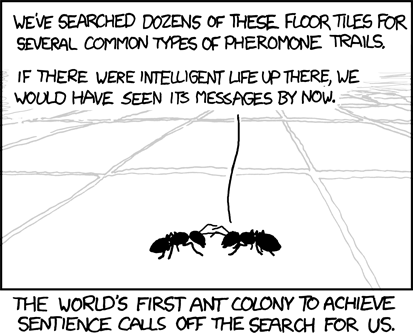
There are scientists who like to insist that "absence of evidence is evidence of absence." At least, there are those who like to do so when the subject is the existence of God; I don't know if they chant the same mantra with regard to SETI (Search for Extra-Terrestrial Intelligence). Certainly, though, there are many outside the scientific community who consider SETI a waste of time and money, and who make essentially that argument against it—and not without scientific support (see for instance the Fermi paradox).
Against that, though, xkcd's Randall Munroe raises an important question: are we looking for the right sort of evidence? Can we really say that the evidence for which we're looking is sufficient to draw any conclusions about the existence of extraterrestrial life? Put another way, do we know so much about extraterrestrial life that we can be certain that any such beings would necessarily produce evidence of their existence that meets our pre-determined criteria? Or are we, like these ants, looking for the wrong sort of thing?
This is a cluster of questions deserving serious consideration—and not only when it comes to the existence of extraterrestrial life, but also with regard to the existence of God. As the philosopher Edward Tingley has pointed out, much of the argument offered for atheism rests on the dogmatic insistence that if God exists, he must necessarily be subject to scientific proof based on evidence deemed acceptable by people who are philosophically and emotionally committed to atheism. The insistence is, essentially, "Prove yourself on our terms"; which is, essentially, a justification for the fixed intention to disbelieve. God didn't take that from the Pharisees, and there's no reason to think he has any interest in taking it from the scientific community, either. One suspects he probably has that in common with the aliens, if there are any.
Wednesday, September 16, 2009
Thought on atheism and the use of theology
John Stackhouse wrote a post a couple weeks ago responding to the following quote, attributed to Richard Dawkins:
What has theology ever said that is of the smallest use to anybody? When has theology ever said anything that is demonstrably true and is not obvious? I have listened to theologians, read them, debated against them. I have never heard any of them ever say anything of the smallest use, anything that was not either platitudinously obvious or downright false. If all the achievements of scientists were wiped out tomorrow, there would be no doctors but witch doctors, no transport faster than horses, no computers, no printed books, no agriculture beyond subsistence peasant farming. If all the achievements of theologians were wiped out tomorrow, would anyone notice the smallest difference? Even the bad achievements of scientists, the bombs, and sonar-guided whaling vessels, work! The achievements of theologians don’t do anything, don’t affect anything, don’t mean anything. What makes anyone think that “theology” is a subject at all?
His response, “What Good Are Theologians?” is, if I understand him properly, an appeal to scientist/philosopher Michael Polanyi’s concept of “personal knowledge,” and to the lesson of Basil Mitchell’s parable of the freedom fighter. (He doesn’t explicitly reference either, but he does quote Polanyi in one of his comments on the thread.) I say “if I understand him properly” because if I’m right about that, then a number of his respondents don’t understand him properly—my read appears to be a minority opinion.
The post is well worth reading; but it’s worth reading, in part, to set up the discussion in the comments, which I think is better than the original post. I particularly liked this contribution from one Ian:
As Stan Grenz and Roger Olson assert in their invitation to the study of God, Who Needs Theology, “Everyone is a theologian.” (IVP 1996) The only question remains are you a good theologian or a bad theologian. Of course Dawkins is referring to those of us who are or are becoming professional theologians.
Yet, one also has to wonder about his claims concerning the type of world we have. For the Glory of God by Rodney Stark suggests that we would not have many of the technological advances that Dawkins claims for science without Christian theology. Descartes himself found theological ideas significant for his method and science is indeed indebted to him for good or ill.
Finally, Dawkins has made a career out of theology by pitting himself against a theological worldview and its promoters. One wonders what we he would do without us? Who would read his books?
(At first I thought that was Iain Provan, but then I realized that the name was spelled differently.) Other commenters take on the ridiculously (and arrogantly) reductionistic position staked out by Dr. Dawkins, but I think Ian has hit the key point on the head: everyone is a theologian, in that everyone forms and articulates beliefs about the nature and existence or non-existence of God. The role of the theologian is to inform and critique those beliefs; and the reason for the violence of Dr. Dawkins’ response is not rational, but personal and visceral: he is categorically unwilling to have his beliefs (which are the foundation and justification for that reductionism) either critiqued or informed.
This is characteristic of Dr. Dawkins, as it is of his fellow “New Atheists”; I’ve laid out my views of them before, and I remain convinced that they are the mirror image of whom they imagine their opponents to be: dogmatic fundamentalists who have made their chosen god in their own image and will brook no contradiction of their dogma because it would threaten their chosen self-understanding and way of life. Though they make a great parade of their insistence on reason, their rationalism appears to be of the kind best captured by Benjamin Franklin in his Autobiography:
So convenient a thing it is to be a rational creature, since it enables one to find or make a reason for every thing one has a mind to do.
Or, one might add, “believe.” When Dr. Dawkins asks, “What has theology ever said that is of the smallest use to anybody?” he’s defining “use” on his terms—terms which have already, by their narrowness, predetermined the answer, to ensure that he need not have to grapple with the answer.
Monday, May 11, 2009
The theological politics of John Rawls
Those of you who are interested in political philosophy ought to check out William Galston's TNR piece on the roots of John Rawls' views in his college flirtation with serious Christian theology. I can't claim more than a superficial knowledge of Rawls' work, but the questions Galston raises are interesting ones.
Wednesday, March 11, 2009
The importance of theories in conflict
Yesterday I quoted G. K. Chesterton, from one of his short stories, on the importance of the theories we hold about life, the universe, and everything; Chesterton, speaking there through the character Gabriel Gale, declares (correctly) that "most men are what their theories make them." The economist and columnist Thomas Sowell understands this well, as you can see in this interview (video below) he gave Peter Robinson last fall for Robinson's program "Uncommon Knowledge." As Sinistar of C4P sums it up,
In the interview . . . Sowell talks about his 1987 book A Conflict of Visions and the 2008 Presidential Election. . . .
Sowell states that "visions . . . are the implicit assumptions by which people operate" and that with regards to politics, these visions can be divided into two camps—a constrained view and unconstrained view. To put things another way, these visions are your "gut feeling" or views on how the world works, and they will color your views of how you approach many political and social issues.
The unconstrained vision suggests that human nature is changeable and that society's and the world's problems can be solved if rational plans are enacted. The constrained vision, on the other hand, banks on the concept that human nature is static and flawed, and that there are limitations to what can be done.
Of particular interest to those of us who are supporters of Sarah Palin,
[Dr. Sowell] briefly mentions the smears against Gov. Palin and how it relates to the concepts discussed in "A Conflict of Visions". . . . It is a very enlightening interview, and I encourage people to watch the whole thing. However, if you just want to hear Sowell briefly talk about the smears against Gov. Palin and how these conflicting visions relate, you can fast forward to the 30 minute mark. (I suggest starting 28 minutes in for the lead-in to the discussion.)
Tuesday, March 10, 2009
The importance of theory
“Most modern people have a curious contradiction; they abound in theories, yet they never see the part that theories play in practical life. They are always talking about temperament and circumstances and accident; but most men are what their theories
make them; most men go in for murder or marriage, or mere lounging because of some
theory of life, asserted or assumed.”
—Gabriel Gale, in “The Shadow of the Shark.” The Poet and the Lunatics. G. K. Chesterton
Tuesday, March 03, 2009
The limits of liberty
“What exactly is liberty? First and foremost, surely, it is the power of a thing to be itself. In some ways the yellow bird was free in the cage. It was free to be alone. It was free to sing. In the forest its feathers would be torn to pieces and its voice choked for ever.
Then I began to think that being oneself, which is liberty, is itself limitation.
We are limited by our brains and bodies; and if we break out,
we cease to be ourselves, and, perhaps, to be anything.”
—Gabriel Gale, in “The Yellow Bird.” The Poet and the Lunatics. G. K. Chesterton
Sunday, February 01, 2009
A quick reader's guide to postmodernism
courtesy of Brad Holland. This was published in 1996, so more has happened since then, but mostly, it still applies.
Wednesday, January 07, 2009
A point of perspective
In the face of the resurrection it becomes finally impossible to think of our Christian narrative as only "our point of view," our perspective on a world that really exists in a different, "secular" way.
There is no independently available "real world" against which we must test our Christian convictions, because these convictions are the most final, and at the same time
the most basic, "seeing" of what the world is.
—John Milbank
My thanks to the Rev. Dr. Ray Ortlund for posting this quote from Dr. Milbank's book The Word Made Strange. It's a profoundly important point; in particular, it's a crucial rebuke to any purely subjective understanding of Christianity. We're dealing here with a reality which is far greater and wilder than our subjectivity, and which shatters our comfortable reductionism.
At the same time, the logic underlying Dr. Milbank's argument is also a stiff challenge to secular pretensions of greater objectivity; for secularists, too, their convictions "are the most final, and at the same time the most basic, 'seeing' of what the world is." We cannot, any of us, get outside ourselves to measure ourselves against reality apart from any presuppositions; we cannot see from no point of view.
Tuesday, December 09, 2008
Wise words on pride
Pride is a blossom of ashes—bitter in the mouth, sharp to the nose, stinging to the eyes, and blown away on the first wind from the mountains. Plant no pride, lest you harvest shame.
—Proverb of Altiplano
This proverb (and the whole society of Altiplano) comes from Elizabeth Moon's novel Once a Hero; Moon's one of the better writers of military science fiction around, and this is one of her best. I note the irony of posting a proverb from a fictional society so soon after posting the title sequence for a non-existent sitcom, but for all that it was created in the service of a Secondary World (to use Tolkien's term), it has the ring of old truth, and is well worth remembering.
Saturday, November 22, 2008
Interesting comment on being right
from this comment thread over on Lookout Landing (on a post well worth reading if you're a baseball fan), from a commenter named Milendriel:
Bottom line is, there are people who want to be right and approach new information objectively, and then there are people who don’t want to admit they’re wrong—which is necessary to eventually be right; none of us were any good at evaluating from the outset.
Beautifully put, that. To be fair, I think we all need to realize that even the best of us spend at least some time in the second category—this isn't a justification for beating up on people; we need to keep in mind that this isn't about better people vs. worse people (which tends to mentally devolve to "us vs. them," which is completely counterproductive), but rather about differing mental attitudes and approaches. As long as we do that, though, this formulation does as good a job of contrasting the approach that produces real growth and understanding (the former) with that which merely produces pride and folly (the latter) as anything I've seen. It's not that we shouldn't be concerned about being right; it's that our concern should be for the real value of truth, and should thus be essentially disinterested and not about ourselves, rather than for being believed to be right, which is not about truth at all but rather about ego.
Sunday, October 05, 2008
The order of decrees
For those who aren't theology wonks, "the order of decrees" is a theological catchphrase dealing with a disagreement among Calvinist theologians. The phrase relates to the order in which God decided to decree, or determine, certain things; the dispute relates to the question of whether God decided to create people, then decided to permit the fall into sin, and then set the plan of salvation in motion, or whether he decided to create human beings in order to save some and not others. (That's a very rough sketch of the difference between the positions, and not really fair to either of them, but I think it's the best way to capture their difference for those who aren't familiar with this discussion. If you are, my apologies, and I'll be happy to have a serious conversation on the subject with you at some other point. If you aren't but would like to be, go read the chapter for Boettner linked above.)
It seems to me, though, that this is a concept and a question which is of value beyond simply the Reformed understanding of the Christian doctrine of salvation by grace. In particular, I think this is valuable in evaluating our political positions and our political philosophy if we apply it to ourselves: what is our own "order of decrees" with regard to the positions we choose to take and defend?
What got me thinking about this was Chris Matthews (he of the tingly leg), and specifically his comparison of the first presidential debate and the VP debate: as Mary Katherine Ham pointed out, he argued that the Democrat won both—for mutually contradictory reasons. Had he been consistent, he would have had to score one of them as a win for the GOP ticket; so he scrapped consistency for the sake of ideology.
Now, Matthews' performance here is easy to mock, as a particularly blatant (and particularly ludicrous) example of bias trumping logic; but it's also, I think, a valuable pointer to an approach to politics that we see all over the place. To borrow the "order of decrees" language, his decree of support for the Democratic Party and its candidates is prior to all his other decrees in this instance, and controls them. Therefore, his chain of reasoning and consequent analysis of the situation in front of him (the debates, in this case) is not independent, but is dictated by his a priori commitment to do what is best for the Democratic candidate; what matters is not that what he says is logically coherent or represents a rationally consistent position, but that it serves his agenda.
As I say, though this is an especially obvious and risible example, I believe it's something most of us do: we put our decree of which side we're on ahead of our evaluations of people, positions, and situations. Rather than putting our governing principles first and trying to reason independently from them in each instance to determine what we think of this candidate or that, of this position or that, of this bill or that (and, yes, of this debate or that), we have the tendency to decide who we're rooting for and who we're rooting against and let that shape, or even determine, what we think about all those other matters. Chris Matthews did it in his debate analysis. More than a few people on both sides of the political aisle have done it with respect to Hillary Clinton and Sarah Palin—we've seen some of the arguments over Sen. Clinton reprised over Gov. Palin, only with the sides switched. Scads and scads of folks did it over the Paulson plan, because they'd already decided they were against "Wall Street fat cats." It's certainly a faster and more efficient way to come to conclusions, because it cuts out the need for all that time-consuming thought; that's an especially strong temptation given the speed with which our world moves these days. What it isn't, however, is a good way to build politics with integrity—or indeed, to build integrity in any area of life.
Monday, September 22, 2008
My favorite Justice
I meant to post this months ago, back when Phil first posted these on The Thinklings, but somehow or other I forgot to do so. I have tremendous admiration for Justice Antonin Scalia as a brilliant moral and legal thinker, a man of deep and strong principles, and a Catholic of deep Christian faith. I also appreciate his wit, and from what I've seen of him, I think he'd be an enjoyable and fascinating person to know. He is, of course, unpopular with the Left, since a) they don't agree with him on much and b) he doesn't pull his punches (and in fact, he often lands them pretty hard); but like him or hate him, he's truly one of the major figures in the history of American constitutional jurisprudence, and so deserves to be considered and understood on his own terms.
Sunday, July 06, 2008
The atheism of presumption and the case for God
The "New Atheists" have sold a lot of books and spun up a lot of media coverage; what they haven't done, particularly, is make a very good case for atheism. Mostly, they preach to the converted and mock those who disagree with them; along the same lines as C. S. Lewis' observation (in The Screwtape Letters) that not everyone can make a joke but anyone can talk about something as if it's funny (which is how he defines flippancy), they've demonstrated that it's easier to act as if something's already been proven than it is to go out and prove it. Remove their assumption that atheism is the only intellectually respectable position, and there's not a whole lot left.
Now, this wouldn't matter if their assumption were correct; but it isn't. In truth, as William Lane Craig notes in a recent article in Christianity Today, that point of view is behind the times. The relative weakness of the intellectual case for atheism was underscored when the world's most important atheist philosopher, the man who first argued for "the presumption of atheism," Dr. Antony Flew, abandoned atheism (a change of mind he discussed in interviews with Dr. Gary Habermas and Dr. Benjamin Wiker). Perhaps in part consequence, more and more of the younger generation of Christians have become interested in apologetics (the study of the defense of Christianity on rational grounds); as I've posted before, I wouldn't be surprised if the primary long-term effect of the "New Atheists" and their work is not the growth of atheism but the growth of the church.
Wednesday, May 28, 2008
Skeptical theism
I linked to this by the by in my previous post, having discovered that it was up while I was looking for something else, but it really deserves its own: Edward Tingley has a stellar article in Touchstone called “The Skeptical Inquirer: If Only Atheists Were the Skeptics They Think They Are,” which I commend to your reading. It is, drawing on Pascal, a devastating frontal assault on the idea that the absence of scientific evidence for God is an argument against the existence of God. As Dr. Tingley says, “Skepticism raises the question, Is there any way forward after we have given up on material evidence? It certainly doesn’t answer it.”
Here are a few brief excerpts from the essay to whet your appetite:
Unbelievers think that skepticism is their special virtue, the key virtue believers lack. Bolstered by bestselling authors, they see the skeptical and scientific mind as muscular thinking, which the believer has failed to develop. He could bulk up if he wished to, by thinking like a scientist, and wind up at the “agnosticism” of a Dawkins or the atheism of a Dennett—but that is just what he doesn’t want, so at every threat to his commitments he shuns science.
That story is almost exactly the opposite of the truth. . . .
There are skeptical theists; Pascal was one. Skepticism and theism go well together. By a “skeptic” I mean a person who believes that in some particular arena of desired knowledge we just cannot have knowledge of the foursquare variety that we get elsewhere, and who sees no reason to bolster that lack with willful belief. . . .
Evidence is just not available to demonstrate the existence of God, said Pascal, who called himself one of those creatures who lack the humility that makes a natural believer. In that, he was of our time: We are pretty much all like that now. Three hundred and fifty years ago he laid out our situation for us: Modern man confronts the question of God from the starting point of skepticism, the conviction that there is no conclusive physical or logical evidence that the God of the Bible exists. . . .
This is where the modern person usually starts in his assault on the question, Is God real or imaginary?
This is base camp, above the tree-line of convincing reasons and knock-down arguments, at the far edge of things we can kick and see, and it is all uphill from here. Thus, it is astounding how many Dawkinses and Dennetts, undecideds and skeptical nay-sayers—that sea of “progressive” folk who claim to “think critically” about religion and either “take theism on” or claim they are “still looking”—who have not reached the year 1660 in their thinking. They almost never pay attention to what the skeptic Pascal said about this enquiry.
Instead, the dogmatic reflex, ever caring for human comfort, has flexed and decided the question already, has told them what to believe in advance of investigation and rushed them back to the safety of life as usual.
The modern thinking person who rightly touts the virtues of science—skepticism, logic, commitment to evidence—must possess the lot. But agnostics are not skeptical, half the atheists are not logical, and the rest refuse to go where the evidence is. None measures up in these modern qualities to Pascal.
I encourage you to read the rest—it’s truly a superb piece.
Saturday, May 17, 2008
Dawkins, analyzed
I've written on Dr. Richard Dawkins and the rest of the "new atheists" once or twice (or maybe three times, or even four), so I was interested to see Dr. John Stackhouse reflect on a recent appearance Dr. Dawkins gave at the University of British Columbia (UBC, pronounced "you-bys-sey"). His comments are in three parts, evaluating Dr. Dawkins as rhetor, ethicist, and mirror (of the style and flaws of a certain type of Christian apologist and preacher); he has some interesting things to say, especially regarding Dr. Dawkins' encounter with West Coast vegetarianism.
Wednesday, April 30, 2008
The God who speaks
“Let not your hearts be troubled. Believe in God; believe also in me. In my Father’s house are many rooms. If it were not so, would I have told you that I go to prepare a place for you? And if I go and prepare a place for you, I will come again and will take you to myself, that where I am you may be also. And you know the way to where I am going.” Thomas said to him, “Lord, we do not know where you are going. How can we know the way?” Jesus said to him, “I am the way, and the truth, and the life. No one comes to the Father except through me. If you had known me, you would have known my Father also.
From now on you do know him and have seen him.”
—John 14:1-7 (ESV)
These words are much loved and much quoted, and I’m sure have been for as long as there has been a church. Perhaps the most interesting thing about this passage, though, is the basis for Jesus’ promise: it isn’t based on what he’s taught them so far, or even on his crucifixion and resurrection, but on the fact that he’s going to leave them. It’s his going away that makes the fulfillment of his promise possible.
There are various aspects to this, but perhaps the most reassuring is that when Jesus ascended, when he returned to heaven, he wasn’t leaving us, he was leading us; he was going ahead of us to prepare our way, to show us the way, to be our way. That’s why he says, “If I go to prepare a place for you, I will come again and take you to myself, that where I am, there you may also be”; and that’s one reason why he sent us his Spirit, as the agent through whom he leads and guides us in this life, on the way toward the kingdom of his Father. Remember, “the earth is the Lord’s, and all that is in it,” and he’s actively at work in and through all of it. Thus for us, the world is not silent, nor is God silent; rather, God is always speaking to us, and all of life is the medium through which he speaks.
Most basically, of course, and most importantly, God speaks to us through the words he inspired, which include the record of the life he lived for us on this earth; it’s through the Bible first and foremost that Jesus leads us by his Spirit, as he continues to speak to us by his Spirit through these words, and he will not say anything that contradicts what he has already said. But that’s not the only way he speaks to us; it’s not the only way he guides us. He speaks through us sometimes as we talk with each other, making us agents of his wisdom; sometimes he may speak truth to us through people outside the church; he touches our minds and hearts through his creation, the natural world; and sometimes he speaks to us directly, in the back of our minds and the quiet of our hearts. I’ll never forget one time I was absolutely furious at someone—a couple someones, actually—and in my mind I heard Jesus say, “Show them grace.” I knew it was God, since it wasn’t what I wanted to hear, and I protested angrily, “They don’t deserve it.” To which he responded, “I know. That’s why it’s called grace.”
Granted, most of the time God doesn't speak to us quite that clearly; I suspect I was being unusually dense that day. But he does speak to us, and he does lead us, and we can trust that fact no matter what; what’s more, we can trust that he’s good enough at leading us to overcome how bad we often are at following him. We don’t need to worry or be anxious about that, for we can trust God for his grace; we simply need to do our part. We need to spend time with him, in reading his word (the main way we come to know him and recognize his voice) and in prayer—not just talking to him, though that’s important, but also being silent, listening for his voice—so that we learn to know him when he speaks; and we need to learn to expect him to speak, because he is at work leading us by his Spirit every day, in every moment. Christ came down to seek us out in our sin and rescue us from the power of death, and he’s busy right now bringing us home; and what he starts, he finishes. Period. End of sentence.
(Note: those with a philosophical bent might find Edward Tingley’s article “Gadamer and the Light of the Word” a valuable reflection on this matter; though Gadamer was not a believer, he gives a better account of the Spirit's work than many Christians, and Tingley has some excellent things to say on this.)
Tuesday, April 29, 2008
Humble knowledge
A lot of people think that a belief in absolute truth necessarily leads to dogmatism; that is, it seems to me, the main thing that moves people to conclude that truth is relative, because the alternative produces such unappealing behavior. Really, though, it's not the belief in absolute truth as such that produces dogmatism, but the combination of a belief in absolute truth with a belief that the self is absolute; and it's to defend that belief in the absolute self that people declare the truth to be relative. For my own part, I believe that the truth is absolute, and I am relative; my certainty is necessarily limited, not by the absence of absolutes, but by my own limited ability to perceive and apprehend them accurately. As John Stackhouse says, we may be pretty sure we're right, but we lack the ability to get outside ourselves and our own limitations enough to be absolutely sure. We should believe what we believe firmly and with conviction; but also with humility. After all, the fact that we believe something doesn't guarantee that it's true; as Dr. Stackhouse says, it's about confidence in God who is truth, not about certainty in ourselves, who aren't.
Subscribe to:
Posts (Atom)