The Nebraska legislature has signed off on a bill that Governor Dave Heineman will sign today that could head to the courts and ultimately weaken further the Roe v.Wade Supreme Court decision that has resulted in 52 million abortions. The bill bans abortions after 20 weeks of pregnancy based on the well-established concept of fetal pain.
By a vote of 44-5, the Nebraska unicameral legislature this morning gave final passage to the Pain Capable Unborn Child Protection Act introduced by Speaker Mike Flood.
One small step toward a more just and compassionate society.
One of the most interesting stories of the past couple of months has been the whole Climategate scandal. I'm not going to dig that up and rehash the substance of it (though if you didn't see Bill's posts on the Thinklings about the lousy quality of the computer models behind the anthropogenic global-warming argument and the dubious nature of the standard assertions that the results of such models are truly properly peer-reviewed, you ought to), I just wanted to throw an observation out there. To wit, I recognized the spirit in those leaked e-mails, with their insistence that the theory must be right regardless of the data, and their willingness to adjust the facts as needed to fit the dogma: it's the spirit of fundamentalism. It's the exact same tone one meets in people arguing that the Earth must be only 6,000 years old and therefore, whatever facts that would seem to indicate otherwise must be incorrect.
Now, to call someone a fundamentalist doesn't mean they're wrong, by any means. I don't happen to believe the Earth is only 6,000 years old, and I don't happen to believe in AGW, but that doesn't necessarily mean that one or both couldn't be correct. But the spirit in which many who call themselves Christian fundamentalists argue (which is not, be it noted, equal with fundamentalism itself; one can hold to fundamentalist positions without this sort of attitude and approach) is one which is absolutely certain it has discovered the truth, unquestioningly convinced of its own rightness, and thus is committed to maintaining its position by whatever means necessary. This is the sort of spirit one also finds in Islamic fundamentalism—and it's the spirit that's in view as well in Michael Mann and the leaked CRU e-mails.
Again, that doesn't mean their position is wrong; to argue that would be to commit the genetic fallacy. It does, however, give the lie to their claims that they alone are scientific and their opponents are anti-science. In truth, what we have here is a religious dispute, complete with threats by the high priests against the heretics; and the pretensions of those high priests to be above ideology, their insistence that they are disinterested seekers of the pure flame of fact, have been shown to be a sham. This will be, I think, the long-term effect of Climategate: it's knocked AGW proponents off their pedestal, and I don't think they're going to be able to climb back up.
LiTraCon, short for light transmitting concrete, is an innovative new combination of optical fibers and light concrete. The resulting concrete is just as strong as conventional concrete, but it transmits light like glass. The optical fibers are small enough that they aren’t visible in the finished product; the surface of the concrete is homogenous while the structure remains sturdy.
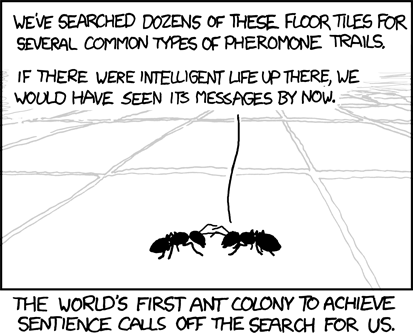
There are scientists who like to insist that "absence of evidence is evidence of absence." At least, there are those who like to do so when the subject is the existence of God; I don't know if they chant the same mantra with regard to SETI (Search for Extra-Terrestrial Intelligence). Certainly, though, there are many outside the scientific community who consider SETI a waste of time and money, and who make essentially that argument against it—and not without scientific support (see for instance the Fermi paradox).
Against that, though, xkcd's Randall Munroe raises an important question: are we looking for the right sort of evidence? Can we really say that the evidence for which we're looking is sufficient to draw any conclusions about the existence of extraterrestrial life? Put another way, do we know so much about extraterrestrial life that we can be certain that any such beings would necessarily produce evidence of their existence that meets our pre-determined criteria? Or are we, like these ants, looking for the wrong sort of thing?
This is a cluster of questions deserving serious consideration—and not only when it comes to the existence of extraterrestrial life, but also with regard to the existence of God. As the philosopher Edward Tingley has pointed out, much of the argument offered for atheism rests on the dogmatic insistence that if God exists, he must necessarily be subject to scientific proof based on evidence deemed acceptable by people who are philosophically and emotionally committed to atheism. The insistence is, essentially, "Prove yourself on our terms"; which is, essentially, a justification for the fixed intention to disbelieve. God didn't take that from the Pharisees, and there's no reason to think he has any interest in taking it from the scientific community, either. One suspects he probably has that in common with the aliens, if there are any.
courtesy of that consistently brilliant parodist, John Cleese—who truly is, as my wife says, at the top of his form with this one. (Scientism, if anyone is wondering, is the dogmatic faith in science which folks like Richard Dawkins use to replace faith in God.)
The great thing about Cleese, evident here, is his unflagging willingness to skewer everybody, including himself and those with whom he agrees. For an instructive comparison, check out Christopher Hitchens' biting critique in the latest Atlantic of folks like Jon Stewart, Stephen Colbert, and Al Franken, who (though they consider themselves satirists) are unwilling to do so.
Then five more landings, 10 more moonwalkers and, in the decades since, nothing. . . .
America's manned space program is in shambles. Fourteen months from today, for the first time since 1962, the United States will be incapable not just of sending a man to the moon but of sending anyone into Earth orbit. We'll be totally grounded. We'll have to beg a ride from the Russians or perhaps even the Chinese.
Maybe I read too much science fiction, but I agree with Charles Krauthammer: that's a crying shame. It marks, I think, a grand failure of vision, imagination, and nerve on the part of this country.
So what, you say? Don't we have problems here on Earth? Oh, please. Poverty and disease and social ills will always be with us. If we'd waited for them to be rectified before venturing out, we'd still be living in caves.
Yes, we have a financial crisis. No one's asking for a crash Manhattan Project. All we need is sufficient funding from the hundreds of billions being showered from Washington—"stimulus" monies that, unlike Eisenhower's interstate highway system or Kennedy's Apollo program, will leave behind not a trace on our country or our consciousness—to build Constellation and get us back to Earth orbit and the moon a half-century after the original landing.
I can't imagine a better stimulus than to crank up the space program once again; not only would it stimulate the economy by creating lots of new high-paying jobs, it would also stimulate the national spirit. I wasn't around for the first missions to the moon; I'd love to have a chance to see the new ones.
Someone who was, Joyce over at tallgrassworship, illustrates the very real significance of those missions, posting on her childhood memories of the Apollo 11 landing. I can understand the awe she reflects; even forty years later, watching the videos, it comes through.
Just for fun, here's a map NASA produced overlaying the Apollo 11 expedition's exploration of the lunar surface on a baseball diamond (HT: Graham):
Here are a few things I've been meaning to get around to posting on (for quite a while—I think I ran across all of these back in March) that just aren't likely to get their own posts at this point; so I'll toss them out for your interest, and if I ever do get around to putting up a longer post on any of them, well, the duplication won't hurt anything.
Beryllium 10 and climate The science in this is not immediately transparent to the non-specialist, but it's interesting evidence that climate change is far more about what the sun does than about CO2.
is the distinguished cosmologist and mathematical physicist Frank Tipler, of Tulane University. His letter of a few weeks ago (which I missed at the time) to blogger William Katz, detailing the agenda-driven work behind this issue and its relationship to government funding of research, and the developing efforts to suppress scientific challenges to global-warming theory (since its supporters can't disprove them, they must resort to force to silence them), should concern anyone who cares about the state of scientific research in the West.
courtesy of Harold Ambler in HuffPo (which is nowhere I would have expected to see global warming called "the biggest whopper ever sold to the public in the history of humankind," but there you go). He does a nice job of exposing the baloney "science" underlying global-warming claims (including a point about the limited ability CO2 has to absorb heat); perhaps more importantly, he also points out that bowing to global-warming hysteria would misdirect our environmental efforts and do considerable damage to the world economy—which would not only increase human suffering, it would also further damage the global environment by moving the world collectively back toward more primitive, and dirtier, technologies for energy generation.
One of my fellow debaters in high school used to say, "I'm pro-environment, but anti-environmentalist." Issues like this make me think he was right.
In today’s daily piece on the First Things website, titled “The Good Life,” Amy Julia Becker meditates on what it means for life to be good as it is in the face of human disabilities—and in the face of those who vehemently deny that possibility. She begins with this quote from William Motley, an Oxford geneticist, from a letter to the editor of the New York Times:
Fighting Down syndrome with prenatal screening does not “border on eugenics.” It is a “search-and-destroy mission” on the disease, not on a category of citizens.
As Becker notes, this is merely an attempt to evade the fact that his “search-and-destroy mission” will in fact eliminate a category of citizens, regardless of whether they are declared to be its targets or not; he’s attempting to defend himself by redefining the reality, and thus by avoiding the argument rather than answering it. Put another way, he’s attempting to define the humanity of Down Syndrome children out of the discussion.
Which prompts the thought that there is no category of people with whom you couldn’t do the exact same thing. Want to get rid of homosexuals, or black people, or redheads? It’s not eugenics, just a “search-and-destroy mission” on a particular characteristic. All you need is for society to agree that that particular characteristic is undesirable, and boom! you’re free to proceed, unhampered by any of those pesky ethical considerations.
It’s just one more way to argue that society should be free to get rid of the inconvenient. Which seems fine, as long as you’re strong and productive and able to defend yourself. But those who live by that particular sword will die by it in the end. Sure, right now, everyone agrees that you’re a contributing member of society; but will they always?
I spent a while earlier today thinking about fingerprints, courtesy of Heather McDougal—courtesy of both her own rumination on the subject, which considers various aspects of the whys and wherefores of fingerprints (such as why we have them in the first place, and how they work), and of a 2002 New Yorker article raising questions about the forensic use of fingerprints. They're very different articles, obviously, but both are quite interesting; check them out.
Well, OK, not your next car, and not directly—but I'm willing to bet that's the way things are heading. I've been betting on hydrogen fuel cells as the future of power generation (and not just for your car, either) ever since our time in Vancouver when I first heard the story of the remarkable Dr. Geoffrey Ballard (who died early this month at the age of 76) and the company he founded, Ballard Power Systems. The potential for replacing the internal combustion engine and vast coal plants with a power source that produces nothing but water (which in many parts of the world would qualify as a secondary benefit) is staggeringly wonderful—if we can solve two problems: one, storage of hydrogen, which is of course a highly volatile element; and two, finding a way to produce hydrogen that doesn't cause its own set of environmental problems (as, for instance, cracking natural gas would).
I think we might now have a leading contender for solution #2: termites. In an article in the latest Atlantic titled "Gut Reactions," Lisa Margonelli reports on recent discoveries about how termites break down plant material into food in their third gut (or, more accurately, about the microbes, many of which exist nowhere else, which do it for them) and the exciting possibilities those discoveries raise. She of course, and quite rightly, takes this in several different directions, but the line that caught me was right in the beginning:
Offer a termite this page, and its microbial helpers will break it down into two liters of hydrogen, enough to drive more than six miles in a fuel-cell car.
I understand that scientists want to take each one of those tens of thousands of microbes and study each one thoroughly—there's a lot of knowledge there, and a lot of doctoral theses to go with it. Along the way, though, I hope they don't forget to do the most practical thing: follow ArcTech's example.
The Virginia-based company ArcTech trained termites to eat coal, and then rummaged through their guts to find the microorganisms best at turning coal into methane. It cultured those microorganisms and now feeds them coal; the company plans to use the methane they produce to make electricity, and is already selling the by-products, including one used by farmers as a soil additive. ArcTech says this method eliminates virtually all greenhouse-gas emissions from coal-based electricity production.
Let's go and do likewise to provide fuel for our fuel cells, and maybe sooner than you think, you'll be able to look down at your brand new car and think, "This is powered by termites."
There's a fair bit to be said about embryonic stem-cell research, which I'm surprised to realize I haven't written about here hardly at all; there's the fact that research involving adult stem cells is far more promising and far more productive right now (due to the teratoma problem with embryonic stem cells), the fact that we can now produce embryonic stem cells without creating embryos, and the ways in which the pro-abortion movement is clearly using ESCR as a stalking-horse against the pro-life movement. I haven't written about any of that, but I think I'll probably do so at some point in the fairly near future, because it's an important issue—perhaps the most important moral issue of our time.
For the moment, however, I'll just point you to Tyler Dawn's recent post on the subject, which approaches it from a different angle, and a far more personal one—and in so doing, puts her finger right on the most important point. Thanks, Tyler Dawn.
“From the day we heard, we have not ceased to pray for you, asking that you may be filled with the knowledge of his will in all spiritual wisdom and understanding, so as to walk in a manner worthy of the Lord, fully pleasing to him, bearing fruit in every good work and increasing in the knowledge of God. May you be strengthened with all power, according to his glorious might, for all endurance and patience with joy, giving thanks to the Father, who has qualified you to share in the inheritance of the saints in light. He has delivered us from the domain of darkness and transferred us to the kingdom of his beloved Son, in whom we have redemption, the forgiveness of sins.
“He is the image of the invisible God, the firstborn of all creation. For by him all things were created, in heaven and on earth, visible and invisible, whether thrones or dominions or rulers or authorities—all things were created through him and for him. And he is before all things, and in him all things hold together. And he is the head of the body, the church. He is the beginning, the firstborn from the dead, that in everything he might be preeminent. For in him all the fullness of God was pleased to dwell, and through him to reconcile to himself all things, whether on earth or in heaven, making peace by the blood of his cross.
“And you, who once were alienated and hostile in mind, doing evil deeds, he has now reconciled in his body of flesh by his death, in order to present you holy and blameless and above reproach before him, if indeed you continue in the faith, stable and steadfast, not shifting from the hope of the gospel that you heard.”
—Colossians 1:9-23 (ESV)
Laminin is a cell adhesion protein, one of a family of proteins which, according to Wikipedia, are “an integral part of the structural scaffolding in almost every animal tissue”; the article also says that “Laminin is vital to making sure overall body structures hold together.” Or, as a molecular biologist in Texas once put it to Louie Giglio, a story he tells in the clip embedded below, laminin is “like the rebar of the human body . . . the glue of the human body.”
Now, a great many folks out there already know this story, due to the wide audience the Passion conferences have had, so while this was new to me, it isn’t to many; but it’s still quite remarkable. Take a look—here’s the molecular structure of laminin:
So in other words, this molecule that’s vital to holding us together . . . is cross-shaped. The structure of our bodies, at a deep and fundamental level, is cruciform. What’s more, as my delightfully perceptive wife points out, it echoes the Trinity, as it’s a cross made up of three parts.
God has left testimonies to himself buried all through creation, little embedded parables for those who have eyes to see his hand and ears open to hear his voice; this, I believe, is one of them, just a little witness to and reminder of the truth Paul articulates in Colossians: Jesus Christ is the one who holds all things together. This is a spiritual truth, but it’s also a far greater truth about our whole world: Jesus is the one who holds everything together, who holds it all in his hand and sustains it all by his will. He’s the one who keeps the planets orbiting their suns and the suns moving in the vast dance of the cosmos, and the one who keeps protons bound to neutrons and electrons spinning joyfully in their orbitals; all that exists, including us, exists because he continues to will it to exist, because he holds it in his mind and heart and remembers it to itself. And in our own bodies, we have a little echo of that fact, a little parable to point us to that truth, in the tripartite cross-shaped molecule that is “the rebar of the human body.”
I've written on Dr. Richard Dawkins and the rest of the "new atheists" once or twice (or maybe three times, or even four), so I was interested to see Dr. John Stackhouse reflect on a recent appearance Dr. Dawkins gave at the University of British Columbia (UBC, pronounced "you-bys-sey"). His comments are in three parts, evaluating Dr. Dawkins as rhetor, ethicist, and mirror (of the style and flaws of a certain type of Christian apologist and preacher); he has some interesting things to say, especially regarding Dr. Dawkins' encounter with West Coast vegetarianism.
Any actual medical use is still a long way off and far from assured, but we may have seen a major conceptual breakthrough in cancer treatment. Certainly many cancer researchers think we have, and they're excited about the possibilities. The basic idea, the brainwave of a businessman, radio technician and cancer patient named John Kanzius, is simple: use radio waves and small metal particles (carried into the cancer cells by specially-modified antibodies) to cook cancer while leaving normal cells alone. It's already been used to kill small tumors in animals; if they can find ways to target cancer cells that don't rely on doctors knowing the cells are there (and thus to ensure they get all the places where cancers metastasize), they should be off to the races.
Or has he simply rejected a watered-down version of God that isn't the God of the Bible and Jewish/Christian tradition? After running across this joint interviewTime conducted with him and Dr. Francis Collins in November 2006, I'm not so sure. Check out this exchange:
TIME: Could the answer be God?
DAWKINS: There could be something incredibly grand and incomprehensible and beyond our present understanding.
COLLINS: That's God.
DAWKINS: Yes. But it could be any of a billion Gods. It could be God of the Martians or of the inhabitants of Alpha Centauri. The chance of its being a particular God, Yahweh, the God of Jesus, is vanishingly small—at the least, the onus is on you to demonstrate why you think that's the case.
How about, for starters, that if one goes to Scripture and to the history of Christian thought—perhaps especially to the Augustinian stream out of which the Reformers arose, but not only—what one finds satisfies Dr. Dawkins' conditions? This makes me wonder if he is in fact rebelling, not against true Christianity, but against one of the debased, culturally comfortable forms of the sort that moved J. B. Phillips to declare, Your God Is Too Small. (Interesting that he addressed the subtitle “to believers and skeptics alike.”) Certainly in a lot of ways, Dr. Dawkins sounds a lot more like St. Augustine and John Calvin there than he does an atheist.
Then there's this, the final word of the interview as printed:
DAWKINS: My mind is not closed, as you have occasionally suggested, Francis. My mind is open to the most wonderful range of future possibilities, which I cannot even dream about, nor can you, nor can anybody else. What I am skeptical about is the idea that whatever wonderful revelation does come in the science of the future, it will turn out to be one of the particular historical religions that people happen to have dreamed up. When we started out and we were talking about the origins of the universe and the physical constants, I provided what I thought were cogent arguments against a supernatural intelligent designer. But it does seem to me to be a worthy idea. Refutable—but nevertheless grand and big enough to be worthy of respect. I don't see the Olympian gods or Jesus coming down and dying on the Cross as worthy of that grandeur. They strike me as parochial. If there is a God, it's going to be a whole lot bigger and a whole lot more incomprehensible than anything that any theologian of any religion has ever proposed.
Three thoughts on this. First, Dr. Dawkins sounds here a lot more respectful of religion in potential than he ever has of any particular religion; which suggests that his mind is rather more open on the point than I ever would have guessed, and also seems to me to further support the thought I voiced above. I strongly suspect that if anyone asked the right questions, we'd find that the god Richard Dawkins doesn't believe in is a god the church doesn't believe in either, and that his view of what Christianity actually is would prove to be more than a little out of whack.
Second, his lumping Jesus together with the Greek gods fits in with that; it shows real ignorance and failure to understand. If he sees the Incarnation as of a piece with Greek mythology, I hardly blame him for rejecting it.
And third, I think the root of that failure is to be found in the one thing that doesn't occur to him: that that God he has powerfully described might have acted to reveal himself, rather than waiting for us to get smart enough to reveal him for ourselves. I almost think the only thing that divides Dr. Dawkins and orthodox Christian faith—and of course it's a very large thing—is the absence of a doctrine of revelation.
In case anyone suspects this interview might not be representative of Dr. Dawkins' views in this regard, he sounded very similar in a fascinating interview with Ruth Gledhill of the Times; he even told Ms. Gledhill, a Christian, “I don’t think you and I disagree on anything very much but as a colleague of mine said, it’s just that you say it wrong.” (Check out her blog for more thoughts and material.)
29 “And these are unclean to you among the swarming things that swarm on the ground: the mole rat, the mouse, the great lizard of any kind, 30 the gecko, the monitor lizard, the lizard, the sand lizard, and the chameleon. 31 These are unclean to you among all that swarm. Whoever touches them when they are dead shall be unclean until the evening. 32 And anything on which any of them falls when they are dead shall be unclean, whether it is an article of wood or a garment or a skin or a sack, any article that is used for any purpose. It must be put into water, and it shall be unclean until the evening; then it shall be clean. 33 And if any of them falls into any earthenware vessel, all that is in it shall be unclean, and you shall break it. 34 Any food in it that could be eaten, on which water comes, shall be unclean. And all drink that could be drunk from every such vessel shall be unclean. 35 And everything on which any part of their carcass falls shall be unclean. Whether oven or stove, it shall be broken in pieces. They are unclean and shall remain unclean for you. 36 Nevertheless, a spring or a cistern holding water shall be clean, but whoever touches a carcass in them shall be unclean. 37 And if any part of their carcass falls upon any seed grain that is to be sown, it is clean, 38 but if water is put on the seed and any part of their carcass falls on it, it is unclean to you.”
—Leviticus 11:29-38, ESV
Some number of years ago, my friend Hap wrote a poem dealing, in part, with what happens when a dead gecko falls into your pot. She was good enough to send me a copy; unfortunately, thanks to the magic of cross-country moves, I don't know where my copy is. (Update: problem solved. Too perfect. :) Thanks, Hap. To the rest of you—go and read.)
Anyway, it turns out there's good reason the Torah is only worried about dead geckos falling into your pot; apparently, though I didn't know this, gecko feet are among the wonders of nature, maybe up there with the fact that bumblebees can fly. Certainly they were as mysterious as the flight of the bumblebee. I love the picture Heather McDougal paints:
Traveling in Southeast Asia, geckos on the ceiling were a common occurrence. They would stake out territory, chasing each other away with vehemently waving tails, as if they did not notice they were in the middle of a rough, lumpy, peeling ceiling, hanging upside-down. I would lay in my bed and watch them fight, wondering why one of them did not fall on my face. As it turns out, no one else knew either until relatively recently.
The answer to the puzzle is a fascinating one (or at least, I think it is). Go read the post and see if you agree. Personally, it makes me marvel at the incredible imagination of God.
It's one of the interesting (and annoying) things about scientists these days--well, to be precise, about the high-profile ones who write heavily-publicized books attacking Christianity--that they refuse to hear of anyone without a Ph.D. in science writing anything at all bearing in any way on science, and treat anyone who tries with utter contempt, but don't hesitate to wade into the fields of the humanities, of which they know nothing at all, with the serene assurance that since they're scientists, they must be experts here, too. Watching the likes of Richard Dawkins and Steven Weinberg dress up as philosophers, theologians and historians would be hysterically funny were it not so embarrassingly cringe-inducing, at least for those who actually know something about practicing the disciplines of philosophy, theology and history; it's amateur hour to the nth power, rather as if someone stepped out of America's Funniest Home Videos and into the finals of American Idol. Watching the noted philosopher Alvin Plantinga dismantle Dawkins' bookThe God Delusion, however, is a very different experience, one in which Dawkins' work plays the role of carrot to Plantinga's Cuisinart; for his part, Weinberg's smug, self-satisfied theory of historical development doesn't fare much better against Barton Swaim.
I'll concede, it would be unreasonable to expect these folks to stop trying to refute Christianity; but I would appreciate it if they would at least set aside their disciplinary arrogance and treat the humanities with the same academic respect they demand for the sciences.
Edit: as noted in the comments, including Daniel Dennett with Dawkins and Weinberg was inappropriate in more than one respect; he has therefore been removed. Mea culpa; mea maxima culpa. That said, I would still appreciate it if he would "treat the humanities with the same academic respect [he] demands for the sciences," even if he's formally a philosopher himself, as he treats even his own ostensible discipline with public disdain.