Friday, March 20, 2009

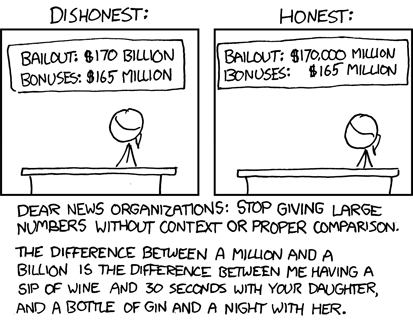
Randall Munroe nails the AIG furor


I hadn't thought about it, but he's right; whatever we know rationally, when we stop to think about it, the actual digits we see in the two numbers are very similar, and that has a subliminal effect.

Also (and for those who might be skeptical about this), the mouseover on this one is classic:  "And 0.002 dollars will NEVER equal 0.002 cents."

Thursday, March 19, 2009

Why America needs Sarah Palin, cont'd.

Other Republican governors, such as Louisiana's Bobby Jindal and South Carolina's Mark Sanford, raised concerns about the "stimulus" bill just as Gov. Palin did, and announced their intention not to take all the money alloted to their states; and when the time came, they followed through on their promise not to take all the money, though they did take most of it.  Gov. Palin, on the other hand, told the feds, "Sorry, but we only need about half of that."

Seriously.

Protesting federal "strings," attached to stimulus funding, Gov. Sarah Palin said she doesn't want nearly half the estimated $930 million Alaska is eligible for.

"Will we chart our own course, or will Washington (D.C.) engineer it for us?" Palin said.

She expected to file an appropriations bill this afternoon accepting about $251.5 million in stimulus funds, coupled with allocations of $262.6 million already requested for transportation and aviation projects for a total state take of about $514.1 million. . . .

The Anchorage Daily News had this quote from the governor explaining her reasoning:

We are not requesting funds intended to just grow government. We are not requesting more money for normal day to day operations of government as part of this economic stimulus package. In essence we say no to operating funds for more positions in government.

The written statement released by the governor's office contains a pretty pointed critique of the "stimulus" bill and the reasoning behind it.

Governor Sarah Palin submitted her federal economic stimulus appropriation bill to legislators today to provide jobs and needed infrastructure improvements in Alaska under the American Recovery & Reinvestment Act (ARRA). Governor Palin is accepting just 55 percent of the available stimulus funds, all for capital projects. This amount includes the funds the state accepted last month for Department of Transportation projects.

"We will request federal stimulus funds for capital projects that will create new jobs and expand the economy," Governor Palin said. "We won't be bound by federal strings in exchange for dollars, nor will we dig ourselves a deeper hole in two years when these federal funds are gone. For instance, in order to accept what look like attractive energy funds, our local communities would be required to adopt uniform building codes. Government would then be required to police those codes. These types of funds are not sensible for Alaska."

The legislation does not include funding requests for government operating programs. . . .

"The law requires me to certify that the requests I forward for legislative approval will meet the requirements of the ARRA to create jobs and promote economic growth," Governor Palin said. "Legitimately, I can only certify capital projects that are job-ready. Alaska has seen unprecedented increases in the level of state funding for education because that is our priority. I don't want to automatically increase federal funding for education program growth, such as the National Endowment for the Arts, at a time when Alaska can't afford to sustain that increase."

"Simply expanding state government under this federal stimulus package creates an unrealistic expectation that the state will continue these programs when the federal funds are no longer available,” said Governor Palin. "Our nation is already over $11 trillion in debt; we can't keep digging this hole." . . .

"Our desire is to foster a discussion about what is true stimulus and what is just more federal interference in Alaskans' lives through the growth of government," Governor Palin said. "We think stimulus items devoted to government agency growth and program expansion ought to be examined in light of the funding needs already being addressed with our pending budget requests." . . .

"We need to ensure that these stimulus dollars are used for job opportunities for Alaskans, while preserving the regular operating spending decisions through the normal budget process," Governor Palin said.

Here's video of her press conference:


For those who may have forgotten, since it's been a while:  that's what conservative government looks like.

Update:  OK, there was another 14% of the money, allotted for Medicaid funding, which the state had already accepted; Gov. Palin's actually only proposing to reject 31% of the "stimulus" money.  The point holds.

The stubborn faithfulness of God

“The former things I declared of old; 
they went out from my mouth, and I announced them;
then suddenly I did them, and they came to pass.
Because I know that you are obstinate,
and your neck is an iron sinew and your forehead brass,
I declared them to you from of old, before they came to pass I announced them to you,
lest you should say, ‘My idol did them,
my carved image and my metal image commanded them.’

“You have heard; now see all this; and will you not declare it?
From this time forth I announce to you new things, 
hidden things that you have not known.
They are created now, not long ago;
before today you have never heard of them, lest you should say, ‘Behold, I knew them.’
You have never heard, you have never known, from of old your ear has not been opened.
For I knew that you would surely deal treacherously, 
and that from before birth you were called a rebel.

“For my name's sake I defer my anger,
for the sake of my praise I restrain it for you,
that I may not cut you off.
Behold, I have refined you, but not as silver;
I have tried you in the furnace of affliction.
For my own sake, for my own sake, I do it, 
for how should my name be profaned?
My glory I will not give to another.

—Isaiah 48:3-11 (ESV)

Israel had a long history of faithlessness to God—it’s what got them taken off into exile—but despite all that, he refused to give up on them. He reminds his people of the many times in the past that he had told them what would happen, and then brought about what he predicted; and look at verses 4-5. Why did he do this? “Because I knew how stubborn you are”! If God had simply done good things for them, would they have given him the credit? No, they would have given the credit as they saw fit, to the idols they themselves had made. God told them what he was going to do before he did it so that they would know who was truly responsible. They could always refuse to admit that knowledge—and sometimes they did; that’s why God has to say, “You’ve heard these things. Won’t you admit them?”—but they would have no excuse and no justification for their refusal.

This is also why he says, “From now on I will tell you of new things, of hidden things unknown to you. They are created now, not long ago; you have not heard of them before today, and so you cannot say, ‘Yes, I knew of them.’” This is the reason, or part of the reason, why God chose to use Cyrus to return the Jews to Israel: because it was a new thing, something he hadn’t done before, and that his people couldn’t and wouldn’t have predicted. It also gave him the opportunity to predict—by name—the appearance and success of someone from a pagan nation, someone who didn’t worship him or even know of his existence, and thus to demonstrate in a new way that he truly is the God of the whole world, the LORD Almighty, not just the God of Israel.

And he does all this despite Israel’s willful refusal to listen. “See,” he says, “I have refined you, but not as silver.” In Malachi 3, the prophet says that the Lord will sit as a refiner of silver; this is significant because the refiner of silver burns away all the dross, all the impurities, until only the silver is left, and in its absolute purity he can see his face reflected in it. Here, the Lord is giving up on that, at least where Israel is concerned. Their time in exile hasn’t brought them around to repentance, it hasn’t brought them to a spirit of true faithfulness—but there’s no point in leaving them in the fire; there’s no point in refining them further, because it wouldn’t accomplish anything. To try to refine them as silver would leave nothing of them at all, because everything would burn away, and so God declares, “I delay my wrath . . . I hold it back from you,” simply for the sake of his own reputation and his own praise.

There’s a real note of grief and sorrow in this chapter. After all God has done for his people and all the promises he’s made them, and even after the promise to bring them back from their exile in Babylon, they remain obstinate, unwilling to open their hearts, unwilling to seek him first; and so here, it seems to me, we have God conceding that that isn’t going to change. Their neck remains unbending iron, their forehead remains obdurate bronze, and their ears remain insistently closed, refusing to hear what God would tell them; and so he says, “I am the LORD your God, who teaches you what is best for you, who directs you in the way you should go”—the very thing his people refused to believe, because they thought they had a better idea what was best for them, and which way they should go.

They thought they knew best, and they refused to accept his correction, and so all God can do is cry out, “If only you had paid attention to my commands, your peace would have been like a river, your righteousness like the waves of the sea. Your descendants would have been like the sand, your children like its numberless grains; their name would never be cut off nor destroyed from before me.” If only . . . if only. “Jerusalem, Jerusalem,” Jesus cried out, “how often I have longed to gather your children together as a hen gathers her chicks under her wings; but you were not willing. Look, your house is left to you desolate, and you will not see me again until you say, ‘Blessed is he who comes in the name of the Lord.’”

And yet, despite it all, God remains faithful. He delivers his people from Babylon, bringing them back to Jerusalem, even though it won’t be the deliverance he desires, even though he knows it won’t bring them his peace because their hearts remain wicked; he delivers them because he has promised, because his nature requires it, because who he is is to be faithful and to keep his word. He remains faithful and delivers his people because even though they don’t believe in him, even though they don’t listen to him, even though they don’t trust him, yet he is who he says he is; he is faithful even when his people don’t expect him to be, don’t trust him to be, maybe at some level don’t want him to be, and even when they will never respond to his faithfulness with faithfulness of their own.

You cannot outrun God, and you cannot go beyond his faithfulness; no matter how far you may go in your sin, repentance isn’t about turning around and trying to find your way back to God, because he’s already there—repentance is simply about accepting being found. No matter what may come and how far you may push it, you cannot go beyond the faithfulness of God until you’re dead—and maybe, somehow, not even then. You just can’t. If you don’t believe that, just look at Jesus; just look at how far God has already gone, and think about it for a while.

So what does God ask from us? To trust him. To trust in his faithfulness, and to live out of that trust. Being faithful to God isn’t a matter of doing certain things, or living in a certain way; that’s what results from faithfulness. The faithfulness God desires is a matter of trusting him enough that we live as he calls us to live, not out of duty, but because we really believe that he teaches us what’s best for us, and because we trust him that he truly is directing us in the way in which we should go.

(Excerpted, edited, from “The Stubborn Faithfulness of God”)

The latest in SheepGI graphics

This must be seen to be believed . . . and even then, it's hard.


HT:  The Anchoress

Notes on the AIG story

Make This One Go Viral: Obama’s Stimulus Bill Explicitly Grants AIG the Legal Right to Hand Out Unlimited Bonuses (Update)

This amendment provides an exception for contractually obligated bonuses agreed on before Feb. 11, 2009, which exempts the very AIG bonuses Obama is condemning every single chance he gets. The amendment is in the final version and is law.

And who’s responsible for that language being there? Sen. Christopher Dodd (D-CT):


Dodd lied. He spent a full day lying to the American people, and now he’s trying to shift blame to others. He and his pal Barney Frank want to publicly name the people who received the bonuses authorized by Congress and this administration in an attempt to deflect blame for their own actions.

And whose idea was it to add the language on the bonuses? The Obama administration’s.

Both Dodd and a Treasury Department official who asked not to be named told CNN the administration pushed for the language because they were afraid that the government would face numerous lawsuits without it.

Dodd told CNN’s Dana Bash and Wolf Blitzer that Obama administration officials pushed for the language to an amendment designed to limit bonuses and "golden parachutes" at those companies."The administration had expressed reservations," Dodd said. "They asked for modifications. The alternative was losing the amendment entirely."

(Incidentally, speaking of bonuses from AIG, you know who else got over $100,000 from them? Barack Obama.) Dodd clearly bears considerable responsibility for this mess; but the president who proclaimed "a new era of responsibility" wants him to take all of it, in order to protect Tim Geithner and Lawrence Summers (and possibly himself). I can’t think that's going to go over well with the Congressional Democrats.

As unpopular as it may be to say, though, hammering AIG and the folks who took the bonuses is unwise.  There was actually some reason for these bonuses, for one thing—it may not have been sufficient, but this wasn't just an attempt to fleece the taxpayer—and for another, the downside here is much greater than the upside, as Ruth Marcus points out:

In the short run, hammering the AIG employees to give back their bonuses risks costing the government more than honoring the contracts would. The worst malefactors at AIG are gone. The new top management isn't taking bonuses. Those in the bonus pool are making sums that for most of us would be astronomical but that are significantly less than what they used to make. Driving away the very people who understand how to fix this complicated mess may make everyone else feel better, but it isn’t particularly cost-effective.

In the longer term, having the government void existing contracts, directly or indirectly, as with the suggestions of a punitive tax on such bonuses, will make enterprises less likely to enter into arrangements with the government—even when that is in the national interest. This is similarly counterproductive.

Remember, the contracts were negotiated long before the government put a cent into AIG. "The plan was implemented because there was a significant risk of departures among employees at [the company]," AIG wrote in a paper explaining the plan, "and given the $2.7 trillion of derivative positions at [the company] at that time, retention incentives appeared to be in the best interest of all of AIG's stakeholders." . . .

"That was then and this is now" is not a valid legal principle. "We are a country of law," Obama economic adviser Lawrence Summers said Sunday. "There are contracts. The government cannot just abrogate contracts." He was right. . . .

The administration argues that anger over the bonuses, among the public and members of Congress, was at such a level that the president needed to say something to show that he understood the fury. Perhaps, but there is a countervailing risk in stoking this populist rage—especially if the administration needs to come back to Congress for more money for the banks.

Once the pitchforks are out, it’s awfully hard to convince the mob to put them down.

Truth to tell, though, I think Marcus has misunderstood the reason for President Obama’s faux-populist outrage; I think this is a deliberate attempt at misdirection.  After all, firing up "the mob" may be risky, but it's the easiest way to manipulate a lot of people at once.  This whole scenario reminds me of the many mysteries I’ve read/watched in which the person who "discovered the body" actually turns out to be the killer.  What better way to keep people from thinking that you’re the one who did the deed than to be the guy who rushes out into the street shouting "Murder!"—it's classic sleight-of-hand.  Blow outrage at the man who only took over after the disaster happened (and who at least has a plan to restructure AIG and repay the Treasury, which is more than we can say of anyone else) and at the big shots getting the big bonuses, you get folks made at all those "rich Republicans" (even if most of them actually voted Obama) and (you hope) keep them from looking for evidence of Democratic complicity.

That complicity, by the way, goes beyond the White House or the Senate.  Most people remember, vaguely, that New Mexico Governor Bill Richardson withdrew his nomination to Commerce because he was under investigation in a pay-for-play scandal, but most folks don’t know anything about the nuts and bolts of that investigation, or about CDR Financial Products, the company on which it’s focused; unless you live in a county that’s staring at bankruptcy because of CDR's "black box" deals, you probably don’t know that this scandal goes a long way beyond New Mexico.  

In particular, you probably aren’t aware that this scandal is connected to the whole mess with AIG, or that Democratic politicians are tied into it at all levels of government.  The blog The 46 has been tracking this story for a while now; start with the post linked above and follow it out—the whole mess is complicated and will take some real focused attention if you aren’t a financial whiz, but it’s well worth your time.  When you understand the ways in which CDR has been colluding with local companies and politicians to use municipal bond issues to line their own pockets at taxpayer expense, it will blow your mind.

Finally, Larry Kudlow offers a note of hope in the midst of everything.  He’s ticked over the way the government has mismanaged the takeover of AIG, calling it a "fiasco" and a "complete farce," and concluding, "The government shouldn’t run anything, because it cannot run anything"; at the same time, though, he believes there’s reason for optimism:

This week’s decision by the Federal Accounting Standards Board (FASB) to allow cash-flow accounting rather than distressed last-trade mark-to-market accounting will go a long way toward solving the banking and toxic-asset problem.

Many experts believe mortgage-backed securities and other toxic assets are being serviced in a timely cash-flow manner for at least 70 cents on the dollar. This is so important. Under mark-to-market, many of these assets were written down to 20 cents on the dollar, destroying bank profits and capital. But now banks can value these assets in economic terms based on positive cash flows, rather than in distressed markets that have virtually no meaning.

Actually, when the FASB rules are adopted in the next few weeks, it will be interesting to see if a pro forma re-estimate of the last year reveals that banks have been far more profitable and have much more capital than this crazy mark-to-market accounting would have us believe.

Sharp-eyed banking analyst Dick Bove has argued that most bank losses have been non-cash—i.e., mark-to-market write-downs. Take those fictitious write-downs away and you are left with a much healthier banking picture. This is huge in terms of solving the credit crisis.

This follows on a piece he wrote last Friday in which he wrote,

Out of the blue, bank stocks mounted an impressive rally this week, jumping nearly 40 percent on the S&P financial list. One after another, big-bank CEOs like Vikram Pandit of Citi, Ken Lewis of BofA, and Jamie Dimon of JPMorgan are telling investors they will turn a handsome profit in the first quarter, their best money gain since 2007. This is big news. And it triggered the first weekly stock gain for the Obama administration.

But this anticipated-profits turnaround doesn’t seem to have anything to do with the TARP. It’s about something called the Treasury yield curve—a medical diagnostic chart for banks and the economy.

When the Fed loosens money, and short-term rates are pulled well below long rates, banks profit enormously from the upward-sloping yield curve. This is principally because banks borrow short in order to lend long. If bankers can buy money for near zero cost, and loan it for 2, 3, or 4 percent, they’re in fat city. Their broker-dealer operations make money, as do all their lending divisions.

So the upward-sloped yield curve is the real bailout for the banking system.

Now, turn the clock back to 2006 and 2007. In those days the Treasury curve was upside down. Due to the Federal Reserve’s extremely tight credit policies, short-term rates moved well above long-term rates for an extended period, and that played a major role in producing the credit crunch. Since interest margins turned negative, the banks had to turn off the credit spigot, and all those exotic securities—like mortgage-backed bonds and various credit derivatives—could no longer be financed.

The Fed’s long-lived credit-tightening also wreaked havoc on home prices and was directly responsible for the recession that began in late 2007. At the time, Fed head Ben Bernanke said the inverted yield curve wouldn’t matter. Gosh was he wrong.

In other words, Kudlow’s arguing (and the evidence seems to be with him) that the credit crash was caused by federal over-management of the economy, and that now that that particular form of over-management has ceased, things are starting to recover.  He went on to argue in that column that "if somebody tells the banks they don’t have to sell these loans at distressed prices," which is what the FASB’s rule change noted above has done,

the banks will enjoy plenty of breathing room to reap the benefits of the upward-sloping yield curve.

Let the banks hold these investments over a long period, rather than force them to sell now. The economy will get better, as will housing and other impaired assets.

If his analysis is correct—and the evidence seems to be with him on this—then the recovery has already begun; we simply need to let it take the time it’s going to take.  The one thing that seems to be clear is that further government attempts to manage the recovery will only make matters worse, since the government can’t manage its way out of a paper bag.  That’s not a shot at Democrats, either, as it was no different when Republicans are running the show—the economy is simply too big to be managed.  All you can really do is try to keep the rules as fair as possible and try to manage the inputs so as not to distort the market (since distortions create greater opportunity for bubbles and subsequent crashes).  Here’s hoping our current government can at least resist the temptation to make matters worse.

Wednesday, March 18, 2009

The gospel-driven church and politicized faith

Hear this, O house of Jacob, who are called by the name of Israel,
and who came from the waters of Judah,
who swear by the name of the Lord and confess the God of Israel,
but not in truth or right.
For they call themselves after the holy city, and stay themselves on the God of Israel;
the Lord of hosts is his name.

—Isaiah 48:1-2 (ESV)

These descriptions mark the Israelites as God’s people: he’s the one who chose them, he’s the one who named them, he’s the deity with whom their nation is identified and in whose name they take their oaths. He is, we might say, the God of their civil religion, in the same way as our public officials and witnesses in our courts swear on the Bible and end their oaths of office with the words, “so help me God.” But just as we have a lot of people who say those words and mean nothing by them, so Israel’s outward participation in the rituals of their faith said little for the reality of their beliefs; and so God says, “Though you call upon me and take oaths in my name, it’s neither in truth nor in righteousness.” Their faith, he says, is false, because it’s not based in real knowledge of him nor does it produce any real willingness to live as he wants them to live.

This is a pretty strong charge. In contemporary terms, he’s saying that the faith of the nation as a whole—not of everyone in it, of course, but of the nation as a whole—is nominal. It’s a matter of outward show with no inward reality, of religious exercise without any real faith. This wasn’t an issue which was unique to them, of course; if we want to be honest, looking around at the church in this country, we’d have to wonder if God would say much the same sort of thing to us, if Isaiah were alive in our day. It seems to me that Michael Spencer would be one who would agree; though he doesn’t put it in the terms Isaiah uses, his indictment of American evangelicalism boils down to pretty much the same thing: on the whole, we invoke the name of the God of Israel, but not in truth or righteousness.

Now, whatever disagreements I have with Spencer’s specific predictions, I think he’s identified a real problem in much of the American church; I think we need to realize that Isaiah’s words to Israel hit a lot closer to home than we might like to think. It seems to me that verse 2 offers us something of a clue as to why. At first glance, this might seem like an odd follow-up to verse 1; but consider the description of the people of Israel here: “you who call yourselves citizens of the holy city and rely on the God of Israel.” Here as in verse 1, God is identified as the God of Israel; and what does the prophet say in response: “The LORD Almighty is his name.”

That’s subtle, but I think it’s a rebuke to the parochialism of Israel. Their concern is only for themselves, and they see their God as just “an amiable local deity who exists to keep track of Israel’s interests,” as John Oswalt puts it. Instead of seeing themselves as a nation formed by the only God of all time and space for the purpose of bringing all the nations to the worship of that God, they see themselves as a nation like any other nation, with a god like any other nation, out for their own best interests like any other nation; and since they’re a small nation, they must have a small god, and thus they keep running after the gods of the bigger, more powerful nations in hopes of improving their geopolitical standing. 

What God wants them to see is that the nation ought to be only of secondary importance; he’s promised to return them to their homeland, yes, but not because their political independence or political power are of any significance whatsoever. It is, rather, for his own sake, for the sake of his reputation and his glory. What matters is God’s plan for the world, and their faithfulness to serve him by doing their part in it.

The Israelites didn’t get that, and didn’t particularly want to; and it seems to me that many American evangelicals, whatever they might say about what they believe, functionally don’t get this one either.  Spencer’s right that the evangelical involvement in American politics has gone wrong in some important ways, and I certainly agree that “believing in a cause more than a faith” is a bad thing; but while that has in some ways and in some cases been the effect of evangelical political involvement, I think the real error goes deeper.

The real problem here, I think, is that we’ve made our nation too important in our worldview and theology—to the point of idolatry, in many cases.  Many of us who consider ourselves Bible-believing Christians have the American flag in our sanctuaries and sing hymns to our country on patriotic holidays, and we never even stop to ask whether doing so honors and pleases God.  There may be a prima facie case for including such things in our Sunday worship—I don’t know, because I’ve never heard anyone try to make it.  It’s simply assumed.

I’m all for patriotism, in its place; I grew up in a Navy family and I’m proud of the fact, and one of the reasons I don’t support the Democratic Party is because I don’t believe they give this nation enough credit.  I don’t accuse Democrats of being unpatriotic, but I do think many of them are deficient in that respect.  But if I’m all for patriotism in its place, I firmly believe that’s second place, behind our allegiance to the kingdom of God; and I think it’s all too easy to mix them up, just as the people of Israel did.

This sort of mindset was evident, for example, in the predictions of many self-proclaimed prophets last fall that John McCain would defeat Barack Obama in November.  Why?  Because Sen. McCain’s policies were God’s policies and God was on Sen. McCain’s side, because Sen. McCain would be a better President for America and God’s on about blessing this country.  They missed the fact, as too many Christians in this country (and not just conservatives, either) miss the fact, that America is not God’s chosen nation.  The Puritan colonists of New England may have been trying to found a city on a hill that would lead the English church to reformation, but for all the many ways in which our presidents have appropriated such language to describe this country, and for all that many have agreed with de Tocqueville in describing America as “a nation with the soul of a church,” the USA is not the city on a hill that Jesus was talking about.  We are at best, in Abraham Lincoln’s words, God’s “almost-chosen people.”

To lose sight of this fact is to lose sight of the truth that we worship, not the God of America, but the Lord of the Universe and Creator of all time and space; it’s to come to see the Lord Almighty as functionally an amiable local deity who exists to keep track of America’s interests.  Granted, this doesn’t pose the same exact temptation as it did for Israel, since in our case, we are no small nation on the edges of power, but are rather one of the dominant powers of the earth; but it does skew our understanding of who God is and what he’s on about, and what we’re supposed to be on about.

When this happens, it results in the phenomenon that Spencer decries, not exactly because we’ve exchanged our faith for a cause, but rather because we’ve identified the kingdom of God in our minds and hearts with the nation of America.  It results in us coming to believe that we advance the kingdom of God in the ballot boxes, legislatures, courts, and executive offices of this nation, that our battle is in fact against flesh and blood and is to be fought with the weapons of flesh and blood; when that battle goes against us, the temptation is there to conclude (as I heard people conclude last November 5) that God has somehow failed and that his will has not been done.  Those sorts of reactions lead many outside the church to conclude that what American evangelicals really worship is our political agenda—a conclusion which should make us deeply uneasy.

None of this is to say that Christians shouldn’t be involved in politics, that the evangelical political agenda (broadly understood) is substantively wrong, that evangelicals should become liberals or retreat from politics, or anything else of that sort.  But whether the substance of our participation is wrong or not, the spirit of our participation has been wrong in all too many cases, because—whether consequently or merely concurrently—we’ve lost the gospel focus to our faith.  We’ve treated our faith as a this-worldly thing—whether it’s “God’s politics” or “your best life now,” it’s all the same mistake at the core—and ended up with a religion defined in this-worldly terms, as a matter of “do this” and “don’t do that” in which success can be quantified in this-worldly categories.  In a word, we’ve ended up back in legalism; whether that legalism is focused on “thou shalt not,” on going out and doing good with Jesus as your role model, or on voting the right way and being politically active for the right causes, in the end, is only a difference in style.  And whatever legalism might be, what it clearly isn’t is Christian.

Again, I do believe that there are things we should do, and things we shouldn’t do, and causes we should support, and votes which are honoring to God and others which aren’t.  But none of those things is central to what the church is supposed to be, and none of them should be what we’re primarily about; none of them should be driving the bus.  As Jared Wilson has been arguing at length for some time now, the church needs to be “cross-centered, grace-laden, Christ-focused [and] gospel-driven”; to be faithful to our calling, that must be the core of who we are and the purpose of everything we do.  That should determine every aspect of our lives, in fact—which, yes, means that we should do certain things and not do other things, and certainly should shape our voting and our political involvement as it shapes everything else we do.  But we should always be bringing everything back to the gospel, not to a list of do’s and dont’s, much less a political platform or agenda; that and nothing else should be the touchstone for our lives and our decision-making.

If our politics is secondary to and derivative of our faith, we’re doing it right.  If our faith is secondary to and derivative of our politics, we aren’t.

(The beginning of this post is excerpted from “The Stubborn Faithfulness of God”)
Congratulations to Michael Spencer

I’ve made a couple comments on Michael Spencer's Christian Science Monitor piece, both expressing some of my differences with his argument and mulling how we as Christians ought to respond to it, and I expect I'll have a few more things to say in relation to his essay; but one unalloyed positive thing to come out of this, which I hadn’t yet noted (and should have), is that this has dramatically expanded his audience beyond the following he’s built online as the Internet Monk and at Jesus-Shaped Spirituality.  As he writes,

[T]wo weeks ago, the phone rang and a young man in Boston asked to edit three of my pieces into an opinion piece on the op/ed of the Christian Science Monitor.
A week ago yesterday, he published it in print and on line.
Within 4 hours, it was on Drudge.
In the week since, the column has been everywhere in the media, and I have 12 interviews done or in process, with everyone from CNN to the Moody Network to a local Christian station.
Over 800 people posted comments or sent emails.

Two of them were literary agents.

One called today.

If this day ever came, I had two things I wanted. 1) I wanted to write about Jesus Shaped Spirituality and 2) I wanted someone to see my writing as marketable somewhere outside of the usual Christian market.

The first things I heard today were these two things. Both of them. Exactly.

This is wonderful news; it’s the blessing of God, not only for Michael Spencer, but for the whole people of God.  From things he’s posted, the iMonk has had a hard couple years; now, he’s in a position to say,

Perhaps the last two years were moving me somewhere; somewhere I couldn’t go otherwise. Maybe this was God’s long road to take me where he wanted me to go.

Now I have an opportunity. An opportunity I’ve dreamed of. An opportunity that has come to me completely from the grace of God.

What will happen next?

I just have to keep writing.

May God richly bless him as he does, for his sake and ours.

HT:  Bill Roberts

Tuesday, March 17, 2009

And also on this St. Patrick's Day

remember to pray for our Irish President, Barack O'Bama.

A good short sketch of the life of St. Patrick

can be found today on the American Spectator website, courtesy of one James M. Thunder, along with a more detailed piece by G. Tracy Mehan III called "The Solitude of St. Patrick."  I commend both to your reading, especially if you aren't familiar with the true life and accomplishments of this towering evangelist-bishop of the early church; if you are, they won't be news to you, but you ought to read them anyway, because St. Patrick is one of those people who's always worth spending time with.  And then go and read his Confession, which stands to this day, over 1500 years later, as one of the greatest Christian books ever written.  Here is deep wisdom, and a great love for God; here is a true saint, and a model for the church.

Parading your ignorance and calling it “reality”

or, The Irony of Ignorant Palin-Bashers Bashing Gov. Palin for Being Ignorant

As I noted yesterday, “echo-chamber types are once again pushing the canard that this is all because Sarah Palin doesn’t believe in teaching contraceptive use in schools”; today saw a particularly egregious example, courtesy(?) of Bloomberg’s Margaret Carlson, who smugly declares,

This isn’t an argument for abortion, but one for reality—drop abstinence only, make contraceptives available and consider adoption, relying on grandparents, or single parenting until the child herself grows up.

OK, so if we’re making a parade about “an argument for . . . reality,” let’s consider what the reality actually is here, shall we?  Unfortunately for Carlson, if we do that, she doesn’t come off very well.

First, she says, “drop abstinence only.”  One problem:

Abstinence-only education doesn’t actually exist. It’s a term used by critics of abstinence education rather than purveyors, who prefer, simply, abstinence education. The term “abstinence-only” attempts to create the perception that abstinence education is a narrow and unrealistic approach. While such loaded terms are to be expected of activists, the media usage of the term is regrettable.

In other words, Carlson’s beating a straw man, asking conservatives to drop something that we don't advocate; she’s busy feeling smugly superior to people who do not in fact exist.  Good for her ego, bad for her argument, and worse for her understanding of what’s actually going on (which might be a trade she's happy to take, for all I know).

Second, as Mollie Ziegler Hemingway also points out, the smugly superior types like Carlson not only don’t know what abstinence education is, they don’t understand what it’s about.

The liberal caricature of abstinence education is of school marms rapping the knuckles of teens and telling them—day after day—not to have sex. In fact, a review of curricula for abstinence education programs shows surprisingly little about sex—and a lot about building self-esteem, understanding risky behavior, finding responsible partners, and growing a family.

ReCapturing the Vision, one abstinence curriculum used for girls-only education, begins with a unit designed to help students see their bodies as beautiful and to accept themselves as they are. Other units teach them how to define their morals and values, resist negative influences, manage conflict and understand their emotions, and determine how to achieve personal, academic, professional, and financial goals. The final unit uses mock interviews, job searches, and résumé writing to help girls transition to adulthood.

In other words, abstinence education isn’t only, or even primarily, about preventing teen pregnancy. It is about learning life skills, encouraging the formation of families, and taking responsibility for your behavior, which helps explain the cultural chasm between its supporters and those who saw Bristol Palin and screamed “hypocrisy!”

Third, when Carlson says we should “make contraceptives available,” she might be surprised to know that Gov. Palin agrees with her.  This isn’t speculation, either, as the governor is already on the record on this subject—and not in the way that her ignorant detractors assume from their bigoted stereotypes:

In a widely quoted 2006 survey she answered during her gubernatorial campaign, Palin said she supported abstinence-until-marriage programs. But weeks later, she proclaimed herself “pro-contraception” and said condoms ought to be discussed in schools alongside abstinence.

“I’m pro-contraception, and I think kids who may not hear about it at home should hear about it in other avenues,” she said during a debate in Juneau. . . .

Palin spokeswoman Maria Comella said the governor stands by her 2006 statement, supporting sex education that covers both abstinence and contraception.

The irony of the whole thing is, that position put her at odds with both the GOP platform and her running mate, which is why the Los Angeles Times titled its story on this “Palin appears to disagree with McCain on sex education”; but when the MSM decided it was more politically advantageous to stereotype Gov. Palin and beat her for something she doesn’t actually believe than to use what she does believe to try to drive a wedge between her and her running mate, the truth was conveniently forgotten.

Fourth, the implicit assumption that since Bristol Palin got pregnant, she must have been taught about sex in a non-liberal-approved fashion is just that:  an assumption, and an unwarranted one, at that, as Hemingway points out.

No one bothered to find out what type of sex education, if any, Bristol had received and assumed her mother—despite on-the-record comments supportive of teaching both abstinence and contraception—opposed sex education.

(As Hemingway further notes, even if the assumption were correct, “it is empirically laughable to judge the effectiveness or utility of abstinence education based on one teen pregnancy”; but folks like Carlson who are pushing an agenda don’t care about inconvenient truths like that.)

Finally, Carlson asserts that people should “consider adoption, relying on grandparents, or single parenting” rather than allowing/encouraging teens to marry.  Her sweeping unfounded assumption here is almost too grandiose and simplistic to answer; this doesn’t qualify as an “argument for reality” because it shows no effort to understand what the reality is.  To wit, who says people don’t do all those things?  No evidence I’ve seen, certainly; and in the case of the Palin family, it’s been crystal-clear ever since the news broke that family support, not just from grandparents but also from great-grandparents and others, was very much a part of the plan for the care and support of little Tripp and his parents.  (As for her suggestion that single parenting is a better option than marriage, I can only conclude two things:  one, Margaret Carlson has never studied the issue in any meaningful way; and two, she probably wasn’t a single mother as a teen.)

Taken all in all, I can only conclude that Carlson’s column on the Palins would be a good deal better if she actually had a clue what she’s talking about.  It’s a pity that the media we have now don’t care enough about such things to enforce them.

Monday, March 16, 2009

Sarah Palin through the spyglass

My father-in-law is a sharp and perceptive chap, with a remarkable ability to think beyond what the conventional wisdom says is possible.  I'll sometimes joke about myself that one of the biggest things I have to offer is my crack-brained ideas—I just need someone else who can tell me which ones are worth keeping once cracked; my father-in-law is like that too, except that he's less inhibited than I am.  He started in February of last year trying to convince me that the first-term governor of Alaska was the best choice for #2 on the Republican ticket; by June, with John McCain the clear nominee for the top slot, he had me convinced.  Since then, my support for Gov. Palin has only increased.  Here are, I think, the most important posts I've put up about the GOP's Great Northern Hope (updated through 5/20/09):

Sarah Palin for VP
The post that started it all

The “I Am Sarah Palin” vote is mobilizing
For all my arguments for Gov. Palin on the ticket, this was one I didn't see coming

Disappointment is no argument against Gov. Palin
Defending her (and her daughter) against conservative complainers

Palin rumors and Palin facts
Debunking the lies (and there have been many)

British Palin envy
What some Brits realized that most Americans didn't

Positive feminist perspectives on Sarah Palin
Because those who were willing to see her for who she is were impressed, even as they disagree with her positions

The speech they wouldn't let Sarah Palin give
is a perspective on Iran that the current administration could use

Whither Sarah Palin?
My $0.02 on the tack she should take for the next few years

Camille Paglia on Sarah Palin
How to admire someone with whom you believe almost nothing in common

Why America needs Sarah Palin
Her 2009 State of the State address is a model of conservative governing philosophy

. . . and Sarah Palin's biography matters, too
This links to an excellent biographical sketch of Gov. Palin's life and its significance for her as a politician and executive

The real meaning of the evangelical response to Bristol Palin
The Palin family as microcosm

Parading your ignorance and calling it “reality”
Correcting the misrepresentation of Gov. Palin's position on sex education.

We should have seen Sarah Palin coming
On why Gov. Palin is the candidate the Republican base has been looking for.

Franklin Graham likes Sarah Palin's coattails
Considering the significance of Samaritan's Purse highlighting Gov. Palin in its fundraising.

Political machines hate reformers
“That, in a nutshell, is the meaning of most of the news stories about Sarah Palin in recent months.”

Mitt Romney, the Beltway GOP, and the meaning of Evansville
On the real significance of Gov. Palin's appearance at the Vandenburgh County Right to Life banquet.

Gov. Palin and the abortion shift
From the time of her appearance (and Trig's!) on the national scene, support for abortion has declined significantly.  Hmmm . . .

The real meaning of the evangelical response to Bristol Palin

I really didn't want to write about the news of Bristol Palin's broken engagement, which I found saddening and disheartening.  In analyzing it, I had two main reactions.  First, that this story is basically about a teenage girl who's done some unwise things and made some bad decisions, both of which are pretty common at that age.  (I was going to write, "that age at which we tend to think we're much wiser and more mature than we really are"—but as far as I can tell, that describes every age.)  If you're honest, you'd have to admit that you did some really dumb things at 17.  For my part, at that age, I didn't do much of anything besides go to school, go home, read, and go to church on Sundays—I didn't hardly have the opportunity to do dumb stuff—but I did.  "Teenage girl does something foolish, pays consequences" is an afterschool special or a Very Special Episode; as "news," it's strictly dog-bites-man.  The only thing that makes this "newsworthy" is who Bristol Palin's mother is.

Second, am I the only one who read the piece in the AP and thought, "Wow, Levi Johnston's sister is a real witch"?  It might not be fair, but I definitely got the vibe that she was jealous of Bristol, glad that Levi dumped her (since it also read to me like he was the dumper and she was the dumpee), and gleeful at the opportunity to shred her reputation in the national media.

As far as national media reaction, though, I really didn't want to go there.  As long as it was just confirmed PDS cases like Bonnie Erbe, I could let it slide; after all, the folks at National Review dispatched her quite handily.  (For those who might not know, PDS stands for "Palin Derangement Syndrome," the official diagnosis for anyone whose rational processes go into violent spasms any time the word "Palin" is mentioned or a moose becomes visible on the horizon; for some reason the alternative name "Palin Madness Syndrome" never caught on.)  I didn't see the benefit in giving Ms. Erbe's commentary the unearned dignity of being treated seriously.  Granted, the fact that she and other echo-chamber types are once again pushing the canard that this is all because Sarah Palin doesn't believe in teaching contraceptive use in schools (when in fact she explicitly supports doing so, though she does believe that sex education should encourage abstinence) deserved a response—but if I'd posted about that by itself, as I've been meaning to do, I could and would have done so perfectly easily without mentioning Bristol Palin.

And then I ran across Jon Swift's post, and I couldn't let that one pass.

Swift, a self-described "reasonable conservative," asks the question, "Why is Bristol Palin different from Murphy Brown?" and comes up with the conclusion, "She is different because she is a conservative"—a conclusion which he then proceeds to argue and extend at tedious and tendentious length.

His argument, to put it politely, is full of holes and rests on a number of unexamined assumptions; he gives a few examples of cases where conservative commentators had non-identical reactions to superficially similar situations and then concludes (without further evidence) that this is because of the political views of the people in question.  (Since one of his examples rests on the assumption that "Mary Cheney is a good conservative woman who will no doubt teach her children that they shouldn't become lesbians like their mother," this is particularly dubious.)  He then launches into what he apparently considers to be biting satire on Christian conservatives, writing,

We should have the courage of our convictions and not play the liberal game of moral equivalency. Instead of trying to explain away Bristol's pregnancy we should be defending it, holding her up as an example of the difference between liberal teenage unwed mothers and conservative teenage unwed mothers. Because just as it is true that, as Richard Nixon once said, "When the President does it, that means it is not illegal." when a good Christian conservative has a child out of wedlock, that means it's not immoral.

The truth of the matter is, even if one concedes that he's caught Kathryn Jean Lopez and Lisa Schiffren in the hypocrisy of which he accuses them—which I do not grant, but for the sake of argument—that doesn't prove anything.  It doesn't prove, first, that their hypocrisy is ideological at its root, nor second, that they would be representative of most conservatives in that respect.

The first is, contra Swift's evident assumption, something which does in fact have to be proven, since political persuasion is not the only difference between, say, Bristol Palin and Rep. Loretta Sanchez, and he doesn't bother to examine Lopez' and Schiffren's arguments to see what they're actually saying—he simply summarizes their positions and moves on to the ad hominem part.  The second rests on yet another assumption on Swift's part, that evangelical attitudes toward teen pregnancy and unwed motherhood are still as hostile as old stereotypes make them out to be—and here's where his argument fails altogether, because that's simply no longer the case.

I'm reluctant to give props to David Frum, who looks more like a giant wooden horse every time I see his byline, but he did a much better job than Swift on this issue in an article he wrote six months ago for Canada's National Post.  He opened his piece in a manner Swift would no doubt approve—"Whoever imagined that we would see a Republican convention rapturously applaud an unwed teen mother?"—but then went on to actually think about what that really meant, and what it really tells us:

That moment confirmed a dramatic evolution in American politics: the transformation of the pro-life movement from an unambiguously conservative force into something more complex. . . .

The pro-life movement has come to terms with the sexual revolution. So long as unwed parenthood is considered disgraceful, many unwed mothers will choose abortion to escape disgrace. And so, step by step, the pro-life movement has evolved to an accepting—even welcoming—attitude toward pregnancy outside marriage.

As I wrote about Frum's article at the time, though I think "welcoming" is an overstatement,

Frum has captured and crystallized something of which I was aware—in my own attitudes and approach to ministry, no less than in the lives of others—but which I hadn't consciously thought about. Put simply, when pro-life concerns cross with the concern for other issues, the tie goes to the baby.

The truth is, Frum is (if you'll excuse the pun) dead right on this subject.  Sure, time was that conservative Christians in this country stigmatized teen pregnancy and disapproved of it as hard as we could; and then folks started pointing out that we weren't really discouraging teenagers from getting pregnant—all we were doing was driving them into the ungentle hands of the abortion industry.  Collectively, we took a look at ourselves and realized that the critics were right; and over time, we by and large decided that we could live with teenage pregnancy and teen single motherhood—just don't kill the baby.

That's the message on which most evangelicals in America have settled, when it comes to kids like Bristol Palin:  just don't kill the baby, and we'll do what we can to support you and help you out.  Why else have we started crisis pregnancy centers all over the place?  We didn't have a utopian choice here, we had the choice of two evils; we stared it dead in the face, thought about it for a while, and picked the lesser one.  This is the bargain we made, and I believe it's done more to reduce the abortion rate in this country than any government policy, even as it's boosted the rate of illegitimacy.  Frum quotes the statistics:

As the stigma attached to unwed motherhood has diminished, the United States has seen both a huge increase in the proportion of babies born out of wedlock—now reaching almost 37%—and a striking decline in the incidence of abortions. 

In 1981, 29.3 abortions were carried out for every 1,000 women of childbearing age in the United States. By 2005, that rate had tumbled to 19.1 per 1,000 women.

Now, it seems to me likely that some of those young women wouldn't have gotten pregnant at all if there were still the old stigma attached to unwed motherhood and illegitimacy; it also seems to me likely that for far more of them, that stigma wouldn't have been enough to keep them from having sex, but only to send them running to the nearest abortionist to keep anyone from finding out they'd gotten pregnant.  I can't prove that scientifically, to be sure, but that's what my experience suggests to me, and many of my colleagues in ministry would say the same.

I don't remember exactly how many weddings I've done (it's not a huge number), but I remember how many couples I've married who were virgins on their wedding night:  one.  Is this a good thing?  No.  Is it reality?  Yes.  Will it be changing any time soon?  No.  And if we're going to make any headway against it, is it going to be through a return to older tactics?  Will we accomplish anything by trying to scare teens away from sex and making examples of girls who get pregnant?  No.  No, we're not—it isn't going to happen.

Our culture is sex-saturated, we're flooded with erotic stimuli, and there's a powerful cultural push toward sexual activity—combined, alas, with other trends that are pushing the average marriage age later and later—and we aren't going to be able to shovel our way out of this flood by making a negative case.  There is nothing to be gained by making a pariah and a target out of girls like Bristol Palin, and whatever you may think about evangelical Christians, we're smart enough to see that.  We need to keep working on rolling back this tide, but we aren't going to do it that way; we're working on other approaches (including the abstinence-education programs Gov. Palin has been unfairly derided for supporting), but they're going to take time.  And in the meantime, we have to live in this culture as it really is, not as we wish it were, and to do the best we can with what we have.

What's the difference between Bristol Palin and Murphy Brown?  Twenty years.  Twenty years' bitter experience of the law of unintended consequences, that's all.

Update:  Welcome to folks coming over from The Point and C4P—I hope you take the time to have a look around.  Those of you from C4P might be particularly interested in today's post responding specifically to Margaret Carlson.

Saturday, March 14, 2009

Channeling Dubya, yet again

This from VO at C4P:

In the closing days of his Administration, President Bush removed gray wolves in the Northern Rocky Mountains from the endangered species list.

Obama's Secretary of the Interior, Ken Salazar, has decided to support President Bush's position on the issue and leave the wolves off the list, prompting outrage from the eco-nuts in Obama's base.

How long before we see Ashley Judd attacking Obama in web ads?

UPDATE: Steve Altman in the comments points out an interesting development: Only two days after his much-publicized lifting of a federal funding ban on research involving human embryos (therefore causing Christopher Reeve to walk again), he has signed into law essentially the exact same ban as part of the Omnibus Spending Bill. So he's basically wasted everybody's time with a bunch of posturing while accomplishing precisely nothing for his base.

Speaking as a former Coloradan who remembers when Secretary Salazar was Colorado Attorney General Salazar, I'm not at all surprised by his action; he represents a Western sensibility on the environment, one that seeks to balance environmental concerns with the needs of people, not the views of the East Coast elite.  I don't always agree with his positions, to be sure, but I expected him to chart a balanced, thoughtful course at Interior, and so far, I've seen nothing to make me think otherwise.

As for the Obama administration's sleight of hand on ESCR, that's no vast surprise either; I wasn't aware that that language was a standard part of the national budget, but since the whole thing combines passing the buck to Congress with a symbolic action that produces no practical effect, two things which we've seen over and over again during the first two months of this administration, there's nothing startling here.

. . . and Sarah Palin's biography matters, too

R. A. Mansour has a long post up today called "Who Is Sarah Palin?"  It's a fine piece of work drawing on all the major widely-available sources—the biographies by Kaylene Johnson and Lorenzo Benet, John Ziegler's interview, Sally Jenkins' Washington Post profile, and others—and drawing, I think, some fine conclusions.  It's an excellent biographical sketch, and I commend it to your reading.  Even if you're already a strong supporter of Gov. Palin, it will likely add to your understanding of her; if all you know of her is what the MSM told you during the campaign, then I strongly encourage you to take the time to find out more about who she really is, as opposed to what it was politically advantageous for the Democratic Party PR machine to say about her.

Yes, Barack Obama's associations mattered

I know his apologists in the media and elsewhere didn't want people talking about Tony Rezko, the Rev. Dr. Jeremiah A. Wright III, Bill Ayers, Fr. Michael Pfleger, Rashad Khalidi, Nadhmi Auchi, James Johnson, and Franklin Raines; I remember many solemn asseverations that talking about these people was just a distraction from the real issues, and a cynical attempt on the part of Republicans to play politics to bring Sen. Obama down.

Except, it wasn't, because his associations did matter. Granted, the fact that Barack Obama did business with Tony Rezko doesn't necessarily mean he's crooked, nor does his friendship with Rashid Khalidi necessarily mean that he shares Khalidi's views on the Near East; these conclusions are not inevitable, but debatable. Even given that, however, the pattern of his associations told us some important things about his judgment of people—most importantly, that his judgment of people is quite poor, which should have led to the conclusion that his personnel judgment in staffing the Executive Branch was likely to be quite poor.

And so it has proven to be. Tim Geithner was approved for Treasury despite being exposed as a tax cheat because the Senate was convinced that he was the best person for the job; instead, his performance has been abysmal, he's a millstone around the president's neck, and Washington's thousand little knives are already out for him. Of course, it would help if the administration didn't keep losing nominees for the rest of the senior positions in the Treasury Department, and particularly for the #2 slot. Equally of course, tax problems haven't just been for Treasury appointees, since failure to pay taxes was one of the things (though not the worst) that forced Tom Daschle to withdraw his nomination, and have caused problems for other appointments as well, including White House Counsel Greg Craig.

Then there's Vivek Kundra.  Kundra was President Obama's choice as Chief Information Officer for the administration; now he's taking a leave of absence after the FBI raided his old office and arrested two people, including one of his former top aides, Yusuf Acar.  According to the Washington Post,

the conspiracy, which operated for at least a year, worked like this:

Acar approved work with a vendor, such as Bansal’s AITC, to arrange the purchase of goods such as software. The vendor ordered fewer items but billed the District for a larger amount. Bansal, Acar and others then split the proceeds, FBI officials said.

Acar also approved fraudulent time sheets for nonexistent employees, [FBI agent Andrew] Sekela wrote. Acar and the others split the proceeds paid by the D.C. government, Sekela alleged.

Authorities traced more than $200,000 in payments last year from Bansal’s firm to a private company, Circle Networks Inc. The firm is co-owned by Acar, even though he is prohibited from having an interest in any company doing business with the city, Sekela wrote. Circle Networks generated about $2.2 million in revenue through D.C. government contracts, the agent wrote.

As Ed Morrissey notes,

Kundra himself hasn’t been implicated in wrongdoing, but it does raise the question of exactly what Kundra did as the head of DC’s technology office. Acar worked as Kundra’s aide, and at best one can say that Acar managed to run this ring right under Kundra’s nose. Kundra had to approve, explicitly or tacitly, the payroll for the agency, which employed less than 300 people. Any competent chief executive of a firm that size would know how many employees worked for him and how much they cost; in fact, it would be one of the primary issues on their agenda. . . .

The best we can say about Vivek Kundra in this episode is that he’s incompetent as an executive.

And then there's the saga of Chas Freeman:  a paid apologist for the House of Sa'ud who's changed his views on the Near East and Middle East for the sake of the Sa'udi oil money in his pockets; a man with financial ties to the Chinese government who defended the Tiananmen Square massacre—or more accurately, argued that the Chinese didn't respond strongly enough to protestors.  Matt Welch of Reason examined Freeman's views and concluded,

This is the definition of clientitis; it exhibits not a "startling propensity to speak truth to power" but rather a startling propensity to lob bouquets at dictators.

As such, though Freeman's trying to blame his withdrawal on the Israel lobby, there were far broader concerns about his appointment, raised by Democrats such as Charles Schumer and Jonathan Chait as well as Republicans, than just the anti-Israel views he evolved during his years on the Sa'udi payroll.  Anyone willing to change his positions to suit foreign governments willing to pay him, whether liberal or conservative, is the wrong person to put in charge of writing the National Intelligence Estimates on which so much of our foreign policy is based.

These aren't the only problems with the administration's appointment process, either—we've also seen the appointment and unappointment of Anthony Zinni, dubious nominations at Labor and Energy, and a press secretary who's Scott McClellan redux and has done the administration no good coping with the blowback.  All in all, it's hard to argue with Billy Hollis' summary of the situation:


Friday, March 13, 2009

An economic Trojan horse

Michael Ledeen summarizes it this way:  "Obama told us he was going to use Congress to redistribute the wealth—explicitly. And he thinks it's in the Constitution."

As a lolcat might put it:


"It" is the message Barack Obama delivered in a radio interview several years back, which is now embodied in his administration's economic policy.  The audio of that interview is below; as Wizbang blogger Steve Schippert summarized it last fall,

Obama laments in the interview that the Warren Supreme Court failed to reinterpret the Constitution to read into it what was not there: Redistribution of wealth for "political and economic justice in this society." . . .

For Obama, the redistribution of wealth is a civil right that the civil rights movement failed to attain. To Barack Obama, the redistribution of wealth is basic "political and economic justice," and one segment of society has the basic right to the money of other segments of society. He's very straight forward about this.

And while in the interview he did not think wealth redistribution could be affected through the courts, he was confident that it could be attained "legislatively."

President Obama's intellectual foundation on this issue is the work of two liberal French economists (if that isn't a redundancy) named Thomas Piketty and Emmanuel Saez.  Daniel Henninger describes their work and its influence on the Obama administration's economic strategy here:

Barack Obama has written two famous, widely read books of autobiography—"Dreams from My Father" and "The Audacity of Hope." Let me introduce his third, a book that will touch everyone's life: "A New Era of Responsibility: Renewing America's Promise. The President's Budget and Fiscal Preview" (Government Printing Office, 141 pages, $26; free on the Web). This is the U.S. budget for laymen, and it's a must read.

Turn immediately to page 11. There sits a chart called Figure 9. This is the Rosetta Stone to the presidential mind of Barack Obama. Memorize Figure 9, and you will never be confused. Not happy, perhaps, but not confused.


Bride of Rove summarizes Piketty-Saez thusly:

From what I gather they have been pulling together tax returns, tracking the rich and have determined that the rich have been getting richer faster than the poor have been getting unpoorer not so fast. Ok. I agree. It does take awhile to build that financial base and it tends to grow exponentially once you put that money to work. So if you have a lot, you make a lot proportionally. If you’ve got squat, you don’t tend to make much on nothing. You have to get a HS diploma, work hard, save and make good decisions. Sometimes you have to take a few risks. Eventually, if you keep at it, you will move up the scale faster and faster—except for now. But, yeah. There are poor people who never get ahead for a myriad of reasons and there are rich people who do better every year.

Piketty and Saez believe that this is not fair.

They are making, as Henninger puts it, "a moral argument for raising taxes on the rich."  As a consequence of President Obama's belief in that argument,

Mr. Obama made clear in the campaign his intention to raise taxes on this income class by letting the Bush tax cuts expire. What is becoming clearer as his presidency unfolds is that something deeper is underway here than merely using higher taxes to fund his policy goals in health, education and energy.

The "top 1%" isn't just going to pay for these policies. Many of them would assent to that. The rancorous language used to describe these taxpayers makes it clear that as a matter of public policy they will be made to "pay for" the fact of their wealth—no matter how many of them worked honestly and honorably to produce it. No Democratic president in 60 years has been this explicit.

The economy as most people understand it was a second-order concern of the stimulus strategy. The primary goal is a massive re-flowing of "wealth" from the top toward the bottom, to stop the moral failure they see in the budget's "Top One Percent of Earners" chart.

The White House says its goal is simple "fairness." That may be, as they understand fairness. But Figure 9 makes it clear that for the top earners, there will be blood. This presidency is going to be an act of retribution. In the words of the third book from Mr. Obama, "it is our duty to change it."

In other words, the first thing you need to understand about this administration's economic policy is that it's not really about the economy.  It's not about prosperity or economic growth or even helping the poor in absolute terms.  It's about reducing the gap between the poor and the rich.  And what's the fastest way to do that?  Make the rich poorer.

In my book, this sort of thing boils down to letting the sin of envy drive economic policy—and envy is a deadly sin for a reason.  It will probably accomplish its purpose; but it will probably also make everyone worse off in the process.  That's a high price to pay for seeing the proud humbled.  It may well be God's judgment on the proud of this nation, but even if so, I don't think that justifies those who bring it about.


Thursday, March 12, 2009

Credit to Patty Murray

Back when I was still officially a Washington resident, I had and took a couple opportunities to vote against Patty Murray for Senate, and if I had another chance I still wouldn’t vote for her; but I have to give her credit for this one.  As you may have seen (since it’s all over the Web; emphasis mine),

Veterans Affairs Secretary Eric Shinseki confirmed Tuesday that the Obama administration is considering a controversial plan to make veterans pay for treatment of service-related injuries with private insurance.

But the proposal would be “dead on arrival” if it’s sent to Congress, Sen. Patty Murray, D-Washington, said.

Murray used that blunt terminology when she told Shinseki that the idea would not be acceptable and would be rejected if formally proposed. Her remarks came during a hearing before the Senate Committee on Veterans Affairs about the 2010 budget. . . .

Currently, veterans’ private insurance is charged only when they receive health care from the VA for medical issues that are not related to service injuries, like getting the flu.

Charging for service-related injuries would violate “a sacred trust,” Veterans of Foreign Wars spokesman Joe Davis said. Davis said the move would risk private health care for veterans and their families by potentially maxing out benefits paying for costly war injury treatments.

That’s just disreputable—especially coming from the Secretary for Veterans’ Affairs, the guy who’s supposed to be the advocate for veterans in the administration.  Kudos to Sen. Murray and her colleagues for telling the administration to forget about it.

Update:  Jon Stewart absolutely trashed the administration over this (transcript here):


Wednesday, March 11, 2009

The importance of theories in conflict

Yesterday I quoted G. K. Chesterton, from one of his short stories, on the importance of the theories we hold about life, the universe, and everything; Chesterton, speaking there through the character Gabriel Gale, declares (correctly) that "most men are what their theories make them."  The economist and columnist Thomas Sowell understands this well, as you can see in this interview (video below) he gave Peter Robinson last fall for Robinson's program "Uncommon Knowledge."  As Sinistar of C4P sums it up,

In the interview . . . Sowell talks about his 1987 book A Conflict of Visions and the 2008 Presidential Election. . . .

Sowell states that "visions . . . are the implicit assumptions by which people operate" and that with regards to politics, these visions can be divided into two camps—a constrained view and unconstrained view. To put things another way, these visions are your "gut feeling" or views on how the world works, and they will color your views of how you approach many political and social issues.

The unconstrained vision suggests that human nature is changeable and that society's and the world's problems can be solved if rational plans are enacted. The constrained vision, on the other hand, banks on the concept that human nature is static and flawed, and that there are limitations to what can be done.

Of particular interest to those of us who are supporters of Sarah Palin,

[Dr. Sowell] briefly mentions the smears against Gov. Palin and how it relates to the concepts discussed in "A Conflict of Visions". . . . It is a very enlightening interview, and I encourage people to watch the whole thing. However, if you just want to hear Sowell briefly talk about the smears against Gov. Palin and how these conflicting visions relate, you can fast forward to the 30 minute mark. (I suggest starting 28 minutes in for the lead-in to the discussion.)