Tuesday, July 28, 2009

Obamacare prescription: the hair of the dog

Wikipedia: “Hair of the dog is a colloquial English expression predominantly used to refer to ingestion of alcohol as treatment for a hangover. It is occasionally used with respect to dealing with the after effects of use of other recreational drugs.”

As I’ve already said, I agree that our health care system in this country is dysfunctional—it’s inefficient, uncompetitive, too expensive, too unaccountable, and not at all transparent. Unfortunately, we have a bunch of politicians (to whom the whole thing is personally irrelevant since they have a superb taxpayer-funded health care plan which won’t be affected at all by anything they pass) whose desire is to solve these problems by feeding it the hair of the dog: making our healthcare system even more inefficient, uncompetitive, expensive, unaccountable, and opaque by adding a vast new tangle of government bureaucracy to the existing vast tangle of government bureaucracy that’s already gumming up the works. If you haven’t seen the organizational chart for this, it’s beyond belief:


If you’re wondering how that will function in practice, here’s a working model:


HT: Aaron Gardner

One of the great problems with a government-centric approach to “reforming” health care is almost theological, the same problem the early church had with the Pharisees (and the church has had throughout the centuries with those who would rather live by law than by grace): if you try to define and control anything through law, then you need a law for every bit of minutiae. This is is why government control is never the most efficient way to run anything, because it’s impossible to fine-tune the law well enough to make it truly efficient; it’s why government control stifles innovation, because all those laws lock innovation down. It’s also why, whatever the overarching principle of any law might be, the devil is always in the details.

As the above organizational chart shows, the details of the current Democratic health care bill are myriad, complicated, and confusing; and as a closer examination of some of those details shows, for this bill, they add up to a mighty big devil. Check out the Economic Policy Journal blog for a list that may very well curl your hair, including a massive expansion of government incursion into individual rights and economic freedom. Then consider that while one of the other big factors driving up the cost of healthcare is runaway litigation, this bill won’t do anything to rein that in—in fact, it will expand it. (HT: Mark Hemingway)

This is the kind of reasoning James Hirsen dubbed “Bidenomics” after our ever-quotable vice president told the AARP,

AARP knows and the people with me here today know, the president knows, and I know, that the status quo is simply not acceptable. It’s totally unacceptable. And it’s completely unsustainable. Even if we wanted to keep it the way we have it now. It can’t do it financially. We’re going to go bankrupt as a nation. Now, people when I say that look at me and say, ‘What are you talking about, Joe? You’re telling me we have to go spend money to keep from going bankrupt?’ The answer is yes, that's what I’m telling you.

It doesn’t really deserve its own name, though, because it’s not new to VP Biden at all; it’s the same old folk logic of the hair of the dog: to fix a problem, just pile on lots more of what created the problem to begin with. Apply it to drinkers, you get drunks, who then use it to justify becoming worse drunks. Now, a government drunk on tax money and a political party supported in large part by trial-lawyers drunk on lawsuit money are using it to try to justify getting even drunker. We need to tell them to sober up.

Monday, July 27, 2009

Perhaps too much credit?

The other day, I tipped the hat to Barack Obama for his gracious response to Cambridge, MA police officer Jim Crowley. At the time, I hadn’t really thought about the fact that his motivation for doing so might be purely political—namely, that he might have significant political reasons for wanting the flap over his response to Henry Louis Gates’ arrest to go away as quickly as possible. Jennifer Rubin lays it out:

The president’s decision to weigh in on the arrest of his Harvard law professor friend Henry Louis Gates Jr., who mouthed off to a Cambridge cop threw a grenade into his health care PR offensive and revived questions about his promises of a post-racial presidency. He tried to defuse matters with a Friday appearance in the White House briefing room, but like his predecessor, he found it impossible to say “I am sorry” or “I was wrong.”

It is not surprising that the cable TV news and the Sunday talk shows continued to chew over the story. Unfortunately for the president, the comment was harmful on multiple levels. We can count at least five ways in which the story is a loser for Obama.

First, it suggests he is an uninformed busy-body. . . .

Second, he sucked the oxygen out of the health care debate at the very moment Democrats were pleading for him to become more involved. . . .

Third, Obama indisputably fanned the flames of racism and rekindled animosity on both sides by assuming or making this all about race. . . .

Fourth, the underlying fault line in Obama’s presidency and his agenda is the growing sense that government is getting too big and is accumulating too much power. It is not just core Republicans who think government is doing too much, but an overwhelming number of independents who are irked by the Washington power grab. . . .

Fifth, Obama has fallen into the unfortunate habit of blaming others.

Perhaps the most damaging thing of all this is the way it shows a reflexive assumption of racism on the president’s part.

Juan Williams, on Fox News Sunday, did the country an immense service by recounting what exactly occurred: “The president spoke without the facts. You can’t have a ‘teachable moment’ if it’s based on a lie.”As Williams explained, in this case, the neighbor called the police, Gates began to berate the officer (“Do you know who I am?”), trash-talking about the officer’s mother and pursuing him out of the house. The black and Hispanic officers confirmed Gates’ abusive behavior, and Sergeant Crowley took out the handcuffs and warned Gates before finally having to cuff him.

Williams asked, “Is this an instance of a poor black kid being beaten by the cops?” No. And in converting this into a tale of police misconduct (he acted “stupidly,” Obama said) and racial injustice, Obama only reinforced the country’s racial divide. Whites often think blacks scream racism at the drop of a hat; blacks think whites are out to get them. Good work, Mr. President.

This sort of reaction on President Obama’s part directly undermines the foundation of his appeal among moderates and independents—namely, his promise of a post-racial America, free from this sort of conflict. That’s why, though this flap in and of itself is a minor thing, he might find it much harder to put behind him than his strongest supporters believe.

As Williams argued, his knee-jerk reaction to cry racism “hurt the country and it hurt him.” It was, to put it mildly, exactly what Obama didn’t need. A polarizing event—confirming the worst fears that he is arrogant, not at all post-racial, and prone to play last-and-loose with the facts—is not what he needed in the midst of the biggest political challenge of his young presidency. The stimulus is working, he is teaching us about race, and now he wants to run your health care. Not an attractive picture.

HT: Sister Toldjah

On the way to a functional health care system

Like most folks, I agree that our health care system in this country is dysfunctional and needs serious treatment. I agree with those who say that we need to uncouple medical insurance from employers and employee benefits, for a lot of reasons; that linkage was a 1940s expedient that has done more, I think, to distort both the cost of health care and the functioning of our medical system than anything else. I think if we recognize and accept this, a real bipartisan reform is possible on that basis, providing that the Democratic Party is willing to stand up to the unions on that point.

Where I part company with the current administration is its analysis of where we go from here. To my way of thinking, the great functional problem with our health care system is that it’s an anticompetitive mess. The majority of us don’t choose our medical insurance; instead, they get what comes with their situation (in most cases, their current or former job). We sort of choose our doctors, but from a limited list preselected by our (unchosen) insurer, and based on a far more limited set of data than we might use to choose, let’s say, a new washing machine or coffeemaker. (Side note: the Cuisinart DCC-2000 carafeless coffeemaker is wonderful if you don't mind the electrical system dying every year or so; they’re very good about replacing it free of charge when it does.) And when we need to go to the hospital, we don't do a price comparison, we go where they send us.

Indeed, we can’t do a price comparison, because hospitals don’t make that information available; as my wife rightly insists, requiring hospitals to be transparent about their rates and tell you in advance what they charge for everything is an essential element in any meaningful health care reform. Without that information, it’s impossible for the market economy to function, because it's impossible for people in need of healthcare to make economically-informed decisions; there is only the upward pressure on costs produced by the desire for more and better and more elaborate services (because after all, there’s just a chance that this or that test might tell us something we don't already know) with no countervailing downward pressure on costs produced by the desire to save money (because after all, those tests are horrendously expensive and not worth the cost when they’re not really necessary). If we want to bring costs down while preserving the quality of our health care system, what we need to do is open up the system to market forces, not close it still further by making it a part of our highly-inefficient government apparatus.

Deroy Murdock argued this case well last week on the National Review website.

Rather than endorse such big-government overkill, pro-freedom members of Congress should promote a simple concept: Let every American own and control an individual health-insurance policy that can be transported among jobs, self-employment, graduate school, and life’s other twists and turns. . . .

There is no need for a gargantuan health plan that spends $1.5 trillion—as the Congressional Budget Office estimates House Democrats want—nor for the 29 new federal boards, panels, and agencies that Senate Democrats envision. As for creating a “government option” for health insurance, why not create a government option for grocery stores and clothing shops, lest famine and nudity erupt across the land?

What Americans need is a thriving market in individually owned and controlled health-insurance plans. When you book an airline flight, PriceLine.com does not ask, “What is your group number?” You decide when and where to fly, and then buy your ticket. At least with personal travel, your boss does not fund this. The same is true for car insurance, home insurance, and often life insurance. Why must Americans shop for health insurance at work, rather than online or through independent agents?

Health-care reform should give Americans the option of using money tax-free to purchase whatever kinds of health insurance make them happy. If employers offer such plans, lovely. If not, individuals should be encouraged, through tax-free Health Savings Accounts, to buy their own policies and maintain them throughout their careers. This dramatically would reduce the tragedy of “job lock,” whereby employees put up with bosses and duties they cannot stand, merely to keep employer-furnished health coverage.

As Rep. John Shadegg (R., Ariz.) has argued, Americans also should be free to buy health plans across state lines. Today, such policies usually must be purchased within consumers’ own respective states, subject to state-level insurance regulations. If New York residents may arrange home loans through Illinois-based banks, for example, why are we only allowed to buy health plans through insurers who operate in the Empire State?

Creating a massive government bureaucracy to control health care will only be good news for bureaucrats; for all that this is couched in the language of “making health care a right,” the actual result will be the opposite. After all, as Peter Singer has already said (I won’t say “admitted,” because he doesn’t view it as an admission), the inevitable result of government funding of healthcare will be government control of your health care decisions, and government rationing of healthcare. If government money is necessary for you to live, then the government will make the decision whether you live or die—and the government cares more about your money than it does about you.

This is inevitably what happens when the government takes something over. Robert Wenzel sums it up well in his comment on Dr. Singer’s piece:

The big problem with Singer’s argument is that he makes the mistake of assuming a fixed pool of healthcare services. This is a world where the evidence shows that in a free market economy, innovations are a daily occurrence. Cell phones, big screen televisions and personal computers get better and cheaper. Expensive new products that only the rich can afford are in many ways simply inferior “test” products before they get to the masses in better quality and much cheaper. Would you rather have the current cheaper jumbo screen televisions, cell phones and personal computers or the much more expensive clunkier jumbo TV, cell phones and PCs of yesteryear that only the rich could afford?

By rationed healthcare, and limited bureaucratic controlled access to “expensive” healthcare, new innovations, creativity and advancements in the healthcare industry will be greatly reduced, perhaps eliminated. The incentives will be gone. Remember, there are never any stats on what innovations, discoveries and advancements will have never been created. Those who argue that medical care works in national health care countries fail to understand the innovations that are killed off. This is, of course, in addition, to the usual problems of rationing and bureaucratic distortion of prices—and the government taking the role of decider on whether you deserve to walk or not, or whether you calculate out for life or death.

Rather than moving our medical system toward the world dominated by Moore’s Law (that drives innovation rather than suppressing it), Obamacare would move it into the world of government procurement that gave us the fabled thousand-dollar hammer, and the world of government financial management that has put us trillions of dollars in debt. Given that government has consistently proven itself poor at running anything efficiently and under budget, there’s no justification for the claim that the government can improve our health care system by taking it over (especially when there’s plenty of evidence to the contrary from other countries that have tried it).

Government-run health care systems are no more functional than the one we have now—economically or morally; if anything, they’re less so, especially as they inevitably lead in the end to the government putting a dollar value on people’s lives according to how much they’re worth to the state. If we truly want to make things better (as opposed to transferring large amounts of our personal freedom and autonomy to yet another unaccountable bureaucracy), we need to turn away from this approach and toward the one Murdock lays out, one which has already been shown to work. We need to break the health care bureaucracy that already exists, rather than multiplying it, and give people the information and autonomy they need to make their own decisions with their own money. We need to let the market drive efficiency, as it already does in so many other parts of life. We need to set health care free.

Friday, July 24, 2009

Parents, children, and sin

Heidelberg Catechism
Q & A 7
Q. Then where does this corrupt human nature come from?

A. From the fall and disobedience of our first parents,
      Adam and Eve, in Paradise.1
This fall has so poisoned our nature2
      that we are born sinners—
      corrupt from conception on.3

Note: mouseover footnote for Scripture references.

Our first ancestors fouled the well, and poisoned our inheritance. Kuyvenhoven puts it well, I think, when he says (27),

[The catechism] intentionally calls Adam and Eve our "parents," thereby teaching that, just as black parents get black children and white parents get white children, so sinful parents get sinful children, whether they are yellow, red, black, or white. None of us can escape this poison, for all of us have parents. That's the teaching.

And none of us can avoid passing it on, for all of us are sinners. As the father of three, I can testify that I am far more aware of my own depravity now than I ever was before they came along.

I will give the President credit

after responding to the arrest of Henry Louis Gates in something of a knee-jerk fashion—which is understandable, since Dr. Gates, one of the high-profile members of the Harvard faculty, is a friend of his—has now acted quite graciously to defuse the situation and to defend the officer who arrested Dr. Gates, Sgt. Jim Crowley of the Cambridge police. While of course he continues to insist that the arrest was an "overreaction"—something which is easy to say from a distance, since from an outside perspective it's clear that Dr. Gates didn't actually intend Sgt. Crowley any harm—he has also unbent far enough to admit that "Professor Gates probably overreacted as well." While that's something of an understatement, given the professor's loud, arrogant and abusive behavior (not surprising from a Harvard prima donna), it's still a welcome admission. More than that, President Obama called Sgt. Crowley "a good man . . . who has a fine track record on racial sensitivity," and admitted of his initial reaction,

In my choice of words, I unfortunately gave an impression that I was maligning the Cambridge Police Department, or Sergeant Crowley specifically. I could have calibrated those words differently, and I told this to Sergeant Crowley.

As well, President Obama gave the press another reason to feel good about Sgt. Crowley:

By the way, said Obama, at the end of his conversation with Crowley, there was some discussion of Obama, Gates, and Crowley having a beer in the White House. "I don't know if that's scheduled yet," Obama deadpanned, "but we may put that together. But he also did say that he wanted to find out if there was a way of getting the press off his lawn."

"I informed him," Obama said, "that . . . I can't get the press off my lawn," drawing big laughs from the gathered reporters.

Since he's now been the cause, in a friendly and familiar way, of a presidential joke, as well as the recipient of an official presidential pat on the back it seems unlikely that Sgt. Crowley should have to worry about any further attacks on his character . . . though he may still want to swing wide of Dr. Gates in future. But this is a guy who could easily have been savaged, given the way things go in this country, and who really didn't have it coming; kudos to President Obama for his gracious handling of the situation to keep that from happening.

Obama administration kills dragon tank

Courtesy of The Onion, of course; though I have to admit, as someone whose inner child still remembers playing with G. I. Joe, Mask, and Transformers, to the sneaking thought that it would be cool if our army did have a dragon tank . . .


HT: Toby Brown

Thursday, July 23, 2009

"God made me this way"? Not exactly

Heidelberg Catechism
Q & A 6
Q. Did God create people so wicked and perverse?

A. No.
God created them good1 and in his own image,2
      that is, in true righteousness and holiness,3
so that they might
      truly know God their creator,4
      love him with all their heart,
      and live with him in eternal happiness
for his praise and glory.5

Note: mouseover footnote for Scripture references.

There's a real tendency these days to appeal to genetics to explain behavior—and increasingly, to excuse behavior, as action is reframed as identity. The church can't appeal to the word of God with regard to homosexual activity without someone else (or a number of someones) standing up and saying, "God made me this way, and therefore this is how I'm supposed to be, and therefore God can't really have meant that"; and the repetition of that assertion has convinced a lot of folks (especially younger folks) who consider themselves evangelicals, and thus has done considerable damage to the authority of Scripture in the American evangelical church.

Now, I have no interest in the debate over whether or not or to what degree homosexual desires are a matter of genetics; to be blunt, I consider the whole question a red herring, as we understand full well when it comes to other issues. From the information I've seen, the heritability of alcoholism is about the same as the heritability of homosexual preferences, and nobody uses that as a defense for driving drunk. Certain cancers, we well know, come to us through our genes, yet we don't tell cancer patients, "God made you this way, so he must want you to die of cancer." (The federal government might, if Obamacare passes, but that's another matter.) It would be quite consistent to label homosexual tendencies just another inherited disease—but we don't do that; this makes it clear that it's not the genetic element that's driving the argument, but the affective element, the fact that those who practice such behaviors don't want to give them up.

And yet, given that the appeal to genetics has been effective (whether logical or not), we can expect to see it raised as a defense for other behaviors as well; over time, it will become increasingly hard for the church to call people to holiness without hearing, "God made me this way!" As such, it's important to remind Christians that the Scriptures give the church a firm answer to this, to which the Heidelberg bears witness: No, he didn't. We are all sinners, we are all bent to defy the will of God and to prefer evil to good in at least some areas of our lives, and all of our natural tendencies, preferences, orientations and desires arise out of sin-distorted hearts—but God didn't make us that way. God created us good, in his own image; our sinful desires are someone else's fault altogether.

As such, just because something is natural to us, just because we inherited it along with our hair and eye color, doesn't make it right, and doesn't mean that God approves of it. All it means is that we're born sinful, just like everybody else.

Wednesday, July 22, 2009

Consider the lemmings

One of the enduring myths of modern times is the idea that lemmings have a suicidal streak. Apparently, we have Disney to thank for this, at least in part. During the shooting of their 1958 nature film White Wilderness, the crew purchased a few dozen lemmings, shot footage of them from a number of different angles to make them look like a large herd, then drove them off a cliff in order to show them “hurling themselves into the sea.” It apparently convinced a lot of people—after all, would Disney lie to you?—but it just isn’t so; the real reason for mass lemming extinctions is quite different. You see, in the absence of sufficient predators to keep their numbers in check, lemmings tend to breed out of control and literally eat themselves out of house and home; when there’s no more food, they pack up and move, migrating en masse, looking for a new place with enough to eat. The problem is that lemmings don’t see very far, so if they come to a cliff, or a lake, or the ocean, then yes, they keep right on going and end up dead; but their deaths are accidental, not the result of some long-tailed death wish.

The upside of this myth, at least for lemmings, is that at least we’ve heard of them. If I asked you to name another animal that lives on the Arctic tundra, how many of you could? Granted, it’s not that lemmings themselves are all that interesting, it’s their symbolic value; but the symbol is powerful enough that it doesn’t much matter that the actual animal is really rather nondescript. When we hear “lemming” we don’t think “tundra rat,” we think of someone who’s easily led, who follows the crowd wherever they go; we have an image of an individual who lacks the foresight to see trouble coming, or the insight to ask where their leader is going. We think, in other words, of the kind of person who would blindly follow someone right over the edge of a cliff and not even think twice until they were halfway to the bottom.

Now, there are those who will tell you that lemmings are in the majority, that most people are mindless followers; they might even be right, though I’ve noticed that people who say that tend to be pretty arrogant about their own independence. In the last analysis, though, I think the real lesson to be learned from the lemming is that leadership matters, because the direction in which you go matters. Indeed, that’s even truer for us than it is for lemmings: unlike the rodents, we know there are obstacles out there, we have some idea what they are, and we can plan for them. As such, we can reasonably expect our leaders to see the cliff up ahead, and turn before they get to it.

And if they don’t? Well, we have one other advantage over lemmings: just because we’re currently following a rat doesn’t mean we have to keep doing it.

(Partially excerpted from “Led Astray”)

The shrunken savior of a bobblehead faith

This from Ray Ortlund Jr. is just dead on, and brilliantly put:

Our local deity is not Jesus. He goes by the name Jesus. But in reality, our local deity is Jesus Jr.

Our little Jesus is popular because he is useful. He makes us feel better while conveniently fitting into the margins of our busy lives. But he is not terrifying or compelling or thrilling. When we hear the gospel of Jesus Jr., our casual response is “Yeah, that’s what I believe.” Jesus Jr. does not confront us, surprise us, stun us. He looks down on us with a benign, all-approving grin. He tells us how wonderful we really are, how entitled we really are, how wounded we really are, and it feels good. . . .

Jesus Jr. is the magnification of Self, the idealization of Self, the absolutization of Self turning around and validating Self, flattering Self, reinforcing Self. Jesus Jr. does not change us, because he is a projection of us.

I need to get caught back up on the Rev. Dr. Ortlund's blog; my thanks to Jared Wilson for highlighting this one. Read the whole thing, because he really nails the core idolatry of so much of the American church. I've written before on what some have dubbed "the Jesus heresy," but I think it would be truer to call it "the Jesus Jr. heresy," because it's this shrunken, sanitized, shrink-wrapped, shock-absorbed replacement Jesus that makes it possible.

Tuesday, July 21, 2009

Clearing the decks

There are folks out there (like Examiner.com's George Copeland) suggesting that Sarah Palin may have resigned from office to set up a run for the presidency in 2012, not as a Republican, but as an independent candidate. While I tend to doubt that that will be her approach, the party mandarins have every reason to worry about what she might do to them. After all, the last time Sarah Palin resigned from a position, it was the beginning of an all-out assault on the Alaska GOP, which had betrayed the party's core principles with its corruption and cronyism. Following her resignation, her political career was widely pronounced dead at the scene, but in fact it was only the beginning of the political insurgency that would carry her to the governor's mansion. The past is no guarantee of the future, but there is certainly considerable reason to think that we might see history repeating itself here.

And if so, there's good reason for it. Michelle Malkin took a well-deserved rhetorical machete to the Beltway GOP last week after the news broke of David Keene's utterly disgusting attempt to extort money from FedEx, declaring,

We’ve got major battles on the Hill and fundamental principles to defend.

Show the corrupted, Beltway-infected, power-drunk Republicans the door.

And get back to work.

I heartily agree. To this point, though, not enough Republican voters have; when I tried a while back to argue over on RedState that conservatives should back Rep. Anh "Joseph" Cao (R-LA) in a primary challenge to Sen. David Vitter (R-LA), I was shouted down by a bunch of folks saying, in essence, "His voting record's good—never mind the prostitution thing." Here's hoping that sort of attitude is starting to change; it has to. My second-favorite politician, Florida's Marco Rubio, is right to say,

The Republican party should be the party that always understands that what people want more than anything else in life is for the chance to provide security for themselves and their family and to leave their kids better off than themselves. . . .

For many Americans our party has become indistinguishable from the Democrats. We're viewed as the party of hypocrites who say one thing and do another.

The only way we're going to fix that, and the only way we're going to have a political party whose leaders represent and stay true to the beliefs and concerns of those who elect them, is to finish clearing the decks of the low-character power-focused Washington-corrupted lowlifes who currently make up the bulk of the national party establishment. Gov. Palin, throughout her political career, has been about cleaning folks like that out of the Republican Party, first locally and then on the state level. Now she's stepping down from her position in Alaska so she can take them on—and take them out—on the national stage. All I can say is—you go, Gov.; we're behind you every step of the way.

(Cross-posted at Conservatives4Palin).

Monday, July 20, 2009

The moon is a harsh mistress

so said Robert Heinlein; forty years ago today, the human race took the first giant leap toward finding out if he was right.

Then five more landings, 10 more moonwalkers and, in the decades since, nothing. . . .

America's manned space program is in shambles. Fourteen months from today, for the first time since 1962, the United States will be incapable not just of sending a man to the moon but of sending anyone into Earth orbit. We'll be totally grounded. We'll have to beg a ride from the Russians or perhaps even the Chinese.

Maybe I read too much science fiction, but I agree with Charles Krauthammer: that's a crying shame. It marks, I think, a grand failure of vision, imagination, and nerve on the part of this country.

So what, you say? Don't we have problems here on Earth? Oh, please. Poverty and disease and social ills will always be with us. If we'd waited for them to be rectified before venturing out, we'd still be living in caves.

Yes, we have a financial crisis. No one's asking for a crash Manhattan Project. All we need is sufficient funding from the hundreds of billions being showered from Washington—"stimulus" monies that, unlike Eisenhower's interstate highway system or Kennedy's Apollo program, will leave behind not a trace on our country or our consciousness—to build Constellation and get us back to Earth orbit and the moon a half-century after the original landing.

I can't imagine a better stimulus than to crank up the space program once again; not only would it stimulate the economy by creating lots of new high-paying jobs, it would also stimulate the national spirit. I wasn't around for the first missions to the moon; I'd love to have a chance to see the new ones.

Someone who was, Joyce over at tallgrassworship, illustrates the very real significance of those missions, posting on her childhood memories of the Apollo 11 landing. I can understand the awe she reflects; even forty years later, watching the videos, it comes through.


Just for fun, here's a map NASA produced overlaying the Apollo 11 expedition's exploration of the lunar surface on a baseball diamond (HT: Graham):


Saturday, July 18, 2009

I have never seen this before

Tonight was the closing concert of the 2009 MasterWorks Festival, which finished with Mahler's Symphony No. 1 "Titan"—which the orchestra of course played brilliantly. The audience gave them an immediate standing ovation, which lasted so long that the conductor finally decided to encore the final section of the fourth movement. He then turned around partway through and waved the audience in—so we were clapping along with the orchestra most of the way through. When they finished the second time, they got another standing O; the entire orchestra bowed in response (bassoons, cellists, tubas, everybody), then started walking off the stage as the lights came up. "Thanks for the applause . . . now go home."

Friday, July 17, 2009

Here is beauty

Yesterday and today have been busy and draining days; but today had a graceful coda: the MasterWorks concert. This is the last weekend for the MasterWorks Festival this year, so tonight and tomorrow night wrap the whole thing up, but this might have been the best one yet (of the ones I attended, anyway). The second half of the program was a brilliant performance of Tchaikovsky's Symphony No. 4, which I'd actually never heard up to this point even though I love Tchaikovsky. It's not quite the same, but I figured I'd post videos of the Chicago Symphony performing this at Carnegie Hall in 1997.


Wednesday, July 15, 2009

On presumption

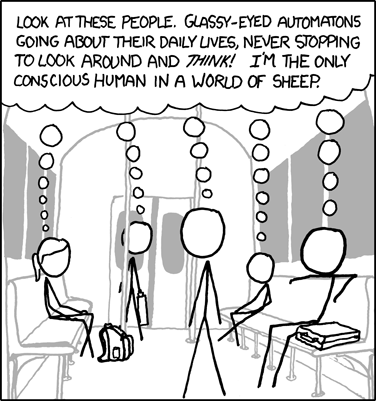
Today's xkcd is brilliant:


It's all too easy for us to slip into this sort of smug presumption—to give ourselves too much credit and others not enough; after all, we can't see anyone else from the inside, only ourselves, so we only know what's going on behind our own eyes. Tip of the hat to Randall Munroe for a nice bit of work with the lancet.

Tuesday, July 14, 2009

On this blog in history: March 1-12, 2008

Outsourcing memory
Technology as prosthetic memory, and its effects.

Adolescent atheism and the nihilistic impulse
An observation on the intemperate tone of the "new atheists."

Is there an echo in here . . . ?
This was a response to a meme on "posts that have resonated with you"; there are some great links here that deserve to be re-mentioned.

Blinded by the darkness
Comments on a brilliant sermon by the Rev. Dr. Paul Detterman, Executive Director of Presbyterians for Renewal.

In defense of the church, part II: The institution
Yes, we need the church, and yes, that means the institutional church, for all its warts.

The Clinton-Obama rivalry continues

When Barack Obama asked Hillary Clinton to serve as his Secretary of State, it appeared to be a move in true "team of rivals" fashion, very much in line with Abraham Lincoln's Cabinet choices: naming the woman who based much of her campaign on presenting herself as better qualified to handle foreign policy to the chief foreign-policy position in the government. It hasn't turned out that way, though, as William Jacobson pointed out recently:

Week-by-week, world event-by-world event, the public humiliation of Hillary Clinton is taking place right before our eyes. Actually, not before our eyes. Hillary has gone missing.

There was a time when United States Secretaries of State were front and center in foreign policy making and implementation. Our first Secretary of State was Thomas Jefferson, and other historical luminaries included John Quincy Adams, Daniel Webster, William Jennings Bryant, and George C. Marshall.

In more modern times, names such as Henry Kissinger, Cyrus Vance, James Baker, Madeleine Albright, Colin Powell, and Condolezza Rice loom large in our psyche and history.

Secretary of State Hillary Clinton? Who? Possibly the most marginalized Secretary of State in modern times. . . .

Obama doesn't act alone in foreign affairs, but he certainly doesn't act through Hillary. . . .

The treatment of Hillary Clinton by Obama to date amounts to a slow drain of Hillary's political persona. The fearsome tiger now is a pussycat. . . .

If Hillary's loss in the primaries was a body blow, being Secretary of State is like being bled by leeches. Hillary seems to know her political persona is being bled dry, but she feels no physical pain.

Tina Brown takes it a step further, writing,

It’s time for Barack Obama to let Hillary Clinton take off her burqa. . . .

It becomes clearer by the day how brilliantly Obama checkmated both Clintons by putting Hillary in the topmost Cabinet job. Secretary Clinton can’t be seen to differ from the president without sabotaging her own power. And ex-President Clinton has been uncharacteristically disciplined about not threatening the careful political equilibrium his wife is trying to maintain. . . .

Before she took the job, she was assured she could pick her own trusted team. Yet she was overruled in appointing her own choice for deputy secretary, Richard Holbrooke. Instead, she was made to take an Obama guy, James Steinberg, who had originally been slated to become national-security adviser. (Hillary took care of Holbrooke, one of diplomacy’s biggest stars, by giving him the most explosive portfolio—Pakistan and Afghanistan.) She lost the ability to dole out major ambassadorships, too. A lot of these prizes are going to reward Obama fundraisers instead of knowledgeable appointees like Harvard’s Joseph Nye, whom she wanted to send to Japan.

Even when there’s legitimate credit to be had, she remains invisible. Contrary to administration spin that Joe Biden played a critical role in the decision to send more troops to Afghanistan, the vice president stayed opposed to Obama's strategy. It was Hillary, sources tell me, whom the president relied on throughout the deliberations with principal national-security advisers to support and successfully argue his point of view. The need to paper over the difference between Obama and the vice president meant Hillary’s role went unacknowledged. . . .

You could say that Obama is lucky to have such a great foreign-policy wife. Those who voted for Hillary wonder how long she'll be content with an office wifehood of the Saudi variety.

It may well be, though, that she's reaching her breaking point. Though the Obama administration has lined itself up firmly behind Kristen Gillibrand, Secretary Clinton's successor in the Senate, to the point of trying to snuff a primary challenge from Rep. Carolyn Maloney, Bill Clinton agreed to headline a fundraiser for Maloney later this month. Ed Morrissey points out the obvious:

Clinton’s spokesperson claims that this doesn’t constitute an endorsement, but it’s hard to read it any other way. Clinton hasn’t campaigned for Gillibrand, after all. Since Gillibrand got appointed to replace Hillary Clinton earlier this year, Bill and Hillary have remained quiet about the seat—until now.

More recently, she handed Obama critics a strong headline while speaking to employees of the U.S. Agency for International Development, criticizing the administration for its abject failure to find someone to run the agency.

Six months into the administration's tenure without having appointed someone to the agency's top spot, Clinton told USAID employees on Monday that several people had turned down the job due to overly burdensome financial and personal disclosure requirements that she called a "nightmare," "frustrating beyond words" and "ridiculous."

She also said the White House had turned down her request to announce on Monday that someone—expected by officials to be physician and Harvard University professor Paul Farmer, who is well known for his work in Haiti—would be named to the post soon.

"Let me just say it's not for lack of trying," Clinton said in response to an employee's question about the delay, despite her and President Barack Obama's stated desire to have USAID play a bigger role in American foreign policy. "We have worked very hard with the White House on looking for a candidate who, number one, wants the job."

The comment drew laughter from the audience, prompting her to say: "It's been offered." She then launched into a critique of the vetting process.

"The clearance and vetting process is a nightmare and it takes far longer than any of us would want to see," Clinton said. "It is frustrating beyond words. I pushed very hard last week when I knew I was coming here to get permission from the White House to be able to tell you that help is on the way and someone will be nominated shortly."

"I was unable," she said. "The message came back: 'We're not ready.'"

It will be fascinating to see how this all shakes out. After all, Sen. Clinton's appointment was political in nature; her real utility to the administration isn't her (relatively meager) foreign-policy credentials, but her political skills and support. (This is rather too bad; given that President Obama can't seem to stop insulting people, it's clear he could really use a foreign-policy ace or two at his side.) As Morrissey says,

If the politics between the two have stopped working, then Obama has no other need for Hillary. If Obama jettisons her, though, Hillary could turn into a formidable foe within the Democratic Party, and might wind up challenging an Obama re-election bid the way Ted Kennedy did to Jimmy Carter, which turned into a disaster for both men. How much defiance can Obama handle?

It will be interesting to find out.

Monday, July 13, 2009

Where have all the good men gone? Blame Roe, for starters

Richard Stith, a law professor just up the road from here at Valparaiso, has an excellent piece in the "Opinion" section of the latest First Things entitled "Her Choice, Her Problem: How Abortion Empowers Men" (subscription required until the November issue comes out). It's an argument that may seem counter-intuitive to some, but it is, sadly, all too true. As Stith writes,

This summer, President Obama proclaimed again that we "need fathers to recognize that responsibility doesn't end at conception. In a sense, of course, he is absolutely right. But the problem is that, in another sense, he is completely wrong: Male responsibility really does end at conception. Men these days can choose only sex, not fatherhood; mothers alone determine whether children shall be allowed to exist. Legalized abortion was supposed to grant enormous personal freedom to women, but it has had the perverse result of freeing men and trapping women. . . .

"Abortion facilitates women's heterosexual availability," [radical feminist Catherine] MacKinnon pointed out: "In other words, under conditions of gender inequality [abortion] does not liberate women; it frees male sexual aggression. The availability of abortion removes the one remaining legitimized reason that women have had for refusing sex besides the headache." Perhaps that is why, she observed, "the Playboy Foundation has supported abortion rights from day one." In the end, MacKinnon pronounced, Roe's "right to privacy looks like an injury got up as a gift," for "virtually every ounce of control that women won" from legalized abortion "has gone directly into the hands of men." . . .

That would be why, as Stith notes, "64 percent of American women who abort feel pressured to do so by others. . . . American women almost always abort to satisfy the desires of people who do not want to care for their children." He continues,

Throughout human history, children have been the consequence of natural sexual relations between men and women. Both sexes knew they were equally responsible for their children, and society had somehow to facilitate their upbringing. Even the advent of birth control did not fundamentally change this dynamic, for all forms of contraception are fallible.

Elective abortion changes everything. Abortion absolutely prevents the birth of a child. A woman's choice for or against abortion breaks the causal link between conception and birth. It matters little what or who caused conception or whether the male insisted on having unprotected intercourse. It is she alone who finally decides whether the child comes into the world. She is the responsible one. For the first time in history, the father and the doctor and the health-insurance actuary can point a finger at her as the person who allowed an inconvenient human being to come into the world.

The deepest tragedy may be that there is no way out. By granting to the pregnant woman an unrestrained choice over who may be born, we make her alone to blame for how she exercises her power. Nothing can alter the solidarity-shattering impact of the abortion option.

Dr. Stith spends the bulk of the article laying out the various ramifications of this reality, the various ways that it plays out. I would make only one correction to his argument: abortion empowers certain types of men, not all men. Specifically, it empowers the cads, the losers, the irresponsible, the promiscuous, the abusers, and those afraid of commitment. It empowers the worst in human impulses, and thus benefits guys who indulge those impulses, who want to take what they like without paying for it. Those who want to choose fatherhood, who want to take responsibility for their actions and choices, too often find themselves barred by the law from doing so.

We thus have a situation that favors "bad boys" over good people; we have a legal and social incentive to antisocial and irresponsible behavior. That's a corrupting influence on our society, creating norms that skew young males away from responsibility and maturity, away from marriage and toward "playing the field." In all seriousness, if young women want to know where all the good men are, one place to look is Roe, Doe, and their progeny; because of them, there are fewer good men than there ought to be.

Sgt. Darrell "Shifty" Powers, RIP

I don't know who wrote this—it's making the rounds—but I thought it was worth posting:

We're hearing a lot today about big splashy memorial services.

I want a nationwide memorial service for Darrell "Shifty" Powers.

Shifty volunteered for the airborne in WWII and served with Easy Company of the 506th Parachute Infantry Regiment, part of the 101st Airborne Infantry. If you've seen Band of Brothers on HBO or the History Channel, you know Shifty. His character appears in all 10 episodes, and Shifty himself is interviewed in several of them.

I met Shifty in the Philadelphia airport several years ago. I didn't know who he was at the time. I just saw an elderly gentleman having trouble reading his ticket. I offered to help, assured him that he was at the right gate, and noticed the "Screaming Eagle", the symbol of the 101st Airborne, on his hat.

Making conversation, I asked him if he'd been in the 101st Airborne or if his son was serving. He said quietly that he had been in the 101st. I thanked him for his service, then asked him when he served, and how many jumps he made.

Quietly and humbly, he said, "Well, I guess I signed up in 1941 or so, and was in until sometime in 1945 . . . " at which point my heart skipped.

At that point, again, very humbly, he said, "I made the 5 training jumps at Toccoa, and then jumped into Normandy . . . do you know where Normandy is?" At this point my heart stopped.

I told him yes, I know exactly where Normandy is, and I know what D-Day was. At that point he said "I also made a second jump into Holland, into Arnhem . . ." I was standing with a genuine war hero . . . and then I realized that it was June, just after the anniversary of D-Day.

I asked Shifty if he was on his way back from France, and he said, "Yes. And it's real sad because these days so few of the guys are left, and those that are, lots of them can't make the trip." My heart was in my throat and I didn't know what to say.

I helped Shifty get onto the plane and then realized he was back in Coach, while I was in First Class. I sent the flight attendant back to get him and said that I wanted to switch seats. When Shifty came forward, I got up out of the seat and told him I wanted him to have it, that I'd take his in coach.

He said, "No, son, you enjoy that seat. Just knowing that there are still some who remember what we did and still care is enough to make an old man very happy." His eyes were filling up as he said it. And mine are brimming up now as I write this.

Shifty died on June 17 after fighting cancer.

There was no parade.

No big event in Staples Center.

No wall-to-wall back-to-back 24x7 news coverage.

No weeping fans on television.

And that's not right.

Let's give Shifty his own Memorial Service, online, in our own quiet way. Please forward this email to everyone you know. Especially to the veterans.

Rest in peace, Shifty.

Law is easy (just find the right law)

A lot of people will tell you that Christianity is all about following a set of rules—the only thing that matters is that you do x and don’t do y. That’s always been a popular view. After all, if Christianity is just about measuring up to particular standards of behavior—whether it’s the “we don’t smoke, we don’t chew, we don’t go with those who do” variety, or the “be nice to everybody” variety, or whatever—then it’s easy to tell who’s a Christian and who isn’t; and perhaps even more importantly, it’s easy to look at yourself and tell how you’re doing. The nice thing about a fence, after all, is that you always know which side of it you’re on. Or perhaps I should say, one nice thing about a fence; the other nice thing is that you know exactly how far you can go before you’ve crossed it. The fence tells you what you can get away with, as much as what you can’t.

As I’ve said before, the longer I do this, the more convinced I become that we really don’t want grace, and we don’t want to live by grace; we may say we do, and we may sing about it, but at some level, we’d just rather live by some form of law. After all, if you ask the law, “How many times do I have to forgive somebody before I can give them the punishment they have coming,” the law will tell you, “Three times,” or “seven times,” or whatever; it will give you a standard you have a chance to live up to. If you ask Jesus the same question, he’s going to say, “Seventy times seven”—which is to say, once you lose count, you’re just getting started. Law gives you a limit to what you have to do; grace is like the Energizer bunny—it just keeps going, and going, and going, long after we want to quit.

The fact of the matter is, whatever version of the law we come up with, whatever standard of behavior we set, if it’s our idea and our standard, we’re going to start defining it as something we can meet, something we can live up to in our own strength; we inevitably make it far too small a thing. It sounds very pious to say, for instance, “Christianity isn’t about believing certain things, it’s about living a life of love”; but how do we know what love is? How do we know what it means to live a life of love? The classical Christian answer is to say that we know what love is because God is love, and because he has revealed himself to us in his word—in his living Word who is his Son, Jesus Christ our Lord, and in the words of Scripture, which his Spirit inspired to show us the living Word. Our understanding of love is grounded in the truth of Scripture, which shows us the truth of who God is, and thus what love is; we take our definition of love from these pages. If we set this aside, or say that those truths don’t matter, then we’re left to define love for ourselves, according to our own preferences, prejudices, and preconceived ideas; we get to decide for ourselves what’s appropriate and act accordingly, and then pat ourselves on the back for being such good Christians, without ever even asking ourselves what God wants us to do, let alone submitting ourselves to his will.

(Excerpted from “The Heart of the Matter”)

Saturday, July 11, 2009

Those who do not understand the past . . .

A charismatic young leader, supported by a coalition of intellectual elitists on the one hand and a dependent underclass on the other, has gained control of the country. With each month that passes, the leader and his court reveal themselves to be more hostile to the interests of the middle class. Vast new spending bills are introduced to fund an extension of government power. New taxes of all kinds, the extension of old taxes to cover a broader array of goods and services, the introduction of stealth taxes and special emergency levies, the borrowing of vast sums of money: all of these excesses deeply disturb the public, especially the middle class who are asked to bear all the burdens, even as the abuses are cheered on by an foolish elite and an acquiescent underclass.

As if this were not enough, our young monarch has decided to conduct foreign policy in a suspiciously conciliatory manner toward declared enemies of the nation. Regimes with a history of supporting violence against the interests of the country are suddenly courted as if they were long-time friends. Organizations driven by ideological and religious extremism are "engaged" as if no stigma attached to their past and continuing conduct. Emissaries are dispatched to the most unlikely of foreign capitals to negotiate a policy of appeasement and conciliation.

Along with this, there is the troubling sense that the young prince's values are alarmingly out of line with the moral and cultural views shared by most of the public. There are reports of lavish expenditures for entertainment, pilgrimages from the capital carried on at public expense, questionable advancement of favorites. There is the suspicion that, when he is not in public view, the young leader is indifferent at best to the deeply held opinions on faith, family, and patriotism that the public holds dear. Many would go further, believing that, when not on show, he and his consort mock these ideals.

Barack Obama? No, Charles I of England.

As any student of history can tell you, that's not a happy comparison to make: Charles I's recklessness and arrogance ultimately drove him into a fight with Parliament, sparking a pair of civil wars that ended with his execution for high treason. Of course, a similar end to Barack Obama's presidency is vanishingly unlikely—but as today's Rasmussen tracking poll shows the Presidential Approval Index standing at -7% (30% of voters strongly approve of his performance, while 37% strongly disapprove), it seems clear that the president's Charles-like path in office so far is having an analogous effect on his personal popularity and political capital. This suggests that he would do well to embrace the bipartisanship he once promised (back in those days before he could dismiss political disagreements with a curt "I won") and moderate his policies, unless he wants to face the modern American political substitute for civil war—a popular revolt at the polls in the next election. Increasing numbers of people would agree with Jeffrey Folks that there's good reason:

Today the power of the political elite in Washington far exceeds that of the court of Charles I, and we are in even greater danger of losing our liberties. John Milton was the great spokesman for the opposition during the days of Charles I, and Milton knew well enough what a tyrant was. "A tyrant," he wrote, "is he who regarding neither law nor the common good, reigns only for himself and his faction." Could there be any better characterization of the actions of the present administration in Washington?

Friday, July 10, 2009

Falling short

Heidelberg Catechism
Q & A 5
Q. Can you live up to all this perfectly?

A. No.1
I have a natural tendency
to hate God and my neighbor.2

Note: mouseover footnote for Scripture references.

This is what causes all the problems. This is what people don't want to admit; but it's true. Left to ourselves, we can't live up to what God wants from us, because we aren't bent to really love God or the people around us. We're oriented all wrong; we need to be re-oriented and straightened out.

John Calvin at 500

In honor of the 500th anniversary of the birth of John Calvin, I’d like to draw your attention to an excellent article by Westminster-California’s W. Robert Godfrey entitled “Calvin: Why He Still Matters.” Here’s the beginning:

There can be no serious doubt that Calvin once mattered. Any honest historian of any point of view and of any religious conviction would agree that Calvin was one of the most important people in the history of western civilization. Not only was he a significant pastor and theologian in the sixteenth century, but the movement of which he was the principal leader led to the building of Reformed and Presbyterian churches with millions of members spread through centuries around the world. Certainly a man whose leadership, theology, and convictions can spark such a movement once mattered.

Historians from a wide range of points of view also acknowledge that Calvin not only mattered in the religious sphere and in the ecclesiastical sphere, but Calvin and Calvinism had an impact on a number of modern phenomena that we take for granted. Calvin is certainly associated with the rise of modern education and the conviction that citizens ought to be educated and that all people ought to be able to read the Bible. Such education was a fruit of the Reformation and Calvin.

Others have insisted that the rise of modern democracy owes at least something to the Reformed movement. One historian said of Puritanism that a Puritan was someone who would humble himself in the dust before God and would rise to put his foot on the neck of a king. Calvinists were strongly persuaded that they must serve God above men, and that began to relativize notions of superiority and aristocracy. King James I of England, who was also James VI of Scotland, once remarked as he looked at Presbyterianism in Scotland: “No bishop, no king.” If the Church is not governed by a hierarchy, certainly the political world does not need to be governed by a hierarchy either. Such Calvinist attitudes toward kings helped contribute to modern democracy.

Calvinism contributed to modern science with an empirical look at the real world. Calvin contributed to the rise of modern capitalism in part by teaching that the charging of interest on money loaned was not immoral. He was the first Christian theologian to do so.

When we look at that list—theology, church, education, science, democracy, and capitalism—here was a man that mattered. He had a profound influence on the development of the history of the West. But does he still matter? Should we care today to revisit John Calvin—who he was, what he thinks—and believe that what he taught is still significant, still valuable? Yes, he still does matter. John Calvin matters still above all because he was a teacher of truth. If truth matters, then John Calvin still matters because he was one of the great teachers of truth, one of the most insightful, faithful teachers of truth, one of the best communicators of truth. He was a teacher who had taken to heart the words of Jesus: “You will know the truth and the truth, and the truth will set you free” (John 8:32).

The bulk of Godfrey’s article, of course, is dedicated to expositing the truth of that last paragraph; I encourage you to read it. If you have additional time and interest, it’s also worth checking out Reformation21, which has a number of excellent pieces up in honor of Calvin’s 500th.

Thursday, July 09, 2009

Leadership: a condition of character

As I reflect on the response to Mark Sanford (and other leaders, both political and churchly, who have fallen to sexual sin in recent times), what blows my mind the most—even more than the new and stunningly creative level of moral and political imbecility Sanford reached in the pursuit of his paramour—is to see people popping up and defending these wretches on the grounds that “people deserve a private life,” and “what they do in private is nobody’s business but their own.” To which I say—and not just me; I say it with St. Paulno! That is, and I say this very precisely, a damnable lie, because it’s a lie that can bring damnation. The first job of leadership is self-leadership; the first challenge of leadership is whether one can keep in honor the vows one swears. Someone who has failed in leading themselves to the extent of breaking the highest and holiest vow they will ever swear cannot be trusted to lead anyone else, or to be faithful to any other task.

Now, is that permanent? Does that mean that if your sin is bad enough, you can never be trusted to be faithful? No, for there is forgiveness and redemption with the Lord; restoration is possible, with repentance, and time for growth. But leadership isn’t a right, it’s a privilege, and the first qualification is real and demonstrated character. That’s why, when Paul lays out what must be expected of the leaders of the church—overseers, whom we would call elders and pastors, and deacons—he doesn’t talk much about gifts or experience or skills; indeed, even though we know overseers were expected to teach, he doesn’t even focus on their knowledge of God’s word, though that’s mentioned. Mostly, he talks about character; he talks about what kind of people should be overseers and deacons. Put another way, he talks about leadership not as a job but as a way of life, and how it must be lived, and what people must be like to be ready to live it. If you lack the character, it doesn’t matter how smart you are, how skilled you are, or how correct your ideas may be: you aren’t qualified to lead.

(Partially excerpted from “The Character of True Leadership”)

Wednesday, July 08, 2009

12:34:56 7/8/9

What can I say? I'm a humanities geek, not a math geek, but little things like this amuse me.

Monday, July 06, 2009

Christianity: a change of orientation

To restate the typical presentation of the gospel slightly, each of us on this earth is born with a global orientation toward sin, which manifests itself in various specific orientations toward particular sins—some stronger than others, some wider-ranging than others, some more fundamental than others, but all of them representative of our general inborn orientation toward rebellion and wrongdoing.

Jesus Christ was God become human. He lived a fully human life, but without that orientation toward sin; he was perfect, oriented totally toward God and his goodness and holiness. As such, he was innocent of any rebellion and wrongdoing. He died on our behalf to take on himself and pay in his own body the penalty for all of our sin; he then rose again from the dead to break the power of sin and death over us; he returned to the throne room of heaven to be our advocate with God the Father; and when he had done so, he sent us the Holy Spirit to live within all those who follow him, so that we might always be connected to his presence and power.

As such, Christ is at work in his people by the will of God the Father and the power of his Holy Spirit to reorient us away from sin and toward God. The work of sanctification is nothing less than a total change of orientation, replacing the sinward orientation with which we are born, to which we are accustomed, within which our mental, emotional and spiritual habits have been formed, with the Godward orientation that is the way of Christ, which is the way of the cross.

This is hard. The grace of God is not about leaving us as we are, or making us comfortable, or protecting us from pain; this is one reason why we resist true grace and prefer a counterfeit of our own making. This is why, as Flannery O'Connor said, "All human nature vigorously resists grace because grace changes us and the change is painful." But as painful as it may be to allow God to change our orientation, it is necessary, because the orientation with which we're born points us, in the end, to nothing but darkness and death. It's only if our souls are turned, if God reorients us to himself, that we can find light and life in his presence.

Here's to you, Mr. Jefferson

This is absolutely brilliant. (They did a good job with the meter and rhyme of the original, which is rare, and matching the sound, which is even rarer.)


Sunday, July 05, 2009

A little eschatological humor

I've had this list kicking around for so long, I no longer remember where I got it. Presented for your amusement (I hope), with a few edits . . .

Okay, we all know that 666 is the Number of the Beast. But did you know that:

670:Approximate Number of the Beast
DCLXVI:Roman Numeral of the Beast
666.0000:Number of the High-Precision Beast
0.666:Number of the Millibeast
/666:Beast Common Denominator
666i:Imaginary Number of the Beast
1010011010:Binary Number of the Beast
0000001010011010:Bitmap of the Beast
1 (666):Area Code of the Beast
00666:Zip Code of the Beast
1 (800) 666-0666:Toll-Free Number of the Beast
1 (900) 666-0666:Live Beasts! One-on-One Pacts! Call Now! Only $6.66 per minute! (Only 18 and older, please.)
$665.95Retail Price of the Beast
$699.25Retail Price of the Beast with 5% state sales tax
$796.66Price of the Beast with all accessories and replacement soul
$656.66Wal-Mart Price of the Beast
$646.66Wal-Mart Sales Price of the Beast
Phillips 666Gasoline of the Beast
Route 666Highway of the Beast
666° FCooking temperature for roast Beast
666(k)Retirement Plan of the Beast
666mgRecommended Daily Allowance of Beast
6.66%5-year CD interest rate at First Bank of the Beast ($666 minimum deposit)
Pentium 666CPU of the Beast
G666Pontiac of the Beast
M666BMW of the Beast
668Neighbor of the Beast
667Prime Beast
999Australian Beast
Mac OS 666Operating System of the Beast

Saturday, July 04, 2009

Our lives, our fortunes, and our sacred honor

This sends chills down my spine. Thanks to Hurley for reminding me of it.


Sarah Palin's resignation: a calculated political act

I've been flat on my back with an unpleasant bug, but the news yesterday of Sarah Palin's resignation knocked me even flatter than I already was. My first thought was, "She's finally decided that the price was too high, and she's giving it all up"; my reaction was one of shame and anger at my own country, that had decided to destroy a gifted public servant rather than accept the challenge she represented.

And then after a while, I read her statement, and my brain started working again. I know there's a lot of speculation about her motives—after all, politicians never tell you the real reason they do anything, right?—ranging from some kind of dirt that's about to come out to a serious medical problem to marital issues under the strain of everything that's been going on. I haven't read all the speculation by any means, since I haven't been at my computer much, but I can tell that a lot of folks out there think that this resignation must be (as most political resignations admittedly are) personal in nature, because it doesn't make any political sense. With the case of Mark Sanford hanging in the near background, we're primed to think this way.

On further reflection, though, I'm inclined to think that Sarah Palin's resignation is probably in fact a political move at its core, and a brilliantly calculated one. It's a gamble, no question, but I think the stakes are worth it, for several interlinked reasons—one of which Adam Brickley laid out yesterday with his usual excellent insight. It all begins (and began, I suspect) with a simple, huge question: should Gov. Palin run for re-election in 2010? I've gone back and forth on that one, but I've argued before that she would be better off not doing so.

At this point, Gov. Palin would have to be regarded as the frontrunner for the GOP presidential nomination in 2012, but a lot of things can happen in four years; if she just rests on her laurels, she'll see others pass her by. She needs to take her position as a leader in (if not formally of) the national party and use it, both to strengthen her own position and to advance the GOP cause. To do this, of course, she needs to keep herself out there as a national politician. . . .

There are several ways by which she can do this. One, as Adam Brickley notes, is to do her job as Governor of Alaska, and in particular to do everything possible to expedite the building of the natural-gas pipeline. This, combined with intelligent national advocacy of drilling in ANWR, will serve to strengthen the country both domestically and in its international position, to strengthen the identification of the national GOP with domestic energy production and energy independence, and also to help her maintain a high national profile as a conservative reformer who gets things done.

Another thought Adam had, which hadn't occurred to me, would be for Gov. Palin to establish a PAC and do fundraising for national Republican candidates for 2010. By doing this, she could give the congressional GOP a real boost two years from now, as well as building support and loyalty among other leaders in the party. Even better, along with sending them money, she could spend time campaigning for Republican candidates across the country, using her own formidable political skills directly to boost their chances. Given that she will be a marked woman for the national Democratic Party in 2010, it might even be better for her not to seek re-election, but to take the time she would need to spend campaigning for herself and invest it instead in other Republican candidates (including, of course, Sean Parnell or whoever would be the GOP candidate to replace her in Juneau). Of course, if she did so, she would need to find another job, but I'll come back to that in a minute.

Now, I also noted along the way (with regard to the possibility of a special election for Ted Stevens' Senate seat) that staying in Juneau "gives the Left two years to hammer her and try to bring her down before her term as governor is up in 2010," and so indeed it has. She's gone back to Alaska and done her job well—but her opponents have found an effective way to turn the job into a straitjacket, and one she's paid handsomely to have the privilege of wearing. They've put her in a position where she gets hit with huge legal bills for anything and nothing, where she's legally restricted in her ability to do what she need to do to repay those legal bills, and where they've found ways to make it very difficult for her to be nationally active. In the meanwhile, other Republicans who don't have jobs have been taking advantage of that fact and doing everything they can to maneuver against her, and to denigrate her in the process.

The biggest arguments, as regards her national political future, for sticking around and running for re-election had to do with the need to go back, do her job, and show that she could get re-elected; with no one really doubting the latter, and the party mandarins refusing to give her credit for the former, there doesn't seem to be much reason why Gov. Palin should want to stay in Juneau after 2010 unless she wants to be a career governor—and given the way the Alaskan establishment has treated her, she shouldn't. The best political move she could make, it seems to me, was to elect not to run, but rather to pursue other angles.

This is where the argument Adam made comes into play, and it's profoundly important. By stepping down now rather than waiting until 2010, she sets up Sean Parnell as the incumbent in that election, greatly increasing the chances that a Palinite Republican (which is to say, a non-Murkowski-RINO-ite impostor) holds the Alaska statehouse—and with the Exxon-TransCanada deal in the bag, she does so at a pretty favorable time.

There's something of a gamble here, that Gov. Parnell will be able to carry the water, but she knows him better than most people do, and she seems pretty clearly to believe he can; while he lacks her formidable political gifts, he also lacks the vulnerabilities she acquired as a consequence of the McCain campaign, so he may actually be able to do an even better job of carrying forward their agenda than she could. At the very least, he ought to do plenty well enough to hold the seat as a proven incumbent.

In the process, his candidacy (assuming nothing crazy happens to remove him) will serve as a test of Gov. Palin's ongoing political clout; and here's where the wider angle of the gamble she's taken comes in. She's now free of the ankle-biters; they've been using the ethics law she brought into being as a tool for political persecution, and they've now lost that lever on her. She's much freer to raise funds, to speak, to write, and to campaign around the country on behalf of causes and candidates without having to worry that she'll be accused of ethics violations for doing so.

Indeed, it seems likely that anyone with aspirations for 2012 will need to spend much of 2010 proving themselves by campaigning for GOP congressional candidates across the country—and not only would Gov. Palin not have been able to do that had she been running for re-election herself, she might well not have been able to do so even as a lame duck. Can you imagine the ethics charges folks like Andree McLeod would have filed? I'm sure Gov. Palin can; no doubt they all would have been dismissed just as all the ones so far have been, but they still would have cost her a lot of money. Now, she doesn't need to worry about that.

On sober reflection, then, leaving office may well have been the best political move Gov. Palin could have made—and a necessary precursor to a 2012 presidential run, if she wants to make one—and if so, then far better to do so now, when it frees her from abuse of her ethics law and enables her to control the transfer of power, than to wait for the end of her term. It may also be the wisest financial move she could make. Not only does this preclude further attempts to bankrupt her via frivolous prosecution, it also gives her a much wider field to raise funds and earn money.

I suspect we're likely to see far, far more Sarah Palin appearances around the country over the coming months, to prove to people that she's not backing down or going away—since one of the real gambles here is that people will label her a quitter, someone who can't take the heat, and look for someone else to support; she needs to address that if she does in fact want a political future—and to help pay the bills; and also for one other reason, which I addressed in that post last fall:

Gov. Palin would do well to work to win over conservative skeptics like Charles Krauthammer, Kathleen Parker, George Will, David Brooks, and Christopher Buckley—not because their opinions are particularly important, but because impressing those who ought to be her supporters and currently aren't is the most direct way to establish herself as the true standard-bearer of the Republican Party. The best way to do this is to address the current lack of a strong conservative identity in the national party, strengthening it and bringing it back to its roots, and to do so in a way which also dispells the easy caricature of her as an intellectual lightweight. Therefore, as one who framed the troubling challenge presented by Iran with the question "what would Reagan do?" I would suggest (as would Jim Geraghty) that Gov. Palin should ask herself the same question, and do what Gov. Reagan did in the 1970s:

Reagan . . . [spent] years in the 1970s mulling the great issues of the day, reading voraciously, and presenting detailed commentaries on everything from the SALT and Law of the Sea treaties to revolutions in Sub-Saharan Africa to the future of Medicare. Then and only then, finally, after 16 years on the national stage, did the GOP give Ronald Reagan its nomination and present him as its candidate for the presidency.

Obviously, she's still going to have her day job, at least through 2010; but in and around that, and raising her kids, I believe Gov. Palin should devote as much time as she can to studying and writing on the great issues of our own day. Keep building her governing experience dealing with the challenges of Juneau—and as much as possible, take advantage of that to use Alaska as a "laboratory of democracy" on issues like health care—but engage intellectually as well with the challenges of Iran and Pakistan, Social Security and judicial philosophy, the future of NATO and how to deal with a resurgent Russia, practical approaches to changing the system in D.C., and what our stance ought to be toward China. Co-author pieces with leading conservative intellectuals—maybe an article on judicial nominations with Antonin Scalia, to throw out one wild idea. Help rebuild the conservative intellectual treasury that was squandered by the GOP during its time in power. And off these articles (and perhaps books), I'd like to see her give speeches under the auspices of the Hoover Institute, the Heritage Foundation, the American Enterprise Institute, the Ethics and Public Policy Foundation, the Institute for Religion and Public Life, and other such organizations. If she does decide not to seek re-election at the end of her term, she could go to work for an organization like AEI, or perhaps in the national party leadership structure, and use that as a platform to continue developing and arguing for her conservative agenda.

Obviously, she in fact no longer has that day job, or soon won't; the rest still holds, at least as regards Charles Krauthammer. I agree completely with Joshua Livestro's takedown of Jonah Goldberg (and with VO's, as well), and with all those who've pointed out that Ronald Reagan was similarly dismissed and derided for his intellect; but one of the reasons that the attempts to convince the public that Gov. Reagan, and then President Reagan, was merely "an amiable dunce" failed to stick is that he had a pretty strong record demonstrating otherwise. I agree that Joshua's dead-bang right that folks like Goldberg need to begin with the presumption that Gov. Palin is to be taken seriously and talk with her on that basis; but clearly, that's not going to happen unless they're forced to do so. The only way to force them to do so, I think, is for Gov. Palin to put in the time and effort writing and speaking to make their current flippant dismissals of her clearly untenable. I think that's an important thing for her to do, not only for her own political future, but for the future of the party, for the reasons I laid out in the quote above. And, sadly, she wasn't going to be able to do it shackled to the statehouse in Juneau. Her enemies in Alaska had made that impossible. To spread her wings and fly, she needed to leave office.

And so she has; and I'm reminded of an image one of my mentors, the Rev. Ben Patterson, used in a sermon one time. He talked about being up in the Rockies, looking out across a mountain canyon, and seeing a bald eagle hurl itself from its perch high atop the canyon wall, wings and head pulled into a tight ball. He saw the eagle tumble down into the depths at dizzying speed, apparently doing nothing to protect itself . . . until suddenly, well below them, it snapped its wings out and began to soar. With no wind in the canyon, it had used its own fall to generate the momentum it needed to fly.

That, I think, is what Gov. Palin just did. The risk to it is real, for she's thrown herself into the canyon of our political cynicism, where nothing surprising any politician does is ever innocent—we know better, they're all guilty until proven guilty. All the folks who got egg on their face defending Mark Sanford just underscore the point; many, many people, even those predisposed favorably toward Gov. Palin, are going to assume that there's another shoe to drop in her case just as there was in Gov. Sanford's, and it's going to take a fair bit of time for her to overcome that. There's a lot of shock here—I know, I'm still recovering from it—and I expect a lot of people feel burned; it will take time for her to rebuild trust. She has the political and intellectual gifts to do it, given that time and effort on her part—but she'll need those of us who've found her to be a beacon of hope in our country's politics to continue to believe in her and support her, and to continue to trust her judgment.

There is good reason to do so. Just hang on; it's going to be a bumpy ride, no doubt (has it ever been otherwise?), but I think it's going somewhere good. And for my part, I continue to believe that Gov. Palin is walking with God and seeking his will, and so I trust that I see His hand in this, for her good, for the good of her family, and for the good of this nation.

(Cross-posted at Conservatives4Palin)

Thursday, July 02, 2009

The core of God's commands

Heidelberg Catechism
Q & A 4
Q. What does God's law require of us?

A. Christ teaches us this in summary in Matthew 22—

Love the Lord your God
with all your heart
and with all your soul
and with all your mind
and with all your strength.1

And the second is like it:
Love your neighbor as yourself.2

All the Law and the Prophets hang
on these two commandments.

Note: mouseover footnote for Scripture references. Also, earlier and better manuscripts of Matthew 22 omit the words "and with all your strength." They are found in Mark 12:30.

As Kuyvenhoven notes (19),

our Lord Jesus made the love-commandment the centerpiece of his teaching. In fact, his whole ministry was designed to teach us that love is God's law, which everyone has broken, as well as God's gift that enables all of Jesus' followers to lead a new life.

Along with that, it must be said, his ministry was also designed to teach us what love really is, and to correct the false ideas we learn about love from our fallen world. We're perfectly happy to believe that love is God's law if we get to be the ones defining what that means . . . but we don't.